
Can you open a UAE account without residency?
Formally, a non-resident can open a UAE bank account. In practice, in 2026 it is one of the hardest tasks in banking. Banks require a confirmed connection to the country: UAE property, a registered company, regular presence. A passport and good intentions are not enough.
Even with property or a company, the bank will request proof of source of funds: statements with a traceable history, income documents, a clear money trail. This is where most applicants drop out — and the reason is rarely the bank. Many people simply do not run their finances through banks: income in cash, savings at home, minimal account activity. UAE banks demand the opposite — full transparency, where salary and business income flow through an account and every amount has a clear origin.
Our recommendation: in most cases it is faster and cheaper to first obtain a UAE residence visa, then open a full resident account — with a debit card, online banking, international transfers and the complete product range. Non-residents are typically limited to a savings account with restricted functionality.
Important — automatic exchange of tax information (CRS):if a non-resident account holds more than USD 200,000 at the end of the reporting period, the bank must report the account to the tax authorities of your country of tax residence. For resident accounts with UAE tax residency, the situation is fundamentally different.
Why UAE banks refuse to open accounts: the main reasons

1. No clear source-of-funds history
The bank wants a traceable chain: employment → salary into an account → savings. For business: company activity → turnover → contracts → profit. Cash savings, unexplained inflows and opaque schemes are an almost guaranteed refusal.
2. Mismatch between declared and actual activity
A free zone company or offshore company is accepted by the bank only as a continuation of an existing business with a confirmed track record. If you want to launch a completely new venture in the UAE, banks will accept it only in the form of a local (mainland) company.
3. High-risk transactions in your statements
Transactions with sanctioned or high-risk jurisdictions, unexplained credits, no visible income sources — all of these are red flags for the compliance team.
4. The client’s overall risk profile
Banks score every applicant: nationality, countries of operation, industry, structure complexity. The higher the assessed risk, the more scrutiny — and clients from high-risk jurisdictions need a longer, cleaner paper trail, often built in third countries.
A bank is a business. If the risks around a client are high and the expected revenue is small, the account will be declined. It is not personal — it is mathematics. A professional adviser’s job is to present your case so that the risk-reward balance works for the bank.
Which UAE bank to choose in 2026
The UAE banking system is among the largest in the Middle East. The systemically important banks are First Abu Dhabi Bank (the largest by assets), Emirates NBD, Abu Dhabi Commercial Bank, Abu Dhabi Islamic Bank and Dubai Islamic Bank.
Dynasty Business Adviser works with the following banks in practice:
|
Bank |
Best suited for |
|---|---|
|
Emirates NBD |
Consulting, services and professional activities |
|
Abu Dhabi Islamic Bank (ADIB) |
Trading companies — faster opening, fewer questions |
|
First Abu Dhabi Bank (FAB) |
Clients with an investment package — maximum transaction loyalty |
|
Dubai Islamic Bank (DIB) |
A universal option for residents and companies |
|
United Bank Limited (UBL) |
A new market player, a working alternative |
Opening speed is comparable across banks — what decides the outcome is your activity, profile and document quality, not the bank’s logo. (We previously also recommended Mashreq: accounts open well there, but clients often face friction with transactions, so we no longer suggest it as a first choice.)
Balance requirements
Every bank expects a working balance on a corporate account. For new international clients, a realistic 2026 benchmark is 200,000 – 500,000 AED. This is not a blocked deposit — it is a balance that shows the bank you are a serious client.
If maintaining such a balance is not yet possible, consider a mainland company working with the local UAE market or low-risk destinations (Europe, parts of Asia). Working with high-risk jurisdictions on a small balance and without a personal banker almost guarantees account closure: every such transaction demands extra monitoring, which is unprofitable for the bank on a small client.

Corporate account: free zone or mainland — where is it easier?
In general, a mainland company (local licence) gets an account more easily: banks have fewer questions for a company with physical presence and local operations.
Much depends on the specific free zone, however. Companies from Meydan Free Zone, for example, successfully open accounts with Emirates NBD, Dubai Islamic Bank and CBD. Other zones face stricter treatment.
A key nuance: even a mainland company declaring purely offshore trade with no local market connection will be vetted as strictly as a free zone one. What matters is not only the legal form but the substance of your business plan and how you present the activity at the bank interview.
A very common mistake is walking into the bank unprepared — saying too much, framing transactions poorly, creating risks where none exist. Interview preparation and a sound business plan are the stage we take on ourselves.
Your UAE account has been frozen: what to do
An account “freeze” in the UAE is usually a block on online banking, not a full stop of operations. The bank cannot arbitrarily block execution of your transactions without a court order — in-branch operations remain available.
Typical freeze triggers:
- transactions the bank found suspicious;
- the client failed to answer the bank’s request in time;
- an expired Emirates ID or residence visa;
- prolonged account inactivity.
Step-by-step action plan:
- Don’t panic.
- Check your email — the bank almost always sends a request with questions or a document list first. A timely reply often resolves the issue completely.
- If there is no correspondence — call the bank and clarify the reason.
- If it cannot be resolved remotely, a visit to a UAE branch or your personal banker will be required.
Prevention: for clients living outside the UAE we recommend holding accounts with at least two banks — it protects the business from stopping if one account is blocked. And the golden rule: consult your adviser before any non-standard transaction. The vast majority of problems are the result of actions taken before the consultation, not after.
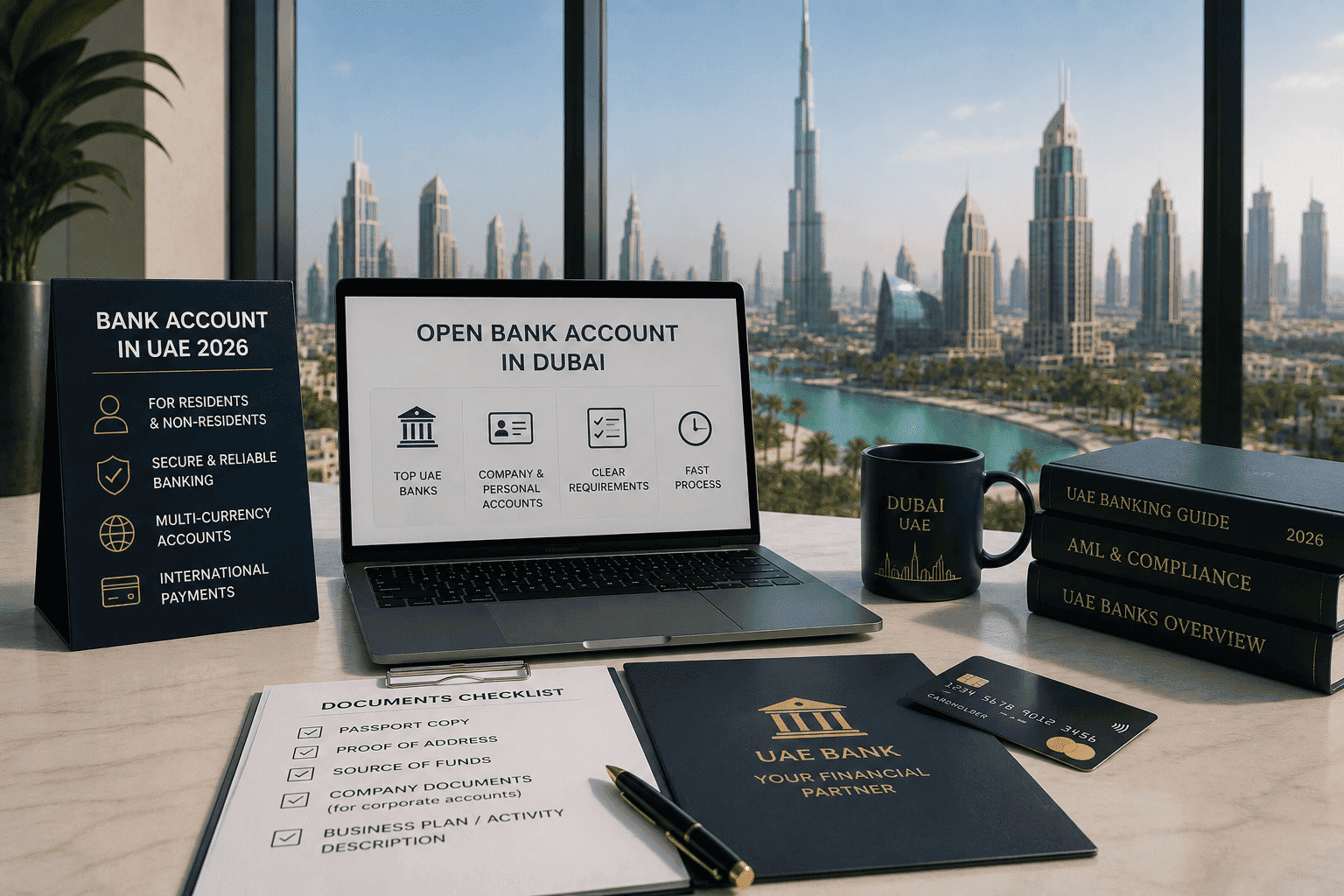
Documents for opening a UAE bank account
Basic set for a personal account:
- passport;
- residence visa and Emirates ID (for a resident account);
- proof of residential address;
- proof of income source (certificates, statements with history);
- a reference letter from your current bank (on request).
Additionally for a corporate account:
- trade licence;
- constituent documents (MoA, share certificates);
- ownership structure down to ultimate beneficial owners (UBO);
- a business plan describing activity, counterparties and expected turnover;
- proof of existing business (for free zone and offshore structures).
The exact list depends on the bank, the activity and the client profile — we tailor it individually to your situation.
How Dynasty Business Adviser helps open a UAE account
- We match the bank to your activity, nationality and business structure — from the banks we work with daily.
- We prepare the full document package the way the bank expects to see it.
- We draft the business plan and prepare you for the bank interview.
- We accompany the process until the account is activated.
- We solve problems with existing accounts: freezes, compliance requests, migrating to another bank.
Our own office in Dubai (Tamani Arts) lets us work with the banks directly, without intermediaries.
Get a free consultation on your situation: WhatsApp +971 52 634 1022
Get advice