
Why Choose the UAE for Business Relocation?
The political and economic situation in Europe keeps getting tighter. Pressure on business from authorities, rising taxes, increasingly complex reporting requirements, and restrictions on the movement of capital are pushing entrepreneurs to look for a jurisdiction that lets them get through this difficult period, protect their assets, and claim a place in a rapidly growing global market.
Many entrepreneurs are drawn to the UAE by the following features of doing business here:
Economic Stability
The UAE economy is growing rapidly on the back of foreign capital inflows, which keeps the dollar and euro exchange rates stable. The national currency, the dirham, has been pegged to the US dollar at 3.6725 since 1997 — the rate has not changed for almost 30 years. Thanks to a reliable banking system, settling accounts with foreign counterparties is straightforward.
Security of Doing Business
The UAE grants companies that relocate here rights and guarantees within a clear legal framework. It is a free trade zone. Corruption is not tolerated. Business interests are a state priority. Investments are protected through a network of agreements and the UAE’s membership in major international unions.
A Market With Real Purchasing Power
Doing business in the UAE is easy and profitable. Tourism draws money flows here from Europe, Asia, and Africa. Celebrities from around the world come here for unique entertainment, high-end restaurants, and shopping at major malls.
Tax Advantages
The UAE has no tax on dividends, salaries, gifts, inheritance, or luxury goods. This means a business can generate profit at a 0% rate. Corporate income tax and VAT are among the lowest in the world. The 9% rate only applies once annual taxable profit exceeds AED 375,000 (about $100,000) — importantly, this threshold is based on profit, not revenue (turnover), which is a common point of confusion. Free zone companies can operate at a 0% rate.
There is also a separate Small Business Relief scheme: companies with annual revenue of up to AED 3 million can elect a 0% rate regardless of profit, subject to the Federal Tax Authority’s conditions. The relief applies to tax periods ending on or before 31 December 2026; no extension to later periods has been announced at this time.
Geographic Location
From the UAE, you can reach any point on the globe through eight international airports (per the General Civil Aviation Authority, GCAA). The largest is in Dubai, handling around 100 flights a day on average. The airport itself is a showcase of modern technology, unique design, functionality, and comfort. Nationals of more than 60 countries can currently get a visa on arrival, and the list keeps expanding in 2026.
An Efficient Visa System
Relocating a business to the UAE opens the door to tax residency status. Maintaining that status is straightforward. Tax residency lets you avoid extra charges, confirm your source of income, register property without mandatory declaration, and freely manage assets both in the country and abroad.
Other advantages of relocating a business to the UAE include:
- Small businesses can access tax relief (Small Business Relief) with revenue under AED 3 million per year — including foreigners who hold resident status. It applies to tax periods ending on or before 31 December 2026.
- The UAE offers favourable conditions for developing a cryptocurrency-related business.
- Special opportunities are available within the free zones.
Key Requirements and Conditions for Relocation
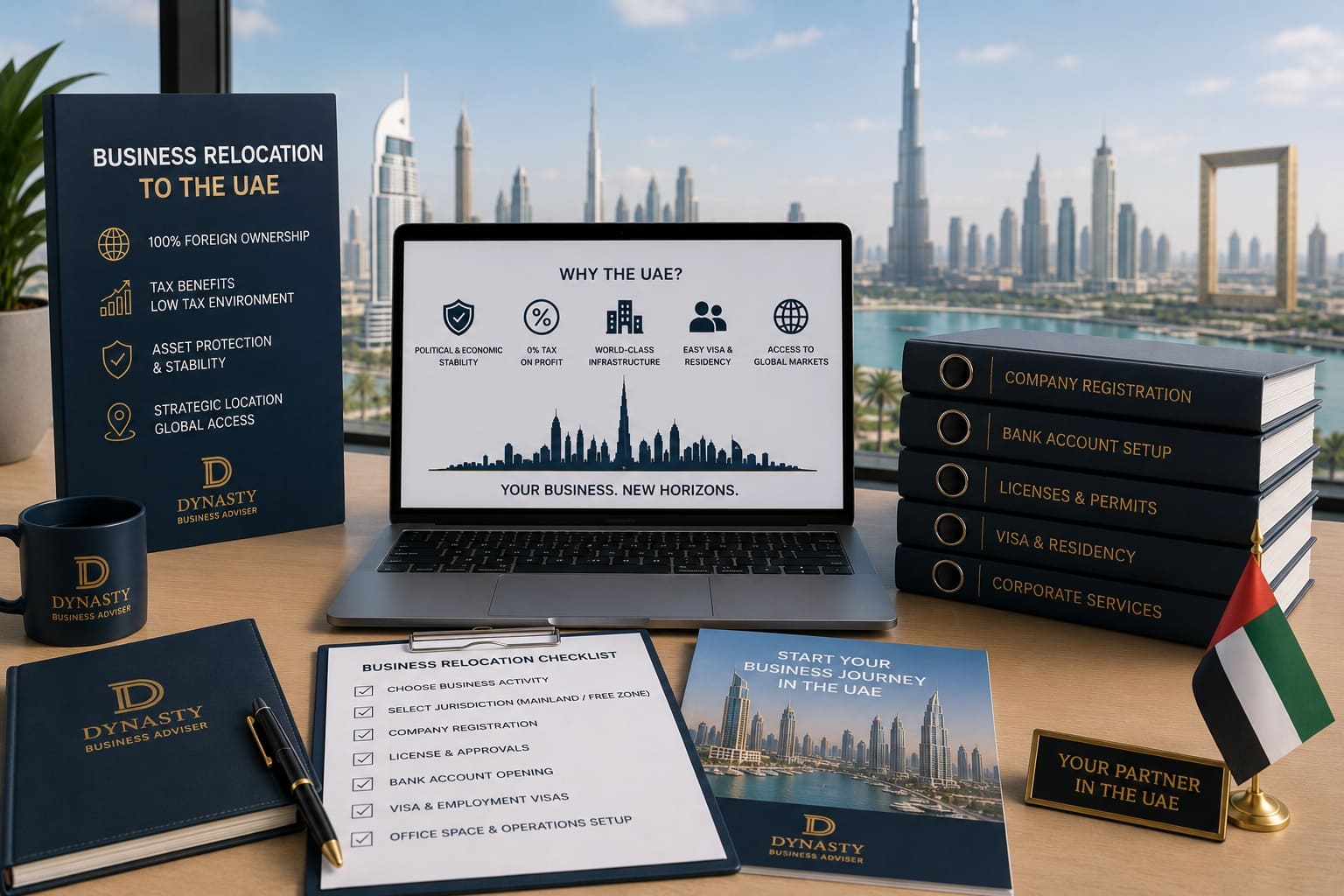
A successful business relocation to the UAE involves the following steps:
- register a company (or redomicile an existing one) and obtain a resident visa;
- secure the necessary licences and permits;
- open a bank account;
- rent an office and housing.

Registering a Company
Foreigners can set up two types of companies in the UAE: a local (mainland) company on the mainland, or a free zone company — a business registered in a free zone. Let’s look at the advantages of each.
Mainland Company
- An office can be opened anywhere in the Emirates.
- Banks are more accommodating, with a simpler account-opening process.
- No limit on the number of employee visas.
- Ability to purchase property in the company’s name.
- Eligibility to bid on large government tenders.
- Room to expand: the company can operate anywhere in the Emirates and abroad.
- A choice of one of 10 legal forms.
Free Zone Company
- Minimal office requirements: a virtual office or a shared desk is enough.
- Tax benefits.
- Simplified customs procedures.
- Discounted licence fees for setting up companies.
- No obligation to undergo an annual financial audit.
- 100% company ownership, with no need for a local investor.
- No restrictions on repatriating capital.
- A choice of one of 3 legal forms.
Redomiciliation: Moving Your Jurisdiction Without Starting From Scratch

Since 2025, there’s a third option alongside mainland and free zone: redomiciliation — officially moving a legal entity to the UAE without winding it up and without losing its legal personality. The mechanism was established by Federal Decree-Law No. 20 of 2025, which amended the Commercial Companies Law (Federal Decree-Law No. 32 of 2021). A company can transfer its registration to the UAE (including from abroad, between emirates, or from mainland to a free zone and back), keeping its contracts, banking relationships, and tax number intact.
The conditions depend on the jurisdiction of origin — you need to confirm that the laws of the country of registration allow such a transfer, and prepare a corporate document package for the UAE regulator. This route is especially relevant for companies with a track record and assets who don’t want to disrupt their relationships with banks and counterparties. It’s a relatively new tool, and the specific timelines are best confirmed separately for your jurisdiction of origin.
It might seem that if you’re opening a small beauty salon, a free zone company is the simpler route, while mainland might be the better option for a scalable business. However, free zones vary by focus area, and the mainland offers its own incentives for startups.
Given the many nuances involved in choosing a company type and relocation method, it’s best to consult our specialists at Dynasty Business Adviser, who will assess your business. They’ll advise on which option makes more sense for you long-term and help you choose a free zone that fits your line of business.
Licences and Permits
A licence is a permit to trade or provide services. It defines a company’s legal status and area of activity and confirms that the business is accountable for its actions. Operating in the Emirates without a licence and the relevant permits is illegal. Once a licence is issued, the company may only carry out the activities listed on it.
Types of licences and permits in the Emirates:
- commercial (trading);
- professional;
- freelance;
- industrial;
- tourism;
- agricultural;
- craft.
A mainland licence requires approval from the Department of Economic Development. In free zones, the zone’s own governing authority handles licensing.
Licensing a company in the UAE involves the following steps:
- Gather the document package: incorporation papers, passports and copies, an office lease agreement, documents confirming qualifications (diplomas, certificates), and a business plan.
- Submit a licensing application specifying the licence category, details of your activity, contact information, the list of documents attached, and information about the company’s structure.
- Wait for the decision and notification that the physical licence is ready, which you’ll receive by email. In some cases, you may be asked for clarifications or extra documents after review, so the process can take a few weeks.
- Receive the licence once all conditions are met: paying the fees, signing an agreement with the licensing authority, and so on.
Dynasty Business Adviser’s experienced specialists will help you get your licence right the first time. On average, our clients complete this stage within just two weeks.
Opening a Bank Account
Relocating to the UAE requires a bank account. It lets you settle transactions in various currencies, including the local one, without conversion. Thanks to the Central Bank of the UAE’s policy, information about clients’ financial transactions is not disclosed, even under international automatic data exchange. Banks in the country offer two types of accounts: for residents and non-residents.
It’s simpler and easier for residents to open an account: you need to submit a document package and go through an address and background check. Non-residents face additional steps: depositing a large sum, providing evidence of business turnover above $1 million, buying property, obtaining a guarantee from local partners, purchasing insurance, or investing a substantial amount in a local business.
Opening a bank account in the UAE should always be left to professionals: if the first attempt fails, you can forget about a second one — it will almost certainly be rejected too.
Renting an Office
Registering a mainland company requires an office lease: the lease agreement is needed to open a bank account and obtain a business licence. In a free zone, however, a Flexi Desk, Smart Office, or Premium Office is enough.
This is why business immigration to Dubai is especially popular among startups and freelancers, since the service is available across several jurisdictions. It works like renting a mailbox in a business centre, complete with a local phone line, where you can also book a meeting room from time to time.
What You Need to Know Before Moving to the Emirates?
Legal Peculiarities
The Emirates is an Islamic state. Its legal system is based on Sharia — a set of rules derived from the Quran. In recent years, the legal system has been gradually supplemented with European legal norms, but it’s still best to adapt your business model to local cultural norms. Business etiquette matters: Europeans should wear conservative, formal business attire, business cards should be translated into English/Arabic, and meetings should be arranged by phone rather than email. There are also restrictions to keep in mind — the following are prohibited:
- setting up a business built around charging interest;
- advertising alcohol and other harmful products;
- producing and selling pork products;
- investing money in gambling;
- importing narcotic substances;
- engaging in unfair competition.
Taxation in the UAE
Tax law in the UAE is set at the level of each individual emirate. Importantly, there is no tax on capital gains, dividends, or luxury goods, but the following rates apply:
- VAT — 0% to 5%;
- corporate income tax — 0% to 9% (the AED 375,000 threshold is based on taxable profit, not company turnover);
- excise tax — 50% to 100%.
Within free zones, the rates above apply at 0% for companies with Qualifying Free Zone Person status, but such companies may only operate within the free zone and abroad.
We covered local taxes in more detail in our article “VAT in Dubai: How Much Is It and What Does It Apply To?”
Free Zones: What They Are and How to Choose One?
Free zones are areas within the UAE where the rules for doing business and tax rates differ from the mainland. They were created specifically to attract investment into the country. There are now more than 40 free zones, most of them in Dubai. Each free zone has its own list of permitted activities, for example:
- Dubai Multi Commodities Centre (DMCC) — focused on trade and services in energy, healthcare, education, and finance.
- Sharjah Airport International Free Zone (SAIF) — a great fit for jewellery trading.
- Hamriyah Free Zone (HFZA) — geared toward industry.
- Dubai Knowledge Park (DKP) — built for technology and education services.
- Meydan — a zone for IT specialists.
Our services page has a detailed breakdown of the free zones and how to choose between them.
How Much Does Business Relocation to the UAE Cost?
Since no two businesses are alike, there’s no single answer to how much it costs to relocate to Dubai, Abu Dhabi, or Sharjah. The list of services and their cost depends on factors such as:
- registering a mainland company, a free zone company, or redomiciling an existing legal entity;
- opening a personal or corporate bank account;
- whether documents need to be legalised for licences, and so on.
That said, we can guarantee responsible, results-driven work, full confidentiality, and the most accessible rates for our services. These can cover comprehensive business relocation support or standalone tasks, such as notarising documents or opening a bank account. To find out the cost, book a consultation — we’ll discuss your situation and confirm the exact steps needed for a successful move.
How We Help With Business Relocation to the UAE?
We are a licensed agent, and for 11 years we have successfully set up and supported businesses in the UAE, helping in the following areas:
- Comprehensive relocation services for a company, family, or employees: preparing and processing documents, obtaining a registered address, opening a bank account, securing visas, and legal advice on permanent residency.
- Redomiciliation of an existing legal entity: assessing whether a jurisdiction transfer is possible and preparing the document package.
- Free zone selection: choosing the best option for growing your business.
- Business support: accounting and legal services.
Thanks to our expertise in international and tax law, we handle individual client requests based on their needs and budget. If you need a qualified team that will fully deliver on your business relocation request and provide sound ongoing support, reach out to Dynasty Business Adviser.
With our help, you’ll move your company to one of the most promising countries for running and growing a business — quickly and easily.
Get advice
Information current as of July 2026, taking into account Federal Decree-Law No. 20 of 2025 and data from the Federal Tax Authority (FTA) and the General Civil Aviation Authority (GCAA). Tax relief schemes and visa rules are revised periodically — confirm current conditions with a specialist before applying.