

The United Arab Emirates remains the leading financial hub of the Middle East, with one of the most reliable and technologically advanced banking systems in the world. UAE banks are regulated by the Central Bank of the UAE (CBUAE) — since 16 September 2025 under the new Federal Decree-Law No. 6 of 2025, which replaced the previous Central Bank Law No. 14 of 2018. In 2026, the UAE bank ranking has been updated: alongside traditional leaders such as Emirates NBD, First Abu Dhabi Bank, and ADCB, a new generation of digital banks — Wio Bank, Mashreq Neo, and Zand Bank — has firmly established itself. This article covers the current UAE bank ranking, an overview of the new regulatory framework, and an updated guide to opening an account.
Who regulates UAE banks: what has changed in the legislation

The UAE banking system has gone through three stages of regulation. Originally, the country’s banking sector operated under Law No. 10 of 1980. In 2018, it was replaced by Federal Decree-Law No. 14 of 2018 “Regarding the Central Bank and the Organization of Financial Institutions and Activities,” which remained in force for more than seven years. Since 16 September 2025, a new Federal Decree-Law No. 6 of 2025 “Regarding the Central Bank, Regulation of Financial Institutions and Activities, and Insurance Business” has come into force — it consolidates the regulation of banks, payment systems, and the insurance market into a single statute, replacing both Law No. 14 of 2018 and Insurance Law No. 48 of 2023.
- New law — expands the regulatory perimeter to fintech companies and “enablers” of digital financial services, including services based on virtual assets
- Expanded Central Bank powers — introduces the Central Bank’s right to intervene early in troubled banks — recapitalisation, management changes, forced mergers
- Sanctions — raises the ceiling on administrative fines to AED 1 billion and introduces criminal liability for unlicensed financial activity
- Transition period — a transition period until 16 September 2026 is provided, during which banks and fintech companies must bring their operations into line with the new law
A separate important element of customer protection is the state Deposit Guarantee Scheme established under Article 122 of the Central Bank Law. It covers individual deposits up to AED 100,000 per depositor per bank — regardless of whether the institution is a traditional bank or a digital one (Wio Bank, Zand Bank, and other CBUAE-licensed neobanks participate in the scheme on the same basis).
UAE Bank Ranking 2026: Top 10 by Assets
Below is the updated UAE bank ranking of the institutions holding leading positions by asset size and customer numbers at the start of 2026.
 First Abu Dhabi Bank (FAB)
Year founded: 2017
First Abu Dhabi Bank (FAB)
Year founded: 2017
The largest UAE bank by assets, focused on corporate and HNWI clients
 Emirates NBD
Year founded: 2007
Emirates NBD
Year founded: 2007
The largest retail network, a leader in digital banking and investment services
 Abu Dhabi Commercial Bank (ADCB)
Year founded: 1985
Abu Dhabi Commercial Bank (ADCB)
Year founded: 1985
A universal bank with a strong position in the small and medium business segment
 Dubai Islamic Bank (DIB)
Year founded: 1975
Dubai Islamic Bank (DIB)
Year founded: 1975
The largest Islamic bank in the UAE by assets
 Mashreq Bank
Year founded: 1967
Mashreq Bank
Year founded: 1967
The oldest private bank in the UAE, with a well-developed range of digital products (Mashreq Neo)
 Abu Dhabi Islamic Bank (ADIB)
Year founded: 1997
Abu Dhabi Islamic Bank (ADIB)
Year founded: 1997
One of the leaders in Islamic banking, with a convenient online banking platform
 RAKBank (National Bank of Ras Al Khaimah)
Year founded: 1976
RAKBank (National Bank of Ras Al Khaimah)
Year founded: 1976
Focused on SMEs and retail clients, with active digitalisation
 Commercial Bank of Dubai (CBD)
Year founded: 1969
Commercial Bank of Dubai (CBD)
Year founded: 1969
A classic bank with the digital product CBD NOW
 Sharjah Islamic Bank
Year founded: 1975
Sharjah Islamic Bank
Year founded: 1975
An Islamic bank with a growing network in Sharjah and across the UAE
 Emirates Islamic
Year founded: 2004
Emirates Islamic
Year founded: 2004
The Islamic banking arm of the Emirates NBD group
Asset figures for the largest players change year to year within a few percentage points, so for precise current numbers it is best to check the banks’ own reporting and CBUAE reviews — the ranking above reflects the stable balance of power as of 2025–2026.
Digital Banks in the UAE: Wio Bank, Mashreq Neo, Zand, and Other Neobanks
A separate and increasingly significant part of the UAE banking system is fully digital banks and neobanks. They operate without branches, and an account can be opened through the app within a few days.
- Wio Bank — a fully digital bank with its own CBUAE licence (not a partner-bank arrangement), launched in Abu Dhabi in 2022. Shareholders include ADQ, Alpha Dhabi Holding, e&, and First Abu Dhabi Bank. At the end of 2025, the bank’s deposits exceeded AED 57 billion, and net profit grew by 57% to AED 622 million. The bank offers multi-currency accounts (AED, USD, EUR, GBP), the Wio Creators product for bloggers and freelancers, and investment tools; in 2026 it is preparing to launch Islamic banking
- Mashreq Neo — the digital arm of Mashreq Bank, merged with the main Mashreq UAE app. It offers accounts with no minimum balance, the NEO PLUS Saver product with rates up to 6.25% per annum on salary transfer, and expense-tracking and investment tools starting from USD 1
- Zand Bank — the UAE’s first fully digital bank with its own CBUAE licence (licensed in 2021), serving both retail and corporate clients; in 2026 it announced plans to expand into the Gulf and African markets
- YAP — a digital product built on a partnership between RAKBank and fintech company YAP, focused on lifestyle features and multi-currency capabilities
- Liv. (Emirates NBD) и CBD NOW — the digital arms of Emirates NBD and Commercial Bank of Dubai respectively — convenient for those already banking with the parent institution who want to manage their account through an app
All the digital banks listed are licensed and regulated by the Central Bank of the UAE on the same basis as traditional banks, and therefore fall under the same deposit guarantee scheme and capital requirements.
Traditional Bank or Digital Bank: Which to Choose
In favour of a traditional bank — a full range of services is needed — cheque books, cash deposits, mortgages, large corporate operations, and offshore accounts
In favour of a digital bank — speed of account opening, no minimum balance, multi-currency accounts, and managing everything from the app matter most — typical for freelancers, sole proprietors, and small IT companies
In practice, many entrepreneurs in the UAE use a combination: an operating account with a digital bank for everyday payments and an account with a traditional bank for lending, large international transfers, and cheque-based transactions.
Banks in the UAE: Services Provided and Advantages
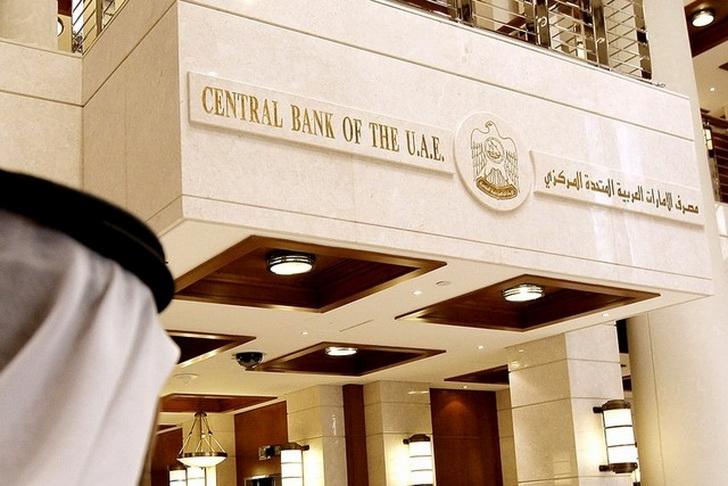
The UAE has built one of the most developed banking systems in the world, and the range of services here is noticeably broader than the regional average. Beyond basic account and cash-handling services, UAE banks offer clients:
- Several types of personal accounts — for UAE nationals, residents, and non-residents — with a different set of available operations and currencies
- Opening corporate and offshore accounts — for mainland companies, free zone companies, and offshore structures
- Lending to individuals and businesses — consumer loans, car loans, mortgages, and trade finance for business — under both conventional and Sharia-compliant (Islamic) models
- Remote banking — full mobile and online banking: transfers, bill payments, investments, and opening deposits without visiting a branch
- Payment instruments — issuance of debit and credit cards, and for residents, cheque books for settling with counterparties
- Investment and wealth services — wealth management services, brokerage access to global exchanges, and asset structuring for high-net-worth clients
Islamic banking deserves special mention: banks in Dubai and other emirates operating under Sharia principles can serve any client regardless of religion — these products simply do not involve charging or paying interest (riba), replacing it with profit-sharing models and mark-ups on sale-purchase transactions.
Key advantages of the UAE banking system include:
- a relatively straightforward account-opening procedure with a clear and reasonable list of documents
- a very high level of reliability and deposit protection, backed by banks’ capital and the state deposit guarantee scheme of up to AED 100,000
- low fees for most everyday payments and transfers within the UAE
- a high level of service, including dedicated relationship managers for business and premium clients
- attractive terms on deposits and savings products — rates at some digital banks reach 5–6.25% per annum
- no personal income tax or tax on individuals’ interest income — a significant advantage compared with many other jurisdictions
If you need a bank account in the UAE, the specialists at Dynasty Business Adviser will explain in detail how to open one and help you go through the whole process in the shortest possible time.
Who Can Open a Bank Account in the UAE
A bank account in Dubai and other emirates can be opened by a citizen of almost any country who is at least 18 years old (21 for some banks and products). A foreigner can open an account even without UAE resident status, but it is noticeably harder for non-residents: banks request more documents and often impose additional conditions:
- opening a fixed-term deposit for several years instead of an ordinary current account
- a higher minimum required account balance
- mandatory opening of an additional investment account or product
Having a UAE resident visa removes most of these restrictions and opens access to the full range of banking products, including credit cards and mortgages.
What Accounts and Cards Do UAE Banks Offer
UAE banks open personal accounts (for individuals) and corporate accounts (for legal entities). Personal accounts, in turn, are divided into two main types:
- Current account — allows an unlimited number of transactions and the issuance of a cheque book
- Savings account — earns interest on the balance but usually limits the number of free transactions per month
As for cards, UAE banks offer debit cards (issued for almost any account), credit cards (mostly available to residents and requiring proof of income), multi-currency cards for payments in AED, USD, EUR, and GBP without conversion, and virtual cards for online payments — a format that is especially well developed at digital banks such as Wio and Mashreq Neo.
Personal Bank Accounts for UAE Residents
UAE nationals, citizens of Gulf countries, and foreigners with a resident visa can open a personal account of any type — current or savings. Residents have access to international debit and credit cards, cheque books, and the ability to use funds in the account without limits on the number of transactions.
Personal Bank Accounts for Non-Residents
Foreigners without a UAE resident visa can open only a savings account, earning roughly 0.1–2% on the balance with a limited number of transactions per month. This is a Central Bank of the UAE requirement: serving a non-resident is considered a higher risk for the bank. A non-resident can also obtain a debit card, and, when placing a deposit, a credit card as well.
Corporate Accounts for Local Companies
A local company (Mainland LLC) can open a corporate current account, including one that is 100% foreign-owned — following the reform of commercial companies legislation, the requirement for a mandatory local partner for most business activities has been abolished.
Corporate Accounts for International Business
International companies and structures operating through the UAE typically open one of the following types of accounts:
- a current account for a company registered in a free zone (Free Zone Company)
- an account for a branch or representative office of a foreign company
- an account for an offshore company — usually with a limited set of operations and no right to conduct business within the UAE
How to Open a Business Account in the UAE

It is impossible to run a business in the UAE without a current account. To open one, you need to:
- register a company (mainland, free zone, or offshore) or a branch of a foreign company
- lease office premises (required for most licence types)
- obtain all the necessary licences
- arrange resident visas for the company’s owners, directors, and account signatories
- choose a bank and confirm the list of required documents — requirements vary between banks
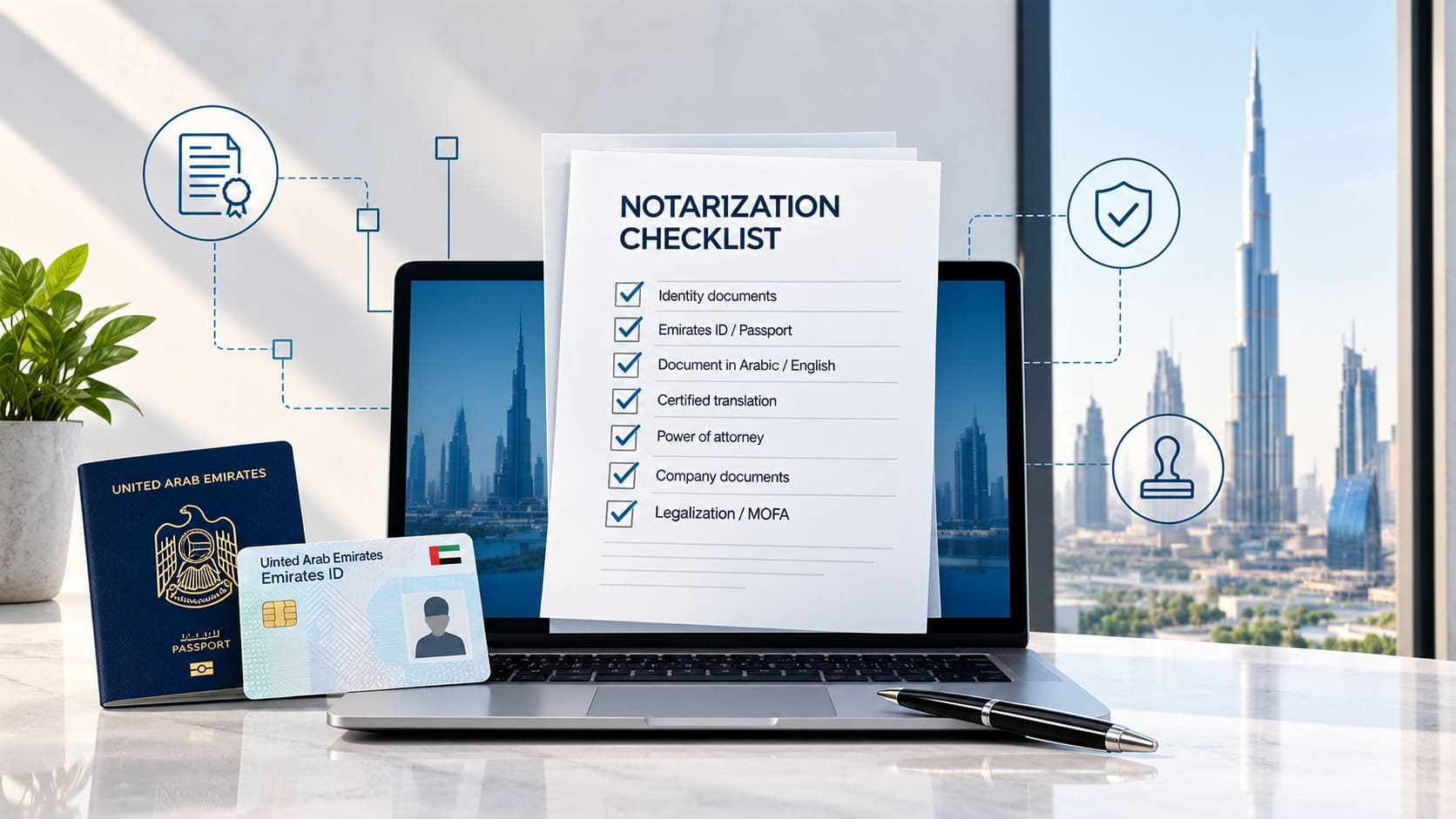
- gather the documents and have them legalised: translate them into English, and have them attested by the UAE consulate in your home country and by the UAE Ministry of Foreign Affairs
- submit the documents together with the application to the bank
For identity verification, the applicant and account signatories are generally required to be present at the bank in person to attend an interview and provide a signature sample on the bank’s documents — this applies to most traditional banks; at some digital banks, part of the process can be completed remotely.
To launch the account-opening procedure with a UAE bank through Dynasty Business Adviser, you need to:
- Pay the invoice for the services.
- Send 3–4 proposed company names for approval and reservation with the DED (if the company is not yet registered).
- Provide a good-quality copy of the passport of the shareholders and the company manager (a clear, legible scan).
- Provide a copy of the UAE entry visa stamp (if available).
- Provide a description of the company’s business activity.
The specialists at Dynasty Business Adviser will help you gather and correctly prepare the entire package of documents and will support you at every stage of opening an account with a UAE bank — so everything is done right the first time, with no returned applications, additional requests, or bank refusals.
How to Open a Bank Account in the UAE for Individuals
To open a personal account in the UAE, you need to:
- choose a suitable bank — not all banks work with foreigners who do not have resident status
- confirm with the bank the list of required documents
- gather the documents and have them translated and legalised
- submit the application and document package to the bank in person
- wait for the bank’s decision on opening the account or its refusal to approve the application
To open an account without complications and use it without restrictions, it is worth arranging a resident visa in advance — the specialists at Dynasty Business Adviser can help with this.
What Documents Are Needed to Open an Account in the UAE
For Individuals
- the original passport and legalised copies of all its pages
- the UAE entry stamp — for non-residents
- the resident visa and Emirates ID card — for residents
- the employer’s written consent, if the resident visa was obtained on the basis of an employment contract
- a reference letter and a statement from a bank in your home country showing account status and fund movements over several months
- utility bill receipts for the past 2–3 months showing the applicant’s address and name
- a written explanation of the purpose of opening the account
For a Company
- the company’s constitutive documents (Memorandum of Association, licence, certificate of incorporation)
- originals and legalised copies of all passport pages of the applicant, the founder (if a different person), and the signatories
- resident visas and Emirates ID cards of the applicant (founder) and signatories
- a reference letter in the required format from the bank where the founder is a client
- a statement of the founder’s account for the past six months (for a branch, a statement of the parent company’s account)
- a document confirming the company’s registered address (lease agreement / Ejari)
- a company and founder profile (résumé), as well as a description of the business activity
The list may vary depending on the bank and the company’s line of business — the exact requirements should be confirmed in advance.
How Long It Takes to Open a Bank Account in the UAE
From 1 week — for a personal account of a country resident and a savings account of a non-resident
From 3 weeks — for a corporate account of a free zone company, a local firm, or a branch of a foreign company
From a few days — for digital banks (Wio, Mashreq Neo), given a complete document package and a resident among the signatories
Account Opening Refusals
Banks in the UAE have the right to refuse to open an account if they have doubts about the applicant’s reliability. The main reasons for refusal are:
- documents were not provided in full
- there is no confirmation of the source of funds or of the applicant’s prior business activity
- the applicant cannot meet the minimum account balance requirements
- the applicant appears on the bank’s internal compliance list as an undesirable client
In addition, it will not be possible to open an account if the applicant refuses to attend a personal interview with a bank representative, or if the applicant’s account was previously blocked by another UAE bank. To avoid a refusal, it is worth preparing a complete and correctly drawn-up package of documents in advance — this is exactly where the specialists at Dynasty Business Adviser can help.
Service Costs and Deposit Protection
Most UAE banks do not charge an account maintenance fee if the average monthly balance or salary credit exceeds AED 3,000–5,000; otherwise, the fee is usually AED 20–30 per month. Digital banks (Wio, Mashreq Neo) most often do not require a minimum balance at all, but may charge a fixed monthly fee for maintaining a business account. All individual deposits at UAE-licensed banks are protected by the state deposit guarantee scheme for up to AED 100,000 per depositor per bank.
How to Open an Account with a UAE Bank Together with Dynasty Business Adviser
.
The specialists at Dynasty Business Adviser support the opening of personal and corporate accounts with UAE banks — from selecting the right bank (traditional or digital) to preparing and legalising documents. Contact us for a consultation: +971 52 634 1022