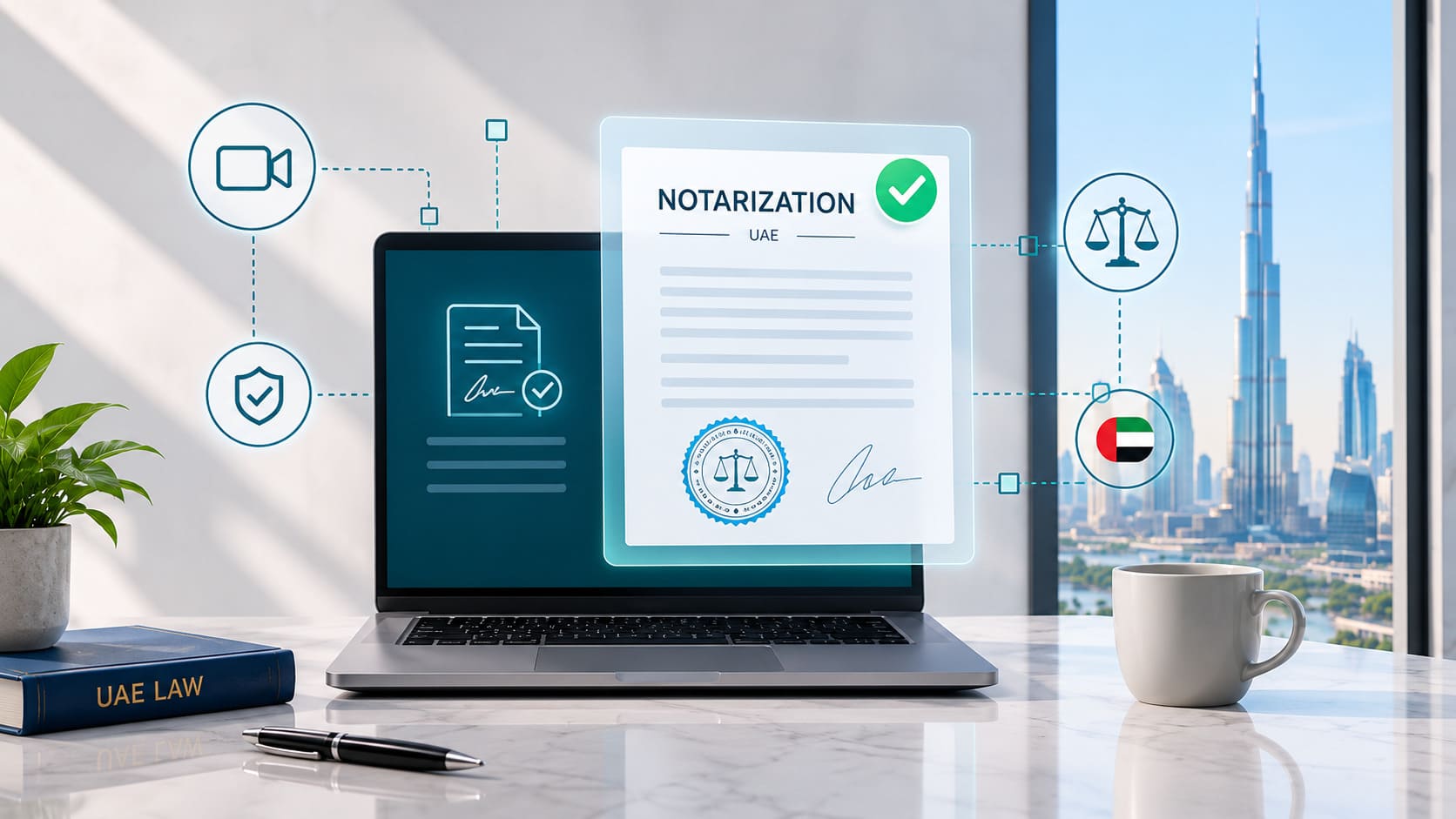
Say you urgently need a power of attorney to sell an apartment in Dubai, but you’re on another continent. A few years ago that meant booking a flight or chasing a chain of consular legalizations. Today, notarization of documents in Dubai online is a routine procedure: a power of attorney, a corporate resolution or a will can be signed over a video call and carries exactly the same legal weight as a paper signed inside a notary’s office.
This guide explains how online notary services work in the UAE in 2026 — which laws govern electronic notarization, how public and private notaries differ, which documents can be certified remotely, what the submission process looks like step by step, and how much it costs. The material is for general information only and does not replace legal advice for your specific case.
Legal Framework: The Laws Behind Remote Notarization in the UAE
The country-wide rules come from Federal Decree-Law No. 20 of 2022 Concerning the Regulation of the Notary Public Profession. This is the law that established the core principle: remote electronic notarization carries the same legal force as an in-person visit. It also formally recognized private notaries as a licensed category alongside public ones.
The procedural detail sits in Cabinet Resolution No. 16 of 2024, the executive regulation implementing Decree-Law No. 20/2022. Dubai additionally runs its own layer of regulation: Dubai Law No. 4 of 2013 on Notarization, amended by Dubai Law No. 26 of 2021, which authorized licensed law firms to provide notary services under Dubai Courts’ supervision.
Two government platforms handle the technical side of remote notarization UAE-wide. Dubai Courts’ Smart Electronic Notary system covers Dubai: documents are filed through the courts’ portal, identity is verified via Emirates ID or UAE Pass, and the transaction itself is recorded on a video call. The rest of the country runs on the Ministry of Justice’s E-Notary system. For non-residents without an Emirates ID, there’s a separate route through a licensed private notary, where identity is confirmed against a passport instead.
Public vs. Private Notary in Dubai: What’s the Difference
Since the 2022 reform, both types of notaries operate under the same legal framework, but their roles diverge. Public notaries sit within Dubai Courts and the Ministry of Justice: they certify signatures and seals, take sworn statements, issue enforcement orders and keep the official register of every notarial act.
Private notaries are licensed lawyers who have passed Ministry of Justice accreditation. They perform the same certifying functions for most documents, but they also support the client end to end: advising on wording, drafting bilingual Arabic-English texts, and arranging translation and legalization. For a client based abroad this distinction matters a lot — the public system is built primarily around residents holding an Emirates ID, while a private notary can complete the whole process using a passport.
Table 1 — Public vs. Private Notary: Which One Fits Your Case
| Criterion | Public Notary | Private Notary |
|---|---|---|
| Operates under | Dubai Courts, Ministry of Justice | Licensed law firm |
| Identity check | Emirates ID, UAE Pass | Passport or Emirates ID |
| Document drafting | Not included, certification only | Drafting and translation included |
| Best suited for | UAE residents | Non-residents and businesses |
Which Documents Can Be Notarized Online

The most requested category is powers of attorney (POA). A general power of attorney (GPOA) grants an agent broad authority — representing you before government bodies, managing property and vehicles, handling financial matters. A special or specific power of attorney (SPOA) is issued for one defined task: selling a property, dealing with a vehicle, opening a bank account or registering a marriage.
Businesses use online notarization for corporate documents: memoranda and articles of association, shareholder and board resolutions, share sale-and-purchase agreements, admission of new partners, and changes of company name or activity. Individuals remotely execute wills — translated into Arabic or English and drafted with UAE inheritance rules in mind — as well as travel consent letters for minors and other personal documents.
There are limits, too. Some actions still require physical presence or extra steps: certain real estate transactions must be registered through the Dubai Land Department, and documents issued abroad in other languages first need legalization and certified translation before they can be notarized. Not every case falls neatly into the categories above, so if you want to notarize documents online in the UAE, it’s worth confirming that your specific paperwork qualifies for the remote route before you pay for the service.
How Online Notarization Works: The 2026 Submission Flow
The process is standardized and typically takes one to three business days. Here’s how it runs when you book through Dynasty Business Adviser, a licensed agent working directly with UAE government authorities.
Step one is the application and document upload. You choose the document type on the notary services page, fill in a form and attach scans — passport or Emirates ID for both the principal and the agent, and for corporate paperwork, the company licence, articles of association and proof of the signatory’s authority. Step two is legal review and drafting: lawyers prepare the document in Arabic and English, walk you through the wording and make any adjustments you request.
Step three is payment through a convenient method and scheduling the video appointment. Step four is the video call itself with the notary: you show the original documents to the camera and confirm your identity and intent; the session is recorded, exactly as the remote-notarization regulation requires. The final step is issuing the electronic certificate: the notarized document in Arabic and English is delivered to you digitally, with follow-up legalization arranged afterward if it needs to be used abroad.
Power of Attorney in the UAE: How the POA System Works and How to Stay Protected
A power of attorney is a legal document through which a principal grants authority to one or more agents. That agent can be an adult family member, a business partner, a company employee or a professional such as a lawyer or accountant. The principal remains responsible for the agent’s actions within the scope of the granted authority, so the wording deserves real attention even at the draft stage.
Practice has settled on a few rules of thumb. Describe the authority precisely — “sale of unit No. X in project Y” holds up far better than “any actions related to real estate.” Set a clear expiry date, especially if you’re granting authority for the period you’ll be out of the country. And plan the revocation mechanism in advance: a power of attorney in the UAE is revoked through formal notice to the agent, and in some cases through a published notice as well. A revoked document stops being valid immediately, but it’s still worth informing any counterparties who had been relying on it.
Issue a general power of attorney only to someone you trust without reservation — a GPOA gives the agent access to almost every personal and financial matter. For one-off tasks, a special power of attorney is always the safer choice: it’s easier to control and simpler to revoke.
Who Needs an Online Notary in Dubai, and When

The typical client for an online notary in Dubai is a property investor living outside the UAE. Buying an off-plan unit, signing a sale agreement with a developer, later selling or leasing out the unit — all of this can be handled through a power of attorney for a local representative, notarized remotely within a day or two.
The second large group is business owners with UAE companies. Changing a director, admitting a new shareholder, opening a corporate bank account, selling a stake — almost every corporate action requires notarization, and doing it online is far more efficient than flying in for each signature. Families make up the third group: wills drafted under UAE inheritance rules, travel consent letters for children, vehicle powers of attorney — routine paperwork that no longer means standing in line at an office.
Cost of Online Notarization
Pricing depends on the type of document, the number of agents named, whether translation is needed, and government fees. Below are the current rates at Dynasty Business Adviser: every package already includes drafting, Arabic-English translation, one round of edits, government fees, scheduling the video session and issuing the electronic certificate.
Table 2 — Prices for Online Notary Services in Dubai (2026)
| Document | Price | Turnaround |
|---|---|---|
| General power of attorney / real estate POA | from AED 1,570* | 1–3 business days |
| Special / specific power of attorney | from AED 1,890* | 1–3 business days |
| Corporate documents for business | from AED 2,100* | 1–3 business days |
| Will | from AED 5,900* | 1–3 business days |
For comparison, filing directly through the government systems is cheaper on fees alone, but it requires an Emirates ID, navigating Arabic-language interfaces, and drafting legally sound wording on your own. A poorly worded scope of authority is the single most common reason a power of attorney later gets rejected by a bank or government office.
How Safe and Legally Sound Is Electronic Notarization

The legal weight of an electronic notarial act is written directly into the law: Decree-Law No. 20/2022 puts remote notarization on equal footing with an in-person visit, and the recorded video session together with the notary’s electronic signature makes the document difficult to dispute. Every act is logged in the state register, so the certificate’s authenticity can always be verified.
On the client’s side, sensible precautions are straightforward. Share documents only through the service’s secure channels, never by open email; check the provider’s licence — a notary firm should hold authorization from Dubai Courts or a Ministry of Justice licence; keep the electronic certificate and payment confirmation on file. If the notarized document is headed to another country, check the legalization requirements ahead of time — for countries outside the Hague Apostille Convention, a consular legalization chain will be required.
Conclusion
Online notary services in Dubai have gone from a pandemic-era stopgap to a fully established legal institution backed by its own federal law. Today, a power of attorney, a corporate resolution or a will can be notarized from anywhere in the world — quickly, and with full legal force.
Dynasty Business Adviser manages the entire notarization process end to end: drafting the text, translation, paying government fees, scheduling the video session, issuing the electronic certificate and, where needed, arranging follow-up legalization. Choose the service you need on our online notary page, or message us on Telegram or WhatsApp for a free consultation.
Get a consultation
This article is for general information only and does not constitute legal advice. Details on laws, prices and procedures are current as of July 2026 and are subject to change — please confirm specifics with our specialists before ordering a service.