
A free zone authority asks for an updated memorandum, a bank wants a founders’ resolution confirming the new signatory, and a buyer of your share wants a notarized sale agreement. Sound familiar? Preparing corporate documents in Dubai is a routine part of running any business in the UAE, and by 2026 almost all of this paperwork is handled online — no flights, no queues, no chasing officials from window to window.
This guide walks through which corporate documents a company in the Emirates actually needs and which laws govern them, when notarization is required, how to legalize documents issued abroad, and what the government fees and total cost typically look like. The material is for information purposes only — the exact document set for your company should be finalized with a lawyer.
Legal basis: what corporate documents in the UAE rely on

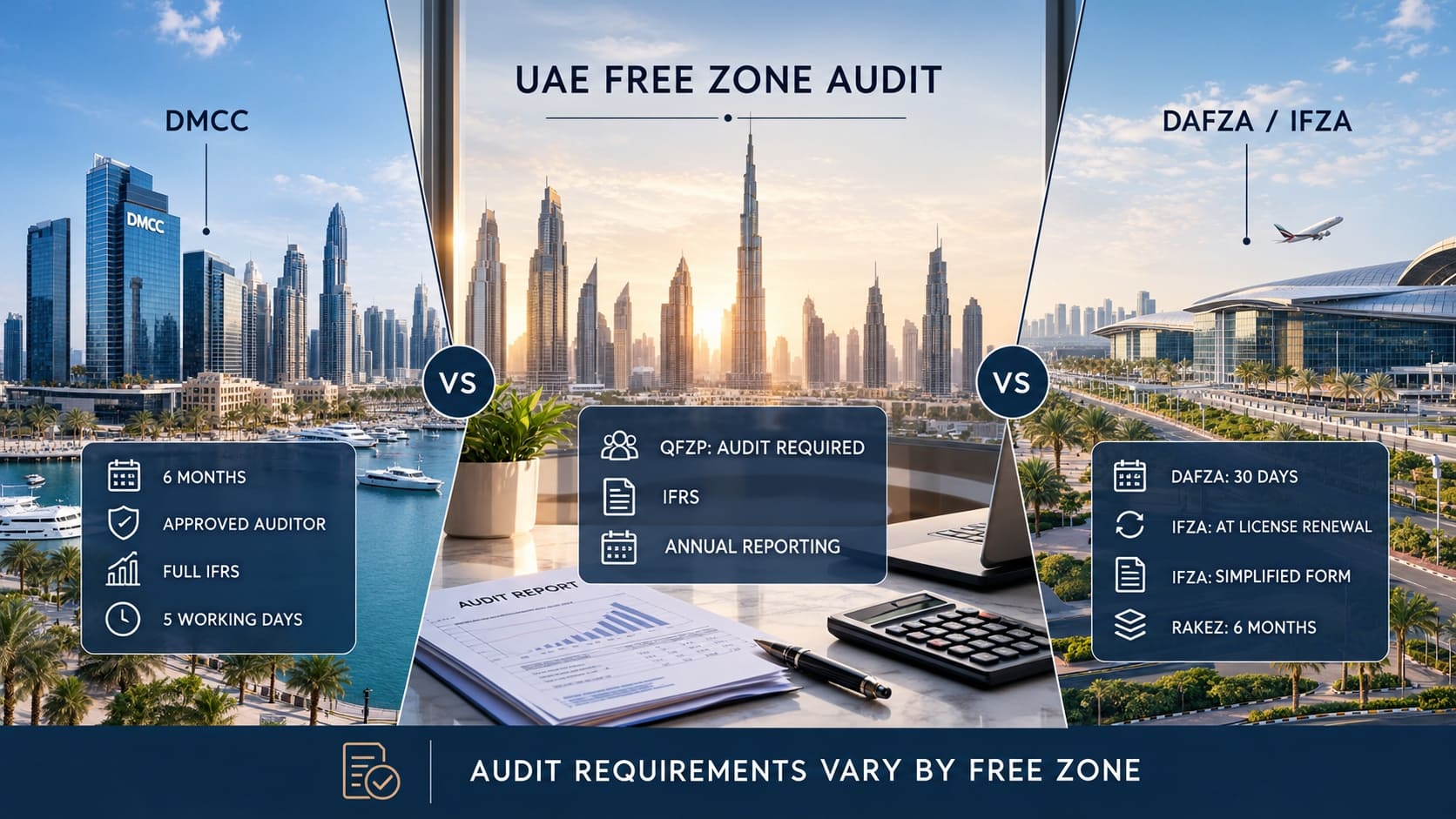
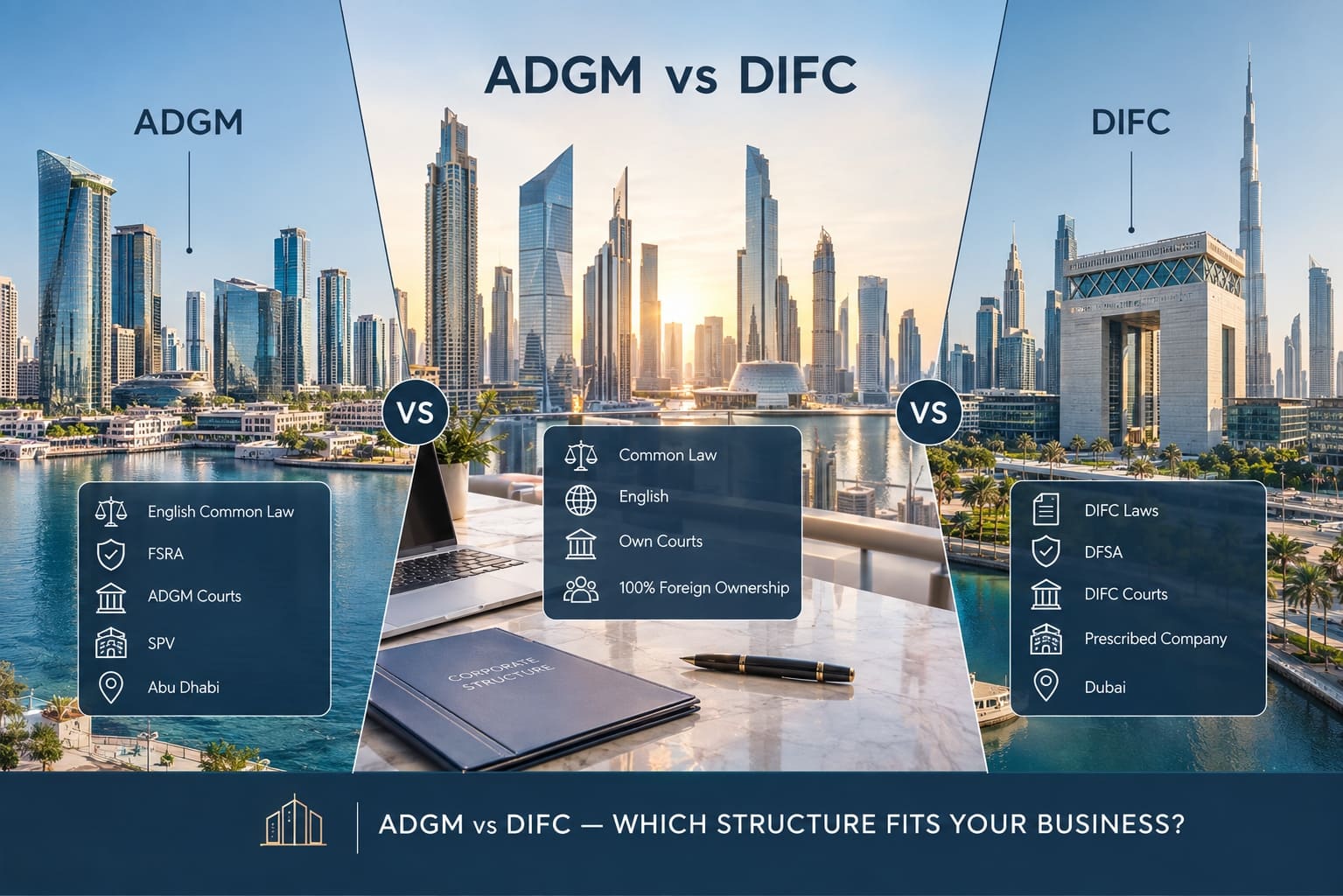
The core statute for mainland companies is Federal Decree-Law No. 32 of 2021 on Commercial Companies, known as the Commercial Companies Law. It sets out the mandatory content of the memorandum of association (MOA) and the articles of association (AOA): company name, licensed activities, shareholding structure, capital split, and management arrangements. Free zone companies follow the rules of their own authority — DMCC, IFZA, JAFZA, and others keep separate registers and templates, but the underlying logic of the documents is the same.
Notarization itself is governed by Federal Decree-Law No. 20 of 2022 on the notary profession: the MOA of a local company, founders’ resolutions, and share transfer deals all require notarization, and an electronic notarization carries the same legal weight as an in-person one. Employment-related documents — collective agreements, HR policies — are checked against Federal Decree-Law No. 33 of 2021 on Labour Relations. Notary fees are standardized under Cabinet Resolution No. 19/2024.
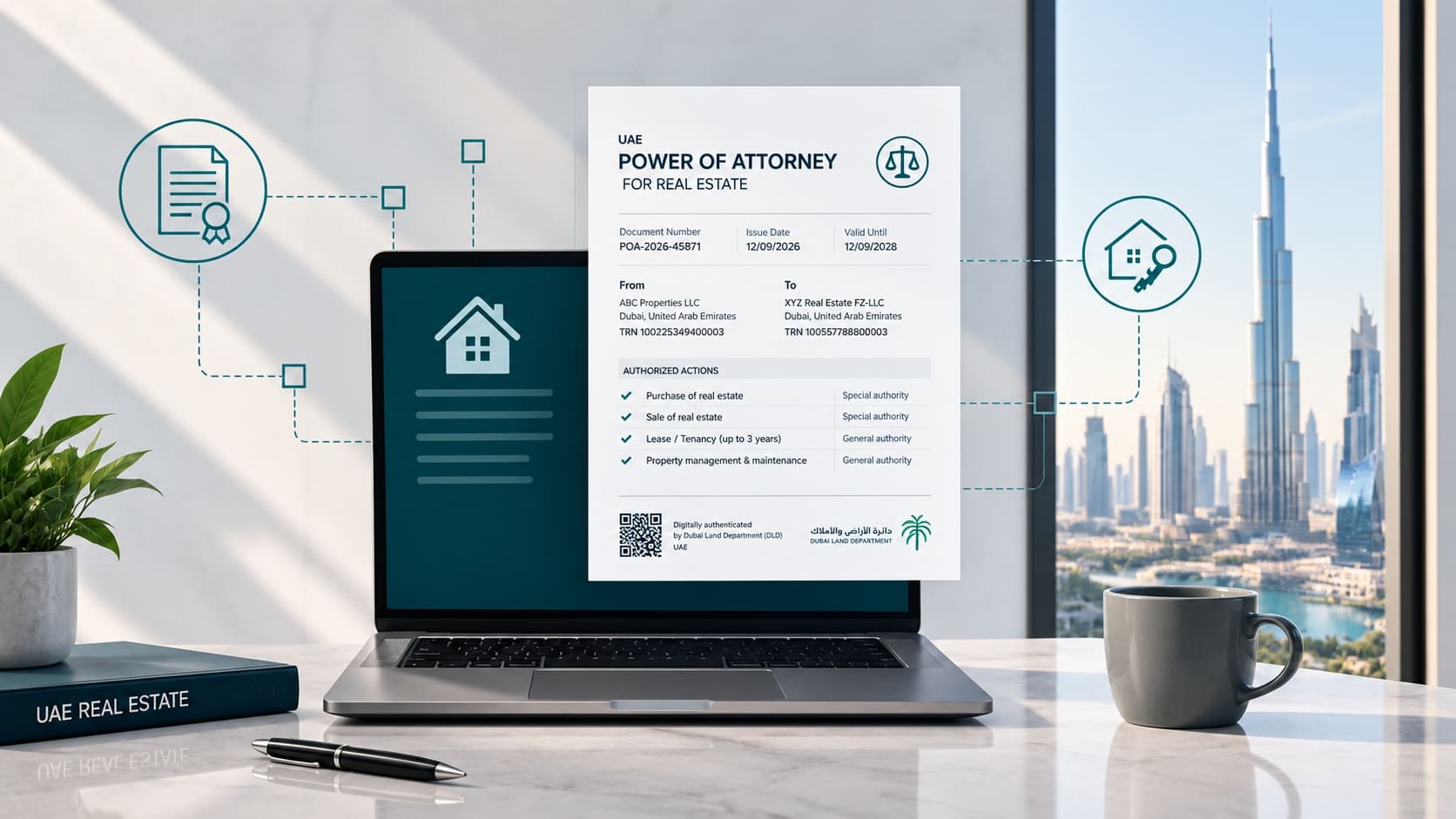
One fact that matters a great deal for foreign businesses: the UAE is not a party to the Hague Apostille Convention. Corporate documents issued abroad — trade register extracts, parent company charters, powers of attorney — go through full consular legalization instead: certification in the country of issue, the UAE embassy, then the UAE Ministry of Foreign Affairs (MOFA), followed by a legalized Arabic translation.
Which corporate documents a UAE company actually needs
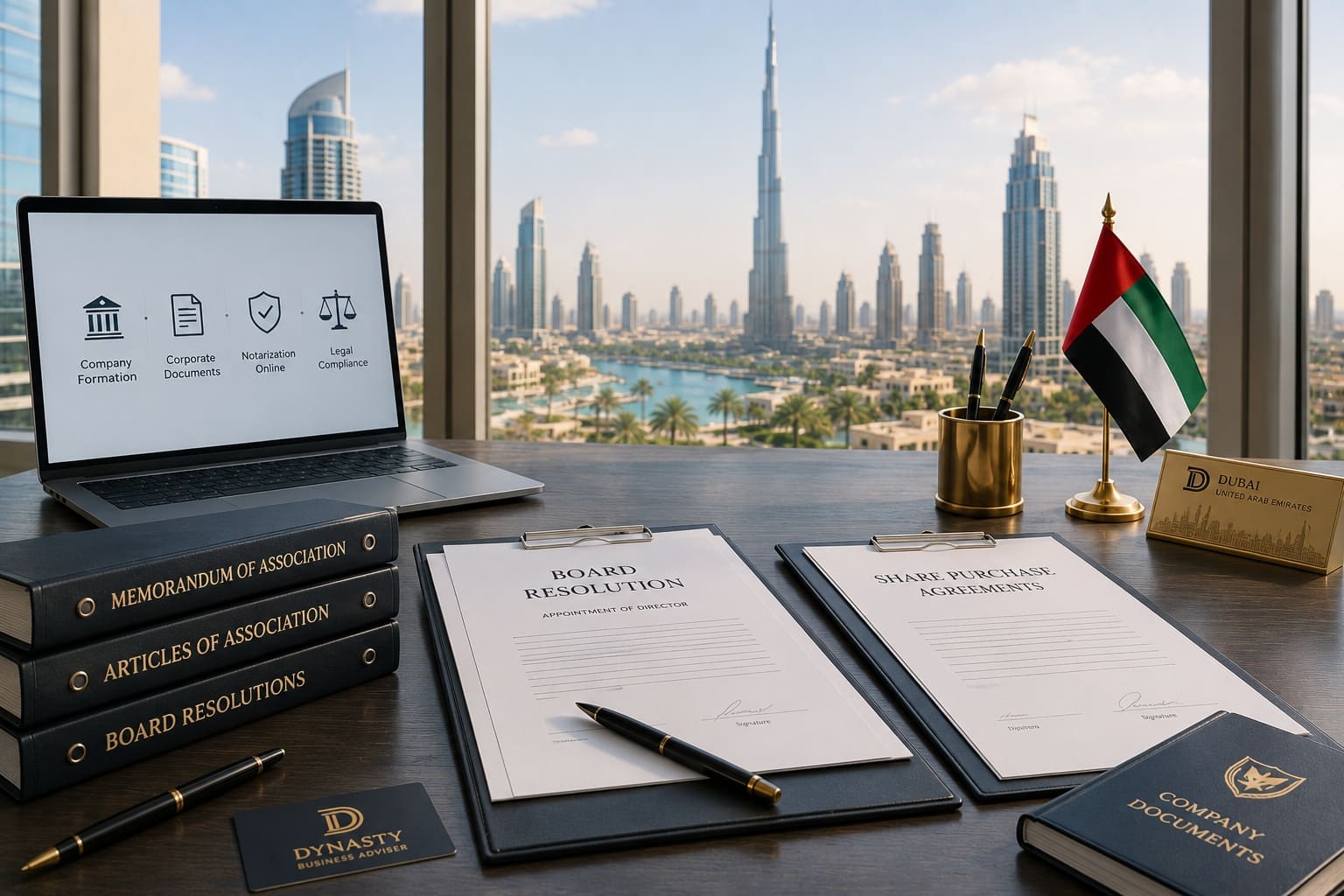
The core of any corporate file is the constitutional documents. The MOA sets out the company’s “constitution” — the partners, their shares, capital, and licensed activities — while the AOA spells out internal governance in more detail. Alongside them sit the trade license, register extract, meeting minutes, and founders’ resolutions: without a current set of these, a bank won’t open an account and no material transaction will go through.
The second group covers amendment documents. A name or activity change, a new partner joining, a capital increase, a director appointment, or the sale of a company (or a share in it) — each of these events is recorded through an MOA amendment or a standalone resolution and needs notarization. The third group is contractual and internal paperwork: shareholder agreements between partners, NDAs, confidentiality policies, and collective agreements with staff.
Table 1 — Corporate documents and formalization requirements
| Document | Notarization | Language |
|---|---|---|
| MOA / amendments (mainland) | Mandatory | Arabic + English |
| Founders’ resolutions | Required for banks and registers | Bilingual |
| Share sale and purchase | Mandatory | Arabic + English |
| NDA, shareholder agreement | On request of the parties | Any language + translation |
Worth noting: in many free zones, part of the paperwork is certified by the zone’s own registrar rather than a notary — check the specific zone’s requirements before preparing your set. One more terminology point that trips people up: UAE corporate documents refer to company members as partners, not the more familiar shareholders — registrars routinely reject filings that use the wrong term.
What it costs: government fees and package pricing
Government fees for notarizing corporate documents are standardized. Certifying contracts and articles of association runs AED 500–2,000 depending on volume and complexity; for documents where the subject matter exceeds AED 100,000 — share sale deals, for instance — the fee is calculated at 0.5% of the value, capped at AED 15,000. As of 2 January 2026, a Dubai Courts decision fixed itemized private-notary charges: AED 100 to register each partner and AED 100 per signature.
On top of the fees, add a legalized translation (AED 50–150 per page) and, for foreign documents, consular legalization with MOFA attestation (AED 150–2,000 depending on the document type). Dynasty Business Adviser’s turnkey package for corporate documents starts from AED 2,100 and already includes drafting or amending the text, a bilingual version, payment of the fees, arranging notarization, and an electronic certificate.
Table 2 — What a corporate document costs in 2026
| Cost item | Amount | Comment |
|---|---|---|
| Notarization fee | 500–2 000 AED | Contracts, articles |
| Deals over AED 100,000 | 0.5%, capped at AED 15,000 | Share sale and purchase |
| Translation | AED 50–150 per page | Into Arabic |
| MOFA attestation | 150–2 000 AED | Foreign documents |
| Dynasty turnkey package | from AED 2,100* | Everything included |
A cut-price “bare” notarization with no legal review is a false economy — a document with the wrong terminology or incomplete details will be rejected by the registrar, and the fees will have to be paid all over again.
How to prepare corporate documents online
The remote process works like this: you describe the task and upload scans — the trade license, the current MOA, partners’ passports, and proof of the signatory’s authority. Lawyers draft the text in Arabic and English to match the registrar’s requirements, walk you through any revisions, and then the document is notarized during a recorded video session — signatories show their original documents on camera. The result is an electronic certificate valid across all the emirates.
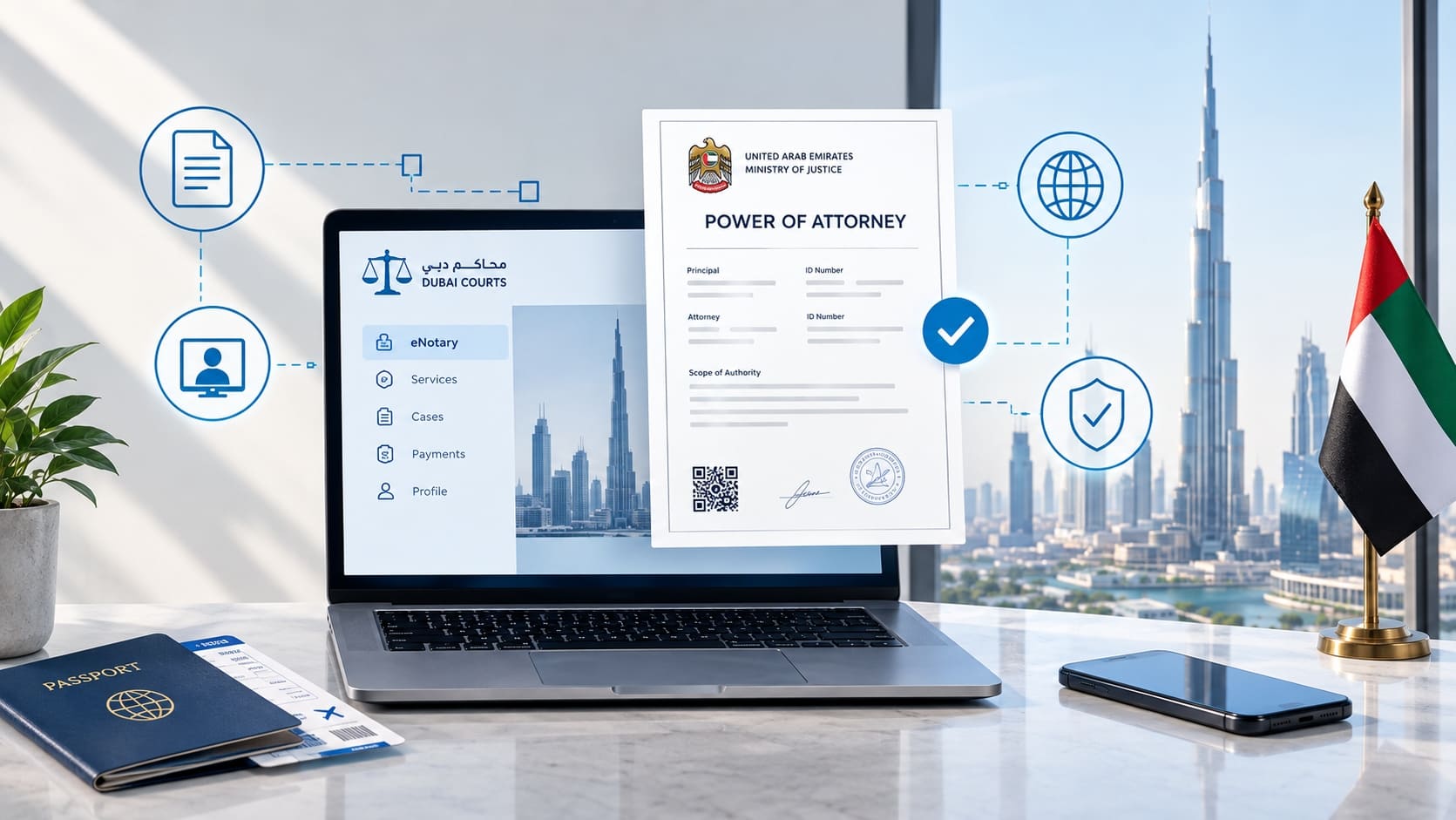
The standard turnaround is one to three business days; consular legalization of foreign attachments adds another three to five days. For a step-by-step breakdown of the video session and identification requirements, see our guide to notarization of corporate documents in Dubai, and if signing authority needs to be delegated to a representative, our article on issuing a power of attorney online covers exactly that.
Common situations: when a business needs this service
Confidentiality: how company data is protected

Corporate documents reveal ownership structure, capital, and commercial terms, so choosing who prepares them is not just a question of price. Dynasty Business Adviser operates under non-disclosure agreements: the NDA is signed before any documents are handed over, files are transferred through secure channels, and only the project team assigned to a client has access to the materials.
On its side, the client company can reduce its own exposure with a few simple measures: share only the documents needed for the specific task at hand, keep internal confidentiality policies up to date, and set out in the NDA how long data will be retained and how it will be deleted once the work is finished.
Conclusion
Corporate paperwork in the UAE in 2026 runs on a transparent system with a federal legal basis and fixed fees. Articles, resolutions, and deals can all be handled online in one to three days, provided the text is drafted properly and the terminology matches the law.
Dynasty Business Adviser has supported companies since 2015: we draft and notarize MOAs, prepare amendments, handle legalization of foreign documents, and put together the package your bank or tax authority is asking for. Leave a request on our notary services page or message us on Telegram or WhatsApp — we’ll assess the task and the timeline for free.
This article is for general information only and does not constitute legal advice. The laws, fees, and rates referenced are current as of July 2026 and may change — confirm the requirements with your registrar before preparing any documents.