

Key Parameters of Cyprus
Before registering a company in Cyprus, it is worth reviewing the basic parameters that show how convenient the jurisdiction is for international structures.
| Parameter | Value | What it gives the business |
|---|---|---|
| Capital | Nicosia | Home to the main government bodies responsible for company registration and administration. |
| Currency | Euro (EUR) | Simplifies settlements with European partners and allows working in one of the world’s main currencies. |
| EU membership | Since 1 May 2004 | Provides access to the single European market and the European legal framework. |
| Corporate income tax (CIT) | 15% of taxable profit | One of the most competitive corporate tax rates among EU countries. |
| VAT | 19% (standard rate) | Complies with common European taxation and trade rules. |
| Double tax treaties (DTT) | 72 treaties in force | Help avoid double taxation in international operations.. |
| Language of business | English | Simplifies interaction with banks, investors and foreign partners. |
| Legal system | English Common Law | Well known to international investors, banks and corporate lawyers. |
| Main form of company registration | Private Company Limited by Shares (Ltd) | Widely used for international trade, holding structures and investment activity. |
Advantages of Registering a Company in Cyprus
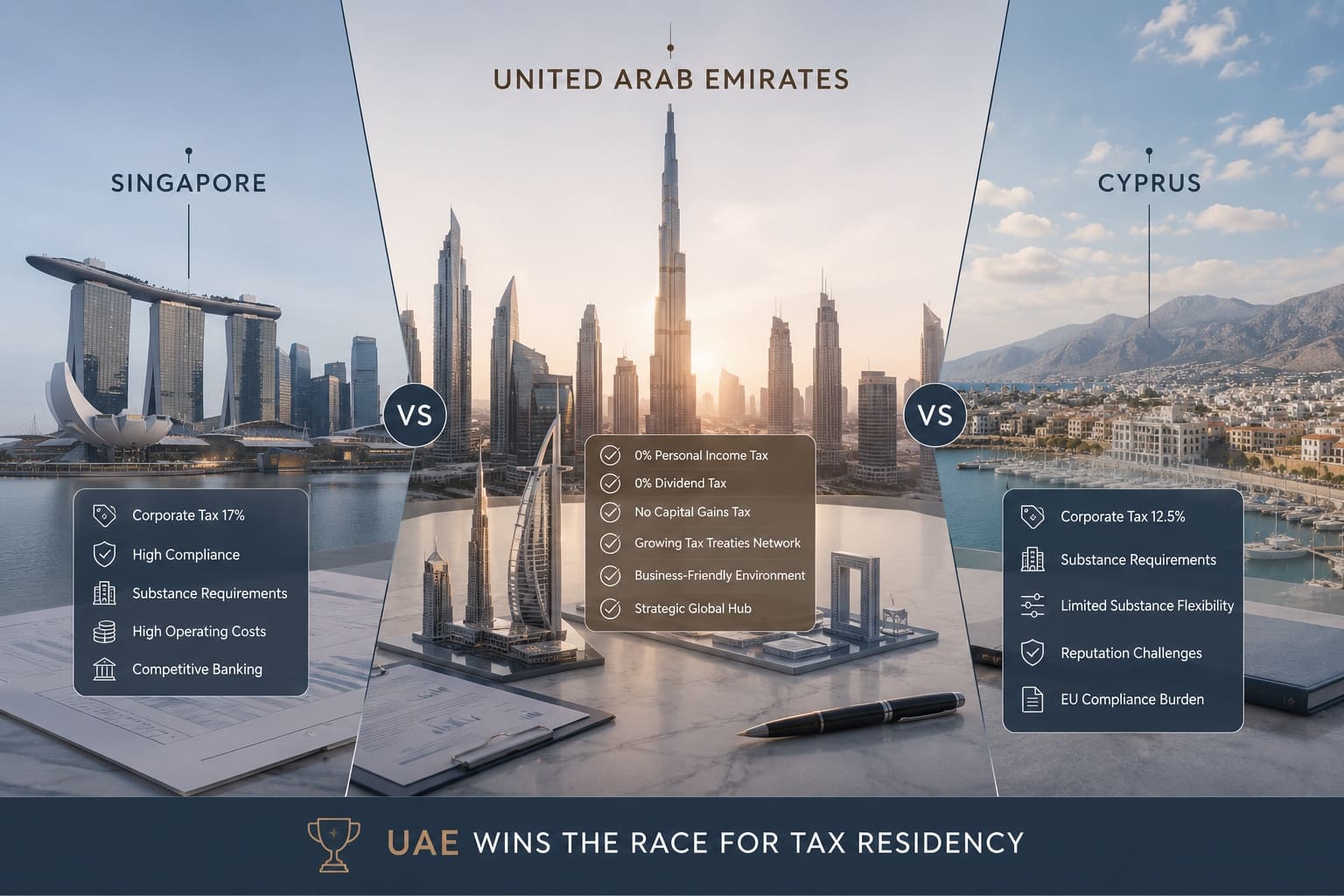
Cyprus offers business not only a European jurisdiction but also a number of practical privileges for international operations. Many of them favourably distinguish the country from popular destinations such as the UAE, Hong Kong or Singapore:
- Access to the European market. Cyprus is a member of the European Union. This facilitates working with clients and partners from the EU and increases trust in the company.
- Competitive corporate taxation. The corporate tax rate of 15% remains one of the lowest among European Union countries.
- Effective holding structures. When properly structured, a Cypriot holding company can not only hold shares, receive dividends, hold IP and manage assets, but also separate operational risks from ownership.
- Tax advantages. Despite the increase in corporate tax to 15%, Cyprus remains attractive due to its favourable holding regime and extensive network of double tax treaties.
- Developed banking infrastructure. The banking system complies with EU and Basel Committee standards. Besides commercial banks, the island hosts about 30 international banking centres. Integration into the European financial system provides access to the SEPA and SWIFT payment systems.
- English legal system. Cyprus corporate law is based on English Common Law, which is well known to international business and provides a high level of protection for owners’ and investors’ rights.
Compared to the UAE, Cyprus wins where a European status matters. For clients and partners from the EU, a Cypriot company often looks more familiar. Hong Kong is more oriented towards Asian markets, so for operating in Europe, Cyprus is often the better fit. Singapore remains a strong jurisdiction for Asia, but European holding structures in Cyprus are often cheaper to maintain and require less complex administration.
Who Is Cyprus Company Registration Suitable For

Cyprus is not suitable for every business. This jurisdiction is oriented towards companies that operate internationally, cooperate with European partners, or build a long-term corporate structure. These include:
- IT and SaaS companies. A Cypriot company is convenient for working with European and international clients: it can accept payments, sign contracts, hire contractors, own IP and serve clients from different countries.
- International trading business. If a company buys goods in one country, sells them in another and works with European counterparties, Cyprus becomes a convenient point for contracts, settlements and profit management.
- Holding companies. The jurisdiction is attractive due to its tax treaties, dividend rules and clear corporate structure.
- Consulting, marketing and service companies. Cyprus suits those who work with foreign clients and can confirm the reality of their activity.
- Investment structures. The jurisdiction is useful for holding shares, portfolio assets, or building a group structure.
But if your main goal is to register a company with minimal requirements and without any real activity, it is better to consider other jurisdictions.
Cyprus is not suitable for a business that expects to maintain full anonymity, does not plan to carry out real activity, or wants to avoid bookkeeping and corporate reporting. This jurisdiction operates under European rules and requires strict compliance. For a small local business without international operations, maintaining a company in Cyprus is hardly justified.
Main Requirements for Opening a Company in Cyprus
To register a company in Cyprus, corporate, tax and banking requirements must be met. Most of them are not complicated, but they should be taken into account in advance when choosing the jurisdiction.
Corporate Structure of the Company
Before registering a company in Cyprus, it is necessary to determine its structure. For a Private Limited Company with Cypriot tax residency, at least one local director, one shareholder, a secretary and a registered address in Cyprus will be required.
The shareholder can be either an individual or a legal entity, regardless of country of registration or citizenship. The secretary function is performed by a local individual or legal entity, and the registered address is used for official correspondence with government bodies and receiving legally significant notices.
Details of the director, shareholders, secretary and registered address are included in the registration documents and are subsequently used in corporate administration and interaction with government bodies.
Banking Compliance
Opening a corporate account in Cyprus is accompanied by verification of the legal entity, its beneficiaries and its future activity. The bank assesses the legality of the origin of funds, the transparency of the business structure and the compliance of planned operations with regulatory requirements.
When opening an account, the bank carries out KYC (Know Your Customer) and AML (Anti-Money Laundering) procedures. In addition to the company’s registration documents, documents on the beneficiaries will be required, as well as confirmation of the source of funds, a description of the structure, resumes of the owners, and proof of address. For an operating business, the bank may also request contracts with clients or suppliers, the company’s financial history, and information about key counterparties.
During the review, not only the documents but also the business model itself are assessed. The bank analyses clients, countries of operation, expected turnover, types of payments, and compares this information with the declared activity and the level of potential risks.
Post-Registration Requirements
After registration, a Cypriot company is required to keep accounting records, retain primary documents, file tax returns, and prepare audited financial statements. In addition, banks, tax authorities and international counterparties increasingly assess economic substance — a genuine economic presence in the jurisdiction. This takes into account contracts with clients and suppliers, invoices, bank statements, the corporate website and business correspondence. The presence of an office, employees, contractors and other evidence of actual activity is also taken into account.
For international holding structures, substance requirements are higher. Particular importance is attached to local directors, the place where management decisions are made, an office, employees or an outsourced team, corporate documentation, and the business purpose of setting up the structure in Cyprus.
What Types of Companies Can Be Opened in Cyprus
Several legal forms of business are available in the jurisdiction, and it makes sense to review them before opening a company in Cyprus.
Private Limited Company (Ltd)
The most common form for international business. It is a separate legal entity in which the owners’ liability is limited to the amount of their contribution. Suitable for trade, IT, holding companies, consulting, investment activity and most commercial projects.
Branch of a foreign company
Not a separate legal entity and acts on behalf of the parent organisation, which ultimately bears responsibility. This option suits a business that already operates in another country and wants to officially conduct activity in Cyprus without creating a new structure.
Representative office
Used exclusively for marketing activity, partner search, market research and business development. A representative office does not conduct independent commercial activity and does not generate profit in Cyprus.
Partnerships
Suitable for jointly running a business with several partners. Depending on the chosen form, the liability of participants and the management procedure may differ.
If you plan to open a company in Cyprus for international trade, IT business, consulting or holding management, choose a Private Limited Company. For investment funds, financial organisations, licensable activities and complex holding structures, a separate assessment will be required.

What Taxes Does Business Pay in Cyprus
The Cyprus tax system attracts businesses with its rates and incentives. But to correctly calculate the tax burden, it is important to take into account tax residency, the source of income, the types of transactions with the EU, the group structure, and the applicability of double tax treaties.
Corporate Tax
The main tax for business is corporate income tax. From 2026, the standard CIT rate in Cyprus is 15% instead of 12.5%. Cyprus tax residents pay tax on income from sources both in Cyprus and abroad. Non-resident companies pay tax only on income connected with a permanent establishment in Cyprus and on certain income from Cypriot sources.
VAT
VAT applies to the supply of goods and services in Cyprus, as well as to the import of goods from EU countries. The standard VAT rate is 19%. Reduced rates of 9%, 5%, 3% and a zero rate apply to certain goods and services — for socially significant products. A company must register as a VAT payer if the volume of taxable transactions has exceeded €15,600 over the last 12 months or, according to forecasts, will exceed this amount within the next 30 days.
Taxation of Dividends
If the conditions of the participation exemption regime are met, dividends are not subject to tax. This helps to avoid double taxation of profit within a group. When paying dividends to non-residents, Cyprus generally does not withhold withholding tax. From 2026, exceptions have appeared: a 5% rate applies to payments to related parties in low-tax jurisdictions, and 17% to recipients from jurisdictions included in the EU blacklist.
Capital Gains Tax
Most transactions in Cyprus are not subject to capital gains tax (CGT). Profit from the sale of corporate titles, including shares, bonds and interests in companies, is exempt from CIT. The exception is real estate transactions. The CGT rate here is fixed at 20%, but reliefs are available: the sale of a main residence or the transfer of property by inheritance may be exempt from tax. Also, if the sale is recognised as business activity, the profit is taxed at the 15% corporate rate rather than the 20% CGT rate.
Other Taxes and Mandatory Payments
In addition to corporate tax and VAT, companies may face other mandatory payments. These include employer social insurance contributions of 8,8% of an employee’s salary, as well as a contribution to the GHS healthcare system of 2.9%. Sometimes stamp duty must be paid on certain contracts, along with taxes on real estate transactions. International groups must also comply with transfer pricing requirements and prepare the relevant documentation.
Therefore, focusing only on the corporate tax rate is not enough. When choosing a jurisdiction, it is important to take into account sources of income, international operations, business specifics and the applicable tax rules.
How Much Does It Cost to Open a Company in Cyprus
The cost of registering a company in Cyprus is made up not only of the registration expenses. In addition to registration, you need to account for the registered address, secretary services, accounting support, audit, opening a bank account, and annual maintenance. The final budget depends on the business structure, bank requirements, the need for licensing, and the volume of subsequent support.
| Service | Approximate cost | Comment |
|---|---|---|
| Company registration in Cyprus | €2 000 to €3 500 | Includes registration, government fees and document preparation. |
| Registered address for 1 year | €600 to €1 200 | Mandatory for all Cypriot companies. |
| Company secretary | €700 to €1 500 per year | Required by Cyprus law. |
| Professional or nominee director (if needed) | from €2 500 per year | Used to ensure company management and, if necessary, tax residency. |
| Opening a bank or EMI account | €1 500 to €3 000 | Cost depends on the chosen bank, EMI, and complexity of client compliance checks. |
| Accounting support | €150 to €500 per month | Depends on the number of transactions and the complexity of the accounting. |
| Annual audit | from €1 500 | Mandatory for most companies. |
| Annual corporate support | €1 000 to €2 500 | Includes corporate documents, filing of mandatory reports, and company support. |
When assessing the budget, it is important to take into account not only the expenses listed but also possible additional costs:
- translation and notarisation of documents;
- licences and permits for certain types of activity;
- consultations on tax residency issues;
- preparation of internal corporate documents;
- legal support for non-standard transactions.
The average registration period is 1–3 weeks, and opening a bank or EMI account takes 3–8 weeks. If the bank requests additional documents or the business structure is complex, verification may take longer.
How to Register a Company in Cyprus: Step-by-Step Guide

Registering a company in Cyprus consists of several sequential stages, including legal, tax and banking steps. Part of the procedures is carried out by the registration agent, but the owner also needs to prepare documents, undergo bank checks, and make a number of corporate decisions. In most cases, the process looks as follows:
- Choosing the purpose of the business, the legal form, and the management model.
- Determining the composition of shareholders, directors and beneficiaries.
- Checking and reserving the company name.
- Preparing the founding documents, including the Memorandum and Articles of Association.
- Filing the documents with the Registrar of Companies.
- Obtaining corporate documents: Certificate of Incorporation, information on directors, secretary, shareholders and the registered address.
- Registering the organisation with the tax authorities and, if necessary, registering for VAT.
- Preparing the package of documents for the bank or payment institution, undergoing compliance, and opening a corporate account.
What Documents Are Needed to Open a Company and a Bank Account
The exact list of documents depends on the business structure, the composition of the owners and the bank’s requirements. However, in most cases, the following will be required to register a company in Cyprus and open a corporate account:
- passport of the beneficiary, shareholder and director;
- proof of residential address;
- a CV or description of professional experience;
- a description of the business and planned operations;
- confirmation of the source of funds;
- the ownership structure, if the shareholder is a legal entity;
- corporate documents of parent companies, if they are part of the structure;
- contracts, invoices or financial history for an operating business;
- information on projected turnover, client countries and supplier countries.
When opening a corporate account, information will be required on the purpose of the account, the nature of future operations, sources of funds, and the countries the company will work with. The more detailed and accurate this information is, the faster the bank will be able to make a decision.
What to Do After Company Registration
Registering a business is only the first stage. To operate successfully in the market without fines or restrictions, it is necessary to fulfil corporate and tax obligations:
- keep accounting records and retain primary documents;
- file the corporate tax return and other mandatory reports;
- calculate and pay temporary tax in two instalments — by 31 July and 31 December;
- prepare and file annual financial statements through an approved auditor;
- pay taxes and other mandatory payments on time;
- file VAT returns and correctly issue invoices (for VAT payers);
- fulfil employer obligations if the company has employees;
- comply with transfer pricing requirements if the company is part of an international group or carries out transactions with related parties;
- renew the registered address, secretary and director services, and update beneficiary information in a timely manner;
- retain corporate documents and minutes of decisions, file annual corporate forms, and keep the business in Good Standing status.
The last three points are particularly important for companies that want to retain tax residency and use banking services without restrictions.
How We Help Register a Company in Cyprus
Registering a company is only one of the stages. It is equally important to choose a suitable structure, take into account bank and tax authority requirements, and prepare the company in advance for further operations. That is why we support the entire process — from analysing the task to corporate support after registration.
As part of our support services, we:
- we analyse the field of activity, client and supplier countries, the ownership structure, planned settlements, the need for licensing, VAT registration, and the creation of a holding structure;
- we select the optimal company structure;
- we prepare documents and register the company in Cyprus;
- we arrange for the appointment of the director, secretary, registered address and other required persons;
- we prepare the package of documents for opening a corporate account and support interaction with the bank or payment institution;
- we arrange accounting, audit and tax support after registration.
If you are planning to register a company in Cyprus, get in touch. We will offer not just competent document preparation, but a solution that will work for the development of your business..
Is It Worth Opening a Company in Cyprus
Cyprus is a strong but demanding jurisdiction. It is best suited to companies with a transparent business model, international clients and long-term development plans. This largely explains why companies register in Cyprus only after assessing the business model, tax consequences, bank requirements and future support costs. This makes it possible, even before registration, to build a corporate structure that will work for the development of the business.
This material is for informational purposes only and does not replace individual legal, tax or corporate advice. Each structure has its own features, so before registration it is important to obtain recommendations from specialists based on the specific business model.