
Why Choosing the Right Jurisdiction Matters More Than Ever?
The world has grown noticeably smaller. Entrepreneurs, freelancers, investors and senior executives are no longer tied to a single country — either physically or legally. With that freedom comes pragmatism: where should you officially ‘live’ for tax purposes? Where can you legally and safely structure your affairs so that income is taxed minimally — or not at all?
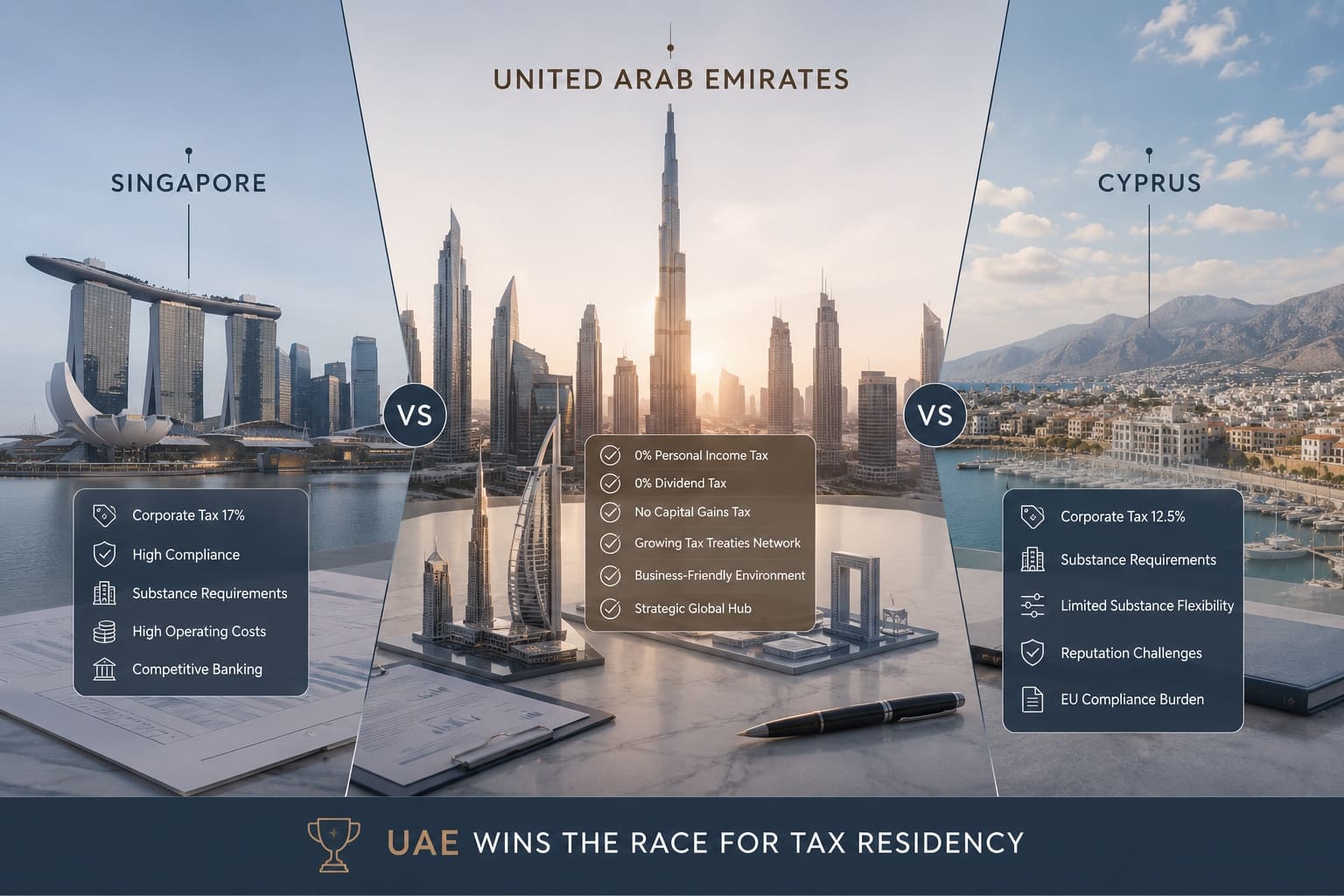
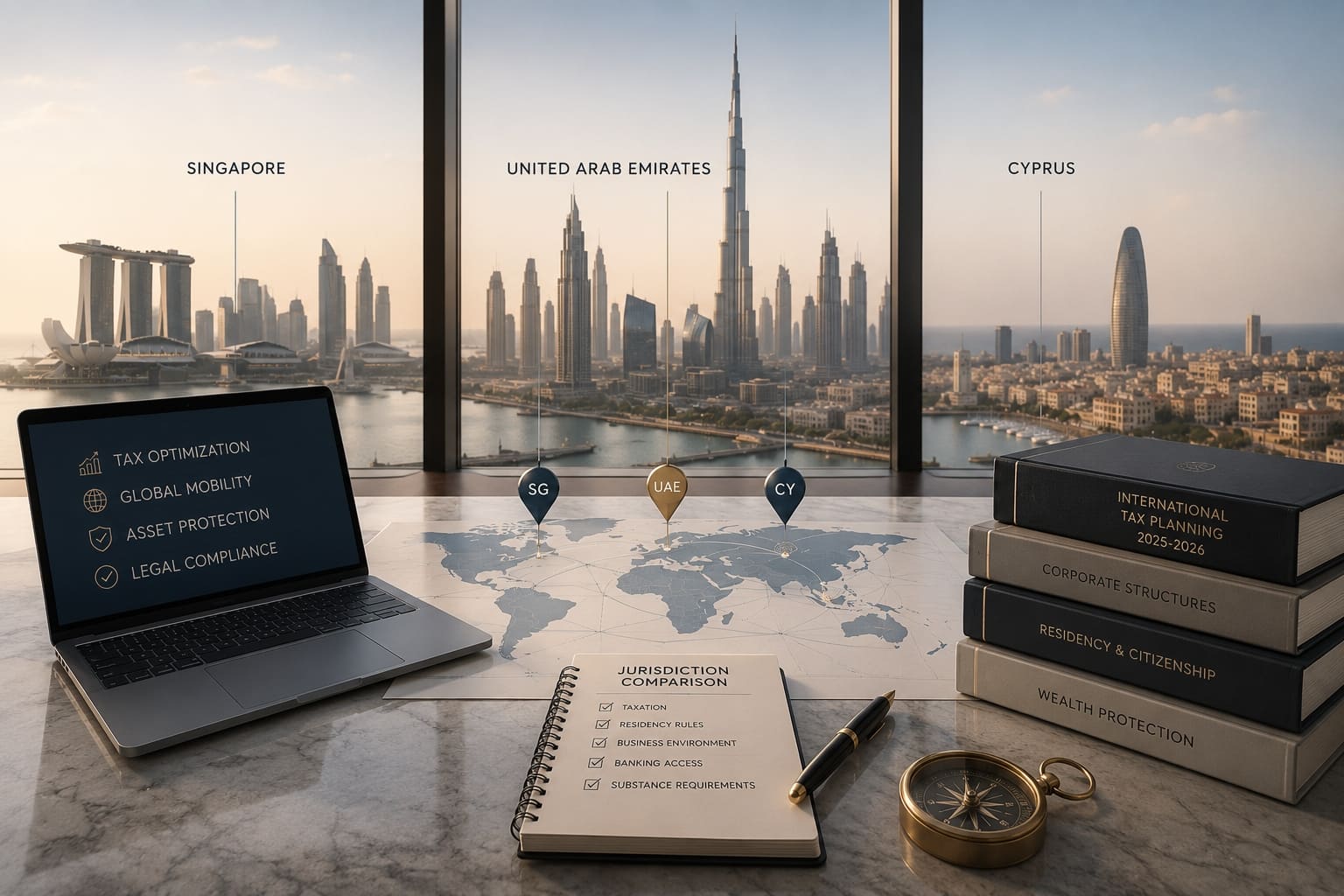
Three jurisdictions consistently lead these conversations: the UAE, Singapore and Cyprus. Each has its own reputation, its own audience and its own genuine advantages. But when you examine the actual numbers, conditions and real-world practice of 2025–2026, the gap between them becomes clear — and it does not favour the Asian city-state or the Mediterranean island.
Tax residency is not merely a change of address. It is a legally recognised status that determines which country has the right to tax your income. And this is precisely where the UAE offers what others cannot: zero.
What Is Tax Residency and Why Does It Matter?
Before comparing, it is important to understand what we are actually discussing. Many expats in the UAE mistakenly believe that holding a residency visa automatically makes them a tax resident. This is a common misconception. A residency visa allows you to live and work in the country, but it does not confirm tax status — these are two separate processes.
Tax residency is needed in order to: benefit from Double Taxation Agreements (DTAs); demonstrate to foreign tax authorities that you have shifted your ‘tax life’ to another country; and obtain an official Tax Residency Certificate (TRC) — the key document required by banks, counterparties and regulators.
In the UAE, obtaining a TRC gives access to more than 130 active Double Taxation Agreements and legally confirms that your personal and business interests are centred in a zero-income-tax jurisdiction. The certificate is issued by the Federal Tax Authority (FTA) through the EmaraTax portal — entirely in digital format.
UAE, Singapore, Cyprus: Analysing Each Option
United Arab Emirates — The Best Choice
The answer here is simple and concrete: the UAE has no personal income tax. Salary, investment income, capital gains — none of it is taxed. There is no wealth tax, no inheritance tax. For individuals, there is no corporate tax — it applies only to businesses with profits exceeding AED 375,000.
Since 1 March 2023, Cabinet Decision No. 85 of 2022 has been in force. An individual is recognised as a UAE tax resident if they meet at least one of the following conditions:
- their usual or primary place of residence and the centre of their financial and personal interests are in the UAE;
- physical presence in the country is 183 days or more in any consecutive 12-month period;
- or physical presence is 90 days or more combined with a valid UAE residence permit and a permanent home or business in the UAE.
❕ An important detail: all days of presence in the UAE, including partial days, count towards the 90- and 183-day thresholds even if they are not consecutive — this significantly increases flexibility for mobile professionals.
Golden Visa: Residency Without an Employer Tie
The Golden Visa provides a 10-year renewable residency without the need for a sponsor. Holders can live, work, study and invest in the UAE, and may leave the country for any period without losing their status. The minimum threshold is an investment of AED 2 million (approximately USD 550,000) in real estate, a company or a bank deposit.
Singapore — A Respected Hub with Real Taxes
Singapore is one of the most competitive financial centres on the planet, with an impeccable reputation, a strong banking system and world-class infrastructure. But when it comes to tax residency, the picture is considerably less straightforward.
Singapore applies a progressive personal income tax system: rates range from 0% to 24%. The first SGD 20,000 is tax-free. For incomes of USD 300,000 or more per year, the effective rate reaches 18–22% — representing real hundreds of thousands of dollars annually. To obtain tax resident status, a foreigner must have lived or worked in Singapore for at least 183 days within a 12-month period.
Cyprus — The European Option with Nuances
Cyprus occupies a unique niche: an EU jurisdiction with relatively low taxes and an attractive non-domicile regime. From 2026: income up to €22,000 is tax-free; €22,001–32,000 — 20%; €32,001–42,000 — 25%; €42,001–72,000 — 30%; above €72,000 — 35%. For incomes of €200,000 or more, you will surrender approximately 30–35% of most of that amount to the state.
The non-dom regime is Cyprus’s genuine privilege. A non-domiciled resident is exempt from the Special Defence Contribution (SDC) on worldwide dividends and passive interest income. However, this status has a time limit: it lapses once you have been resident in Cyprus for 17 of the last 20 years.
Key Parameters 2025–2026
| Parameter | 🇦🇪 UAE | 🇸🇬 Singapore | 🇨🇾 Cyprus |
|---|---|---|---|
| Personal income tax (max) | 0% | 24% | 35% |
| Dividend tax | 0% | 0% (foreign source) | 0% under non-dom |
| Capital gains tax | 0% | 0% | 0% (excl. Cyprus property) |
| Inheritance tax | 0% | 0% | 0% |
| Minimum presence | 90 or 183 days | 183 days | 60 or 183 days* |
| EU membership | No | No | Yes |
| Tax treaties | 130+ | 90+ | 65+ |
| Corporate tax | 9% (above AED 375K) | 17% | 15% (from 2026) |
| Cost of residency | Affordable / from AED 2M | High | Affordable |
| Duration | Indefinite | Indefinite | Non-dom limited to 17 yrs |
Which Jurisdiction Suits Whom?
The investor with passive income
Dividends, interest, portfolio gains — all of this is taxed at 0% in the UAE with no conditions and no expiry date. In Cyprus, the non-dom regime is capped at 17 years. In Singapore, foreign dividends are formally exempt, but this requires careful structuring.
The entrepreneur with active income
On an income of USD 300,000–1,000,000 per year, the difference between 0% and Singapore’s 24% amounts to USD 72,000–240,000 annually. In absolute terms, that is the cost of an apartment or several years of international education. The UAE leaves that money with you.
Top executive at an international corporation
Singapore has historically attracted this particular category—regional headquarters with ties to the Asia-Pacific market. If your employer covers part of your expenses, the tax burden feels lighter. But with salaries of $300,000 or more, progressive tax rates of up to 24% place a significant financial burden on you.
Those who need a European address
This is the one scenario where Cyprus objectively wins. If you need a European address for banking relationships, business partners or personal reasons, Cyprus offers the least burdensome conditions within the EU. But it is a choice of ‘best within the EU’, not a competitor to the UAE.
What Makes the UAE Systemically Stronger?

Maturity of the Regulatory System
The UAE updated its tax residency rules in 2023 to bring them into line with international OECD standards. This is not an exotic offshore with a dubious reputation — it is systemic work recognised at the international level.
Flexibility of Presence Thresholds
Three paths exist for confirming UAE tax residency: standard presence of 183 days or more; the flexible ’90-day-plus’ test with a permanent home or work in the UAE; and the ‘centre of life’ test.
Quality of life—no longer a compromise
Dubai and Abu Dhabi offer IB and Cambridge international schools, private healthcare at the level of leading European clinics, direct flights to most major cities worldwide, and high-quality housing at prices competitive with London or Singapore — but with zero tax.
Key Considerations When Establishing Residency?
If your family lives abroad, you own property in your home country, or you remain an active participant in a business registered there, foreign tax authorities may challenge your UAE resident status. The burden of proof generally falls on the taxpayer.
Sound structuring involves several mandatory steps:
- Deregistering from tax residency in your previous country of residence.
- Documenting ties to the UAE: a lease agreement or property title, an active UAE bank account with regular AED transactions, a movement report from the GDRFA.
- Obtaining a TRC through EmaraTax if you need to use tax treaty benefits.
- Building a consistent picture: your time, ties and documents must all point consistently to the UAE as your primary place of life.
The Mathematics Speaks for Itself
The UAE today is not a tax trick for those trying to game the system. It is a fully-fledged jurisdiction with transparent rules, a modern legislative framework in force since 2023, over 130 tax agreements, and a zero personal income tax rate for individuals.
Singapore is a respected financial centre with real taxes of up to 24% and a high cost of living. Cyprus is an attractive EU option, but with progressive rates up to 35% and a non-dom regime limited to 17 years.
If you are choosing where to officially establish tax residency — and want to preserve your income as legally and comprehensively as possible — the Emirates offer the clearest, most predictable and most durable solution. Not a temporary loophole, but a systemic environment.
Relevance of the data: the information in this article is in accordance with the laws of the UAE, Singapore, and Cyprus as of April 2026. Tax laws are subject to change—we recommend consulting with our specialists on a case-by-case basis before making any decisions.
Ready to relocate to the UAE?
Our specialists will help you build the right strategy based on your citizenship, income structure and assets. First consultation is free.
Get advice