
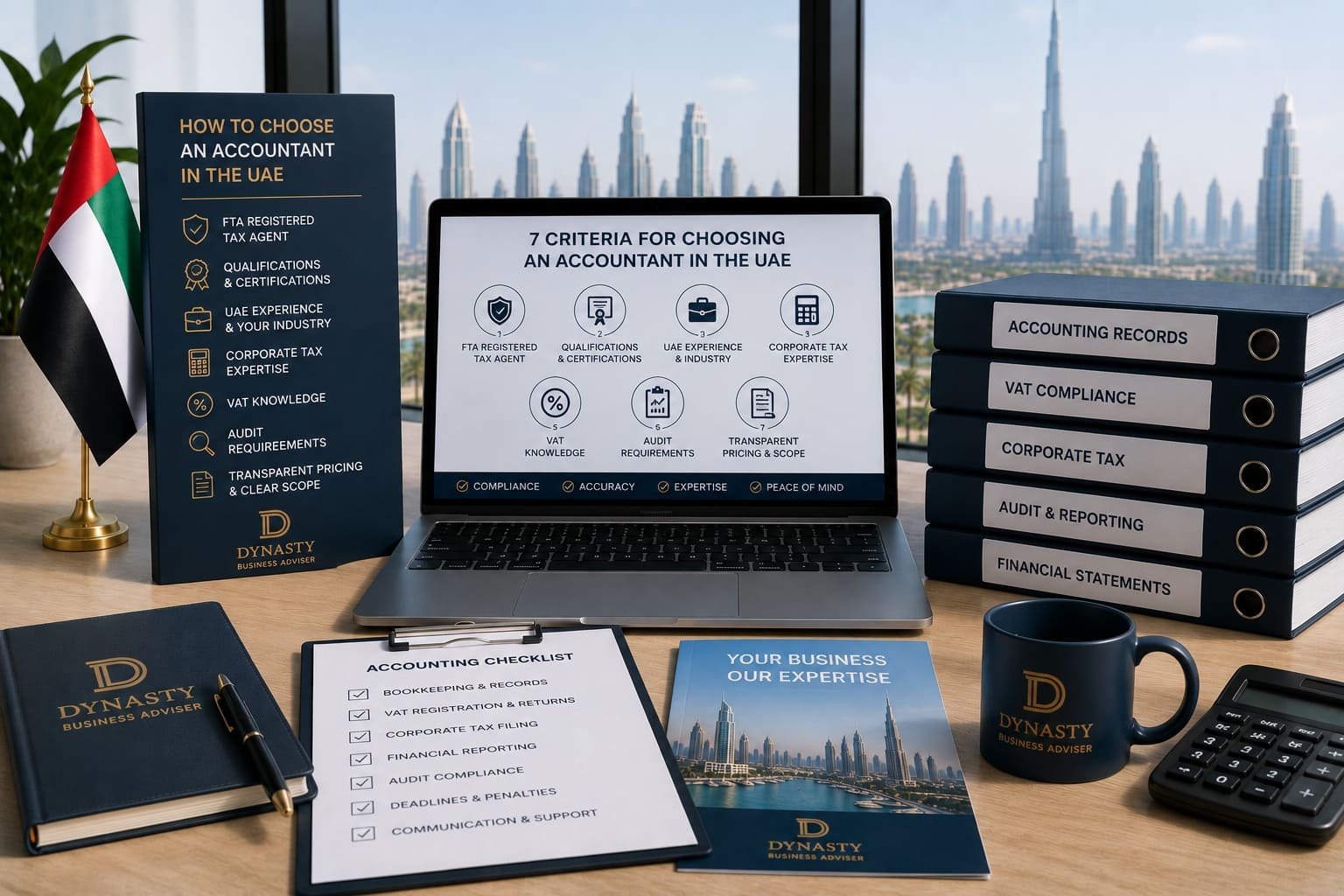
With the introduction of corporate tax and tighter enforcement by the Federal Tax Authority (FTA), an accountant in the UAE has long stopped being just someone who “adds up numbers.” Choosing the wrong provider costs a business fines, the risk of a stalled licence renewal, and a strained relationship with the bank. Meanwhile, the accounting services market in the Emirates is highly uneven — ranging from Big Four firms to unlicensed private freelancers.
This article covers 7 concrete criteria for evaluating an accountant or accounting firm in the UAE, along with a breakdown of common warning signs, pricing benchmarks, and answers to frequently asked questions.
Why the UAE needs a professional accountant at all

Before 2023, many UAE companies kept books on a residual basis — there was no corporate income tax, and VAT only appeared in 2018. That has changed: since 1 June 2023, the country has had a federal corporate tax of 9% on profit above AED 375,000, and 5% VAT requires regular, accurate filings. On top of that come audit requirements for licence renewal in a number of free zones, and increasingly active FTA enforcement of deadlines.
In this environment, an accountant isn’t a back-office function — they’re part of a business’s tax and regulatory risk management system. That’s why choosing a provider should be based on clear criteria, not just price.
Criterion 1. Registered FTA tax agent status
The official register of tax agents is maintained by the Federal Tax Authority (FTA) itself. To be listed, a specialist must hold a relevant university degree, have at least 3 years of relevant experience, and pass the FTA exam; registration is paid and renewed every 3 years.
- ask the accountant to confirm their registration and check it against the public register of tax agents on the FTA portal;
- registered agent status matters especially if the accountant will represent your company in correspondence with the FTA or during a tax audit;
- lacking this status doesn’t always mean low competence, but it does mean any dealings with the FTA on the company’s behalf will still have to go through someone else.
Criterion 2. Relevant qualifications and certifications
International certifications don’t guarantee quality on their own, but they noticeably reduce the risk of basic reporting errors:
- ACCA (Association of Chartered Certified Accountants) — one of the most common standards among accountants working with international business in the UAE;
- CPA (Certified Public Accountant) — a US standard, relevant for companies with American owners or US GAAP reporting;
- CMA (Certified Management Accountant) — a focus on management accounting, useful if you need analytics for decision-making beyond tax filings;
- knowledge of IFRS (International Financial Reporting Standards) is essential — UAE companies’ financial statements must be built on this basis.
Credentials without UAE practice aren’t a reliable indicator on their own. Local specifics (FTA requirements, the quirks of particular free zones) are learned only through real cases, so certification should be weighed together with the next criterion.
Criterion 3. Experience specifically in your jurisdiction and industry
The UAE isn’t a single tax and regulatory environment: mainland companies, free zones, and offshore entities are regulated differently, and the reporting and audit requirements of individual free zones (DMCC, JAFZA, DIFC, and others) vary significantly.
- check whether the accountant has handled bookkeeping specifically for companies in your jurisdiction — mainland or a particular free zone;
- ask about experience specifically in your industry — accounting for trading, e-commerce, consulting, and real estate is all structured differently;
- if you’re planning for Qualifying Free Zone Person (QFZP) status with 0% tax on “qualifying income,” separately check whether the accountant has worked with this regime — it’s not an automatic benefit but a set of conditions that need ongoing monitoring.
Criterion 4. Current knowledge of corporate tax
Federal corporate tax has applied since 1 June 2023: the 9% rate applies to profit above AED 375,000, while profit below the threshold is taxed at 0%. A fixed penalty of AED 10,000 applies for late corporate tax registration.
- ask the accountant how they track registration and filing deadlines for corporate tax for your company category;
- check whether they understand the conditions of Qualifying Free Zone Person status, if applicable to your company;
- a useful reverse red flag: if an accountant still offers to prepare and file Economic Substance Regulations (ESR) reports — this regime has been abolished for financial periods starting on or after 1 January 2023 and no longer needs to be maintained. This is a fairly common piece of outdated advice that signals stale expertise.
Criterion 5. VAT competence
The standard VAT rate in the UAE is 5%. Mandatory registration is required above AED 375,000 in annual taxable turnover, with voluntary registration available from AED 187,500. Filing frequency is usually quarterly, but the FTA can assign monthly filing to larger taxpayers.
- ask how often the accountant has dealt with corrections and amended VAT returns — an indirect measure of practical experience;
- ask about experience with zero-rated VAT on exports and the specifics of import VAT calculation — a common source of errors;
- check how they track filing deadlines — a late VAT payment or filing leads to penalties that accumulate quickly with repeat violations.
Criterion 6. Understanding of audit requirements
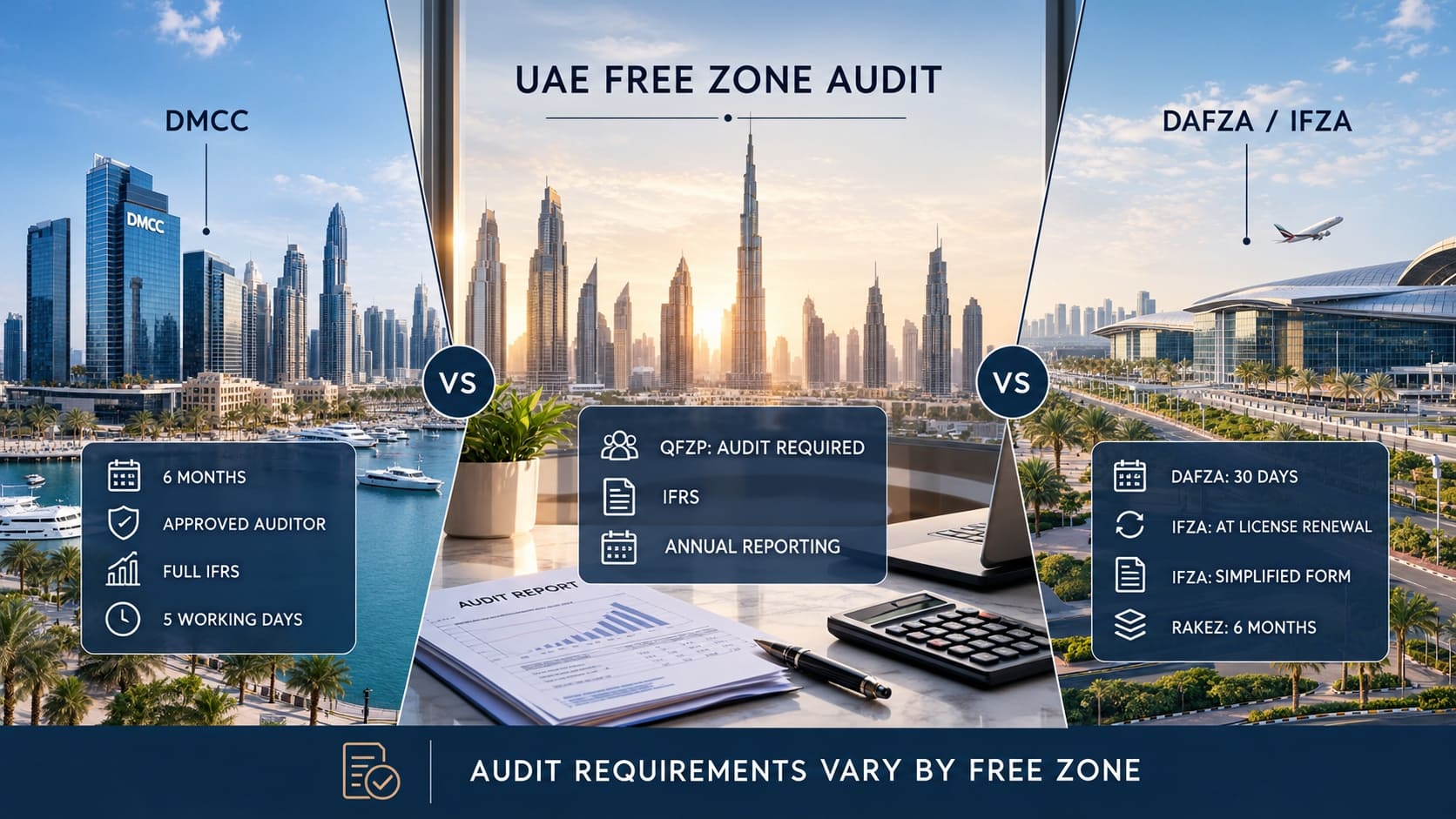
An annual statutory audit is mandatory for all mainland companies (LLCs) under the UAE Commercial Companies Law, and for most major free zones — for example, DMCC and JAFZA require audited financial statements to be submitted within roughly 90 days of the financial year-end for licence renewal. Several other free zones (DIFC, DAFZA, Meydan, and others) have similar requirements.
- check whether your specific free zone or company type requires an audit, and whether the accountant prepares reports with enough lead time before the auditor’s deadline;
- ask whether the accountant works alongside specific audit firms or prepares reports “in a vacuum,” without reference to actual audit requirements;
- banks servicing corporate accounts also frequently request audited financials — the absence of an audit can create problems not only with licence renewal but with the bank as well.
Criterion 7. Transparent pricing and a clear service scope
Pricing for accounting services in the UAE varies widely, and a low price often means a reduced scope — for example, without audit support or tax consultations.
Approximate accounting support cost by company size
| Company size / transaction volume | Cost, AED per month |
|---|---|
| Small company, up to ~30 transactions per month | from 1,100–2,000 |
| Mid-sized company with regular turnover | from 2,000–4,000 |
| Company with audit-preparation support | from 4,000 and up |
| Large business / comprehensive support (Big Four, large local firms) | individually quoted |
Warning signs: when it’s time to switch accountants
- the accountant can’t confirm registered FTA tax agent status despite representing you before the tax authority;
- they regularly miss or blow VAT or corporate tax filing deadlines;
- they keep preparing reports under the abolished ESR regime instead of current corporate tax requirements;
- they can’t clearly explain whether Qualifying Free Zone Person status applies to your company and what conditions must be met to keep the 0% rate;
- they don’t stay in touch with an auditor and only learn of your free zone’s audit requirements at the last moment before licence renewal;
- pricing is opaque or keeps “growing” after the engagement starts due to hidden add-ons..
“Over the past two years, accounting requirements in the UAE have grown by an order of magnitude — corporate tax, active FTA enforcement, free-zone audit requirements. Meanwhile, part of the market keeps operating on old templates, to the point where clients are still being handed reports under the abolished ESR regime. Choosing an accountant today is, first and foremost, choosing someone who actually keeps up with legislative changes — not just someone who can keep a spreadsheet”.
Sergey, Lead Legal Counsel at Dynasty Business Adviser
14+ years of practice in corporate law and international tax planning across the GCC
How we can help

Dynasty Business Adviser provides turnkey accounting support for companies in the UAE:
- primary bookkeeping and preparation of financial statements under IFRS;
- registration and filing of VAT and corporate tax returns, tracking FTA deadlines;
- checking eligibility for Qualifying Free Zone Person status and supporting ongoing compliance with its conditions;
- preparing reports for mandatory audit in line with your specific free zone’s or mainland requirements;
- tax planning and business structuring consultations in the UAE.
What to do next
Request a consultation — we’ll help assess whether your company’s current accounting support in the UAE meets current FTA requirements, or take over your bookkeeping from scratch. We work with mainland and free zone companies of any size.
Our clients regularly turn to Dynasty Business Adviser for exactly the service described in this article — accounting and tax support for companies in the UAE — and receive it from specialists who themselves meet the 7 criteria listed above:
- more than 11 years of practical experience supporting businesses in the UAE;
- License №829095, issued by Dubai Economic Department;
- License №1222411 (GRAND DYNASTY CORPORATE SERVICES PROVIDER L.L.C.), issued by Dubai Economic Department;
- Certificate No. 80055936 (DYNASTY BUSINESS ADVISER LIMITED), issued by the Registrar of Companies, Hong Kong Special Administrative Region;
- a team of certified accountants and specialists familiar with current FTA requirements on corporate tax, VAT, and free zone audits.
Get advice
Information current as of July 2026, based on the official portal of the UAE Federal Tax Authority (tax.gov.ae), the UAE Ministry of Finance (mof.gov.ae), and audit requirements published by the DMCC and JAFZA free zone authorities. Rates, thresholds, and legislative requirements may be revised — confirm current conditions with a specialist at the time of enquiry.
This material is for informational purposes only and does not constitute legal or tax advice.