

A fund manager called on a Thursday: signing was two weeks out, the seller was insisting the buyer be a standalone company, and money from four co-investors was already earmarked. The question wasn’t “which jurisdiction” — it was “can we make it.” We made it, not through any magic button, but because preparation ran in parallel with the SPA negotiation, not after it.
A deal SPV is its own kind of work. You don’t need a structure built to last twenty years — you need a working company by closing date that the seller, the bank and the co-investors will all accept. And you need confidence that six months from now the regulator won’t call it a fund.
Below: what actually fills a one-week timeline, where the line sits between an investment syndicate and a collective investment fund, what the exempt regime gives licensed managers, and how serial structures work across multiple deals.

Deal SPVs and Holding SPVs Are Not the Same Thing
A holding SPV gets built at a relaxed pace, for long-term ownership — the priorities are ownership configuration, tax structure and succession. A deal SPV gets assembled against a deadline, and the priorities shift: speed, acceptability to the other side, and a clean line of liability.
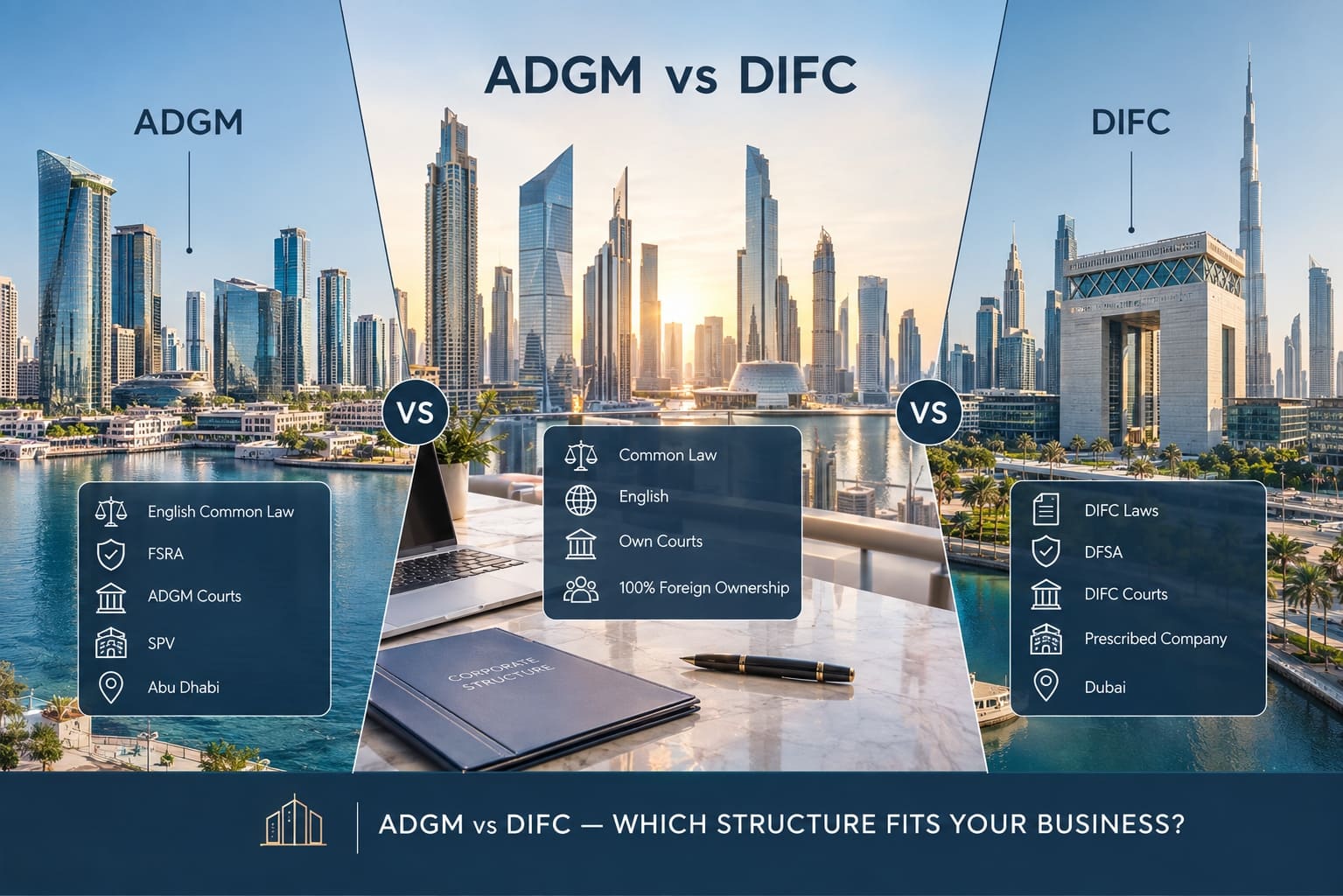
By ADGM’s, own definition, an SPV is a passive holding company set up to ring-fence financial and legal risk by separating specific assets and liabilities from the rest of a group. That’s exactly what a deal needs: the buyer isn’t dragging in the history of other assets, and the seller sees a clean counterparty with no baggage.
The vehicle itself is a private company limited by shares, holding an SPV licence. The legal framework is the ADGM Companies Regulations 2020, built on English common law — which removes half the friction for foreign co-investors and their lawyers, since the documents look the way they’re used to seeing them.
Seven Days: What That Actually Means
Honesty matters here, or the promise turns into a dispute.
Seven days is our timeline for preparation and filing: reviewing the deal, choosing the structure, collecting documents from every participant, drafting the articles, resolutions and business plan, and submitting the application through the portal. That’s the part we control, and it’s the part we commit to.
After that, the application goes to the ADGM Registration Authority, and that timeline isn’t ours to give. ADGM’s own FAQ states two figures: approval within 10 business days once all requirements are met, and an average processing time of five working days for a complete application. ADGM does not offer a paid expedited service — there’s no official priority track in its public materials. Any promise of “an SPV in two days” is promising something the seller can’t actually deliver.
Table 1 — What the Weekly Timeline Looks Like
| Day | What happens |
|---|---|
| 1 | Deal review, ownership structure, screening for fund characteristics |
| 2–3 | Collecting documents on shareholders, directors, signatories and beneficial owners |
| 3–4 | Articles of association, resolutions, business plan on the ADGM template |
| 5 | Name reservation |
| 6–7 | Final review and filing |
The timeline holds on one condition: documents from every participant arrive in the first two days. That’s where projects actually stall — not on ADGM’s side, but on the co-investor’s side, when someone is travelling and unreachable. That’s why we hand over the document list on day one, before we start preparing anything.
Build in extra time if any participant is a foreign legal entity: their documents need certifying and translating, and that’s an external timeline we don’t control.
The Core Risk for a Syndicate: When an SPV Becomes a Fund
This is the part almost everyone skips, and getting it wrong is a regulatory problem.
When several investors pool money into one structure, the question becomes whether it falls under the definition of a Collective Investment Fund, which requires a licence and registration. ADGM’s regulations define one through several conditions that must all be met together: the arrangement lets participants earn profit or income from the acquisition, holding, management or disposal of property; participants don’t have day-to-day control over management, even if they can be consulted or give directions; contributions and returns are pooled together; and the property is managed as a whole by a fund manager or someone on their behalf. That last element gets overlooked most often, and it’s the decisive one: without a manager figure exercising discretion over pooled property, the arrangement doesn’t meet the definition.
The key exclusion is written almost as if for deal SPVs: an arrangement isn’t a fund if it’s a closed-ended body corporate or partnership — unless, on reasonable grounds, the purpose or effect of that structure looks like discretionary investment management carried out for the collective benefit of its shareholders or partners.
In practice, that reads as follows. A closed-ended company built around a specific, known asset, where investors are buying into a deal they already know, is not a fund. The moment a manager gains discretion to decide what to buy and sell on the group’s behalf, the structure starts to look like a fund, with everything that follows from it.
Table 2 — Where the Line Sits
| Structural feature | Leans “not a fund” | Leans “fund” |
|---|---|---|
| Asset | Known to investors upfront | Selected later by the manager |
| Structure type | Closed-ended, single deal | Open-ended, accepts new money |
| Asset decisions | Agreed with participants | Manager discretion |
| Horizon | Until exit from the known asset | Open-ended portfolio |
There are other exclusions, but each has a narrow condition and needs to be read literally. The group exclusion only works if every participant is a corporate entity within the same group as whoever performs the management function — a natural-person co-investor breaks it. The family exclusion requires every single participant to be a close relative, and the term is defined narrowly: spouses, children and stepchildren, parents and step-parents, siblings including half-siblings, the spouses of any of the above, plus grandchildren for the purposes of this rule. Cousins and nieces or nephews are not included. The commercial exclusion is stricter than it looks: every participant must be running their own business unrelated to regulated activity, and doing so specifically because of their stake in the structure — a passive co-investor doesn’t qualify. And separately excluded are arrangements set up to invest through a Private Financing Platform: that regulated venue’s own regime expressly allows for the use of an intermediate investment vehicle.
We screen every deal against these criteria at the first review call. If a structure looks like it’s heading toward fund territory, we say so immediately and talk through the options: adjusting the configuration, routing through a regulated platform, or building a proper fund rather than dressing one up as an SPV.
Tell us about the deal — one call, and we’ll tell you whether the structure qualifies as an SPV and whether it fits your closing date.
The UAE Nexus Requirement: A Point of Debate

The ADGM Registration Authority requires evidence of a connection between the future SPV and ADGM, the UAE or the wider Gulf region — commonly called the nexus requirement. For a fund holding an asset in Europe, this is a real filter: appointing a UAE-based provider on its own does not count as a connection.
In the autumn of 2026, word spread through the market — via consultants — that the requirement had been dropped. We checked the primary sources directly: there is no official confirmation that it has been abolished. ADGM’s own SPV guidance, which addresses the nexus requirement in its own dedicated section, is still published on the registrar’s site, and both current filing checklists on that same page still require applicants to demonstrate a connection to the UAE in line with the Registration Authority’s policy. No announcement or circular confirming a repeal has been published. What changed was the wording of a descriptive page on the website — the underlying regulatory and procedural documents have not changed.
The practical takeaway: we confirm the requirement with the registrar for each specific application, and we prepare every filing as though demonstrating the connection is still required. If a repeal is confirmed later, you skip a step. If it isn’t, the justification is already assembled, and the timeline doesn’t slip because of a query on day seven.
Exempt Regime for Licensed Managers
There’s a concession available to licensed players that even their own administrators often don’t know about.
Under ADGM’s regulations, a company carrying on SPV activity is required to appoint a corporate service provider. But an exclusion lifts that requirement if the company is a parent or subsidiary of certain listed persons — and the list expressly names an authorised person within the meaning of the Financial Services and Markets Regulations 2015.
In practice, that means subsidiary SPVs under an FSRA-licensed manager can operate without an external provider. That changes the economics of running multiple structures, and it speeds things up — fewer external links in the filing chain.
The same list of exclusions includes other grounds too: persons exempted by a specific order, structures regulated by the Central Bank of the UAE, companies with securities listed on a regulated market in the UAE, and companies that have demonstrated sufficient presence in the UAE to the registrar’s satisfaction. The registrar assesses the last of these based on assets, turnover and staff in the country, together with the quality of management and procedures.
Status needs confirming before filing: it determines both the document set and who’s involved in the process.
Running Multiple Deals: When One Company Isn’t Enough

If deals come in a steady stream, registering a fresh standalone SPV every time isn’t the only path. ADGM’s regulations include a dedicated section on cell companies, covering both structures: the protected cell company and the incorporated cell company.
The idea is that a single umbrella entity holds separate cells, each with assets and liabilities ring-fenced from the others. For a manager running five deals a year with a different mix of co-investors each time, that’s a faster launch for every new deal.
One limitation is worth knowing: a restricted scope company cannot be a cell company and cannot become one. And separately, in a fund context, setting up a protected cell company or an incorporated cell company requires regulator consent — so a structure meant for collective investment needs to be discussed with the FSRA rather than assembled on your own initiative.
Table 3 — Matching the Structure to the Task
| Situation | Solution |
|---|---|
| One deal, known asset | Standard deal SPV |
| A steady stream of deals with different co-investors | Cell company with individual cells |
| Structure under a licensed manager | SPV under the exempt regime |
| Raising investors through a platform | SPV paired with a Private Financing Platform |
The choice isn’t made on elegance — it depends on who the other side is and what they’ll accept. Sellers and their lawyers sometimes have their own view on the kind of buyer they’re prepared to deal with, worth learning before registration, not after.

What’s Included in the Work
We run the project from deal review through to a working company with a bank account.
On day one, you get a personalised document list for every participant: passports and proof-of-address for individuals, up-to-date corporate documents for legal entities, and an ownership chart down to the ultimate beneficial owner. The list is personalised because what’s needed depends on the configuration.
The work covers: reviewing the configuration and screening for fund characteristics; choosing the form — standard SPV, exempt regime or cell; drafting the articles, resolutions and business plan;
collecting and verifying documents from every participant, including foreign legal entities; reserving the name and filing; support through to licensing; appointing a corporate service provider and registered address where one is required; setting up the statutory registers, including the register of beneficial owners; and support with opening a bank account and registering for corporate tax.
We don’t publish pricing, deliberately. It depends on the number of participants, whether there are corporate shareholders, whether translations and certifications are needed, the structure chosen, and whether a provider is required. We quote a fee after the first review call, together with a realistic date.
What an SPV Cannot Do
ADGM’s restriction is stated plainly: an SPV cannot be used for operating a business or employing staff. It is an asset holder, not a company you can trade through, invoice clients from, or use to employ people and sponsor visas.
For deal structures, this matters at the design stage. If the deal requires the same company to provide services, earn a management fee, or employ people, an SPV won’t work — you need a different vehicle, or two structures instead of one, with the operating side kept separate.
How to Start
A deal SPV comes down to two things: making the closing date, and not creating a regulatory problem along the way. The first is a matter of timeline and document discipline. The second is a matter of screening for fund characteristics before co-investors wire any money.
Send us the deal parameters: what you’re buying, how many participants, who makes the decisions on the asset, and when closing is. On one call, we’ll tell you whether the structure qualifies as an SPV, which regime fits, and whether we can hit your date.
Get a consultation
Disclaimer. This material is for informational purposes only and does not replace legal or tax advice. References to ADGM regulations reflect the official versions current as of the publication date; rules and subsidiary legislation are updated regularly. Confirm the classification of your structure and any regulatory consequences for your specific deal before investor funds are committed.
Data current as of September 2026.