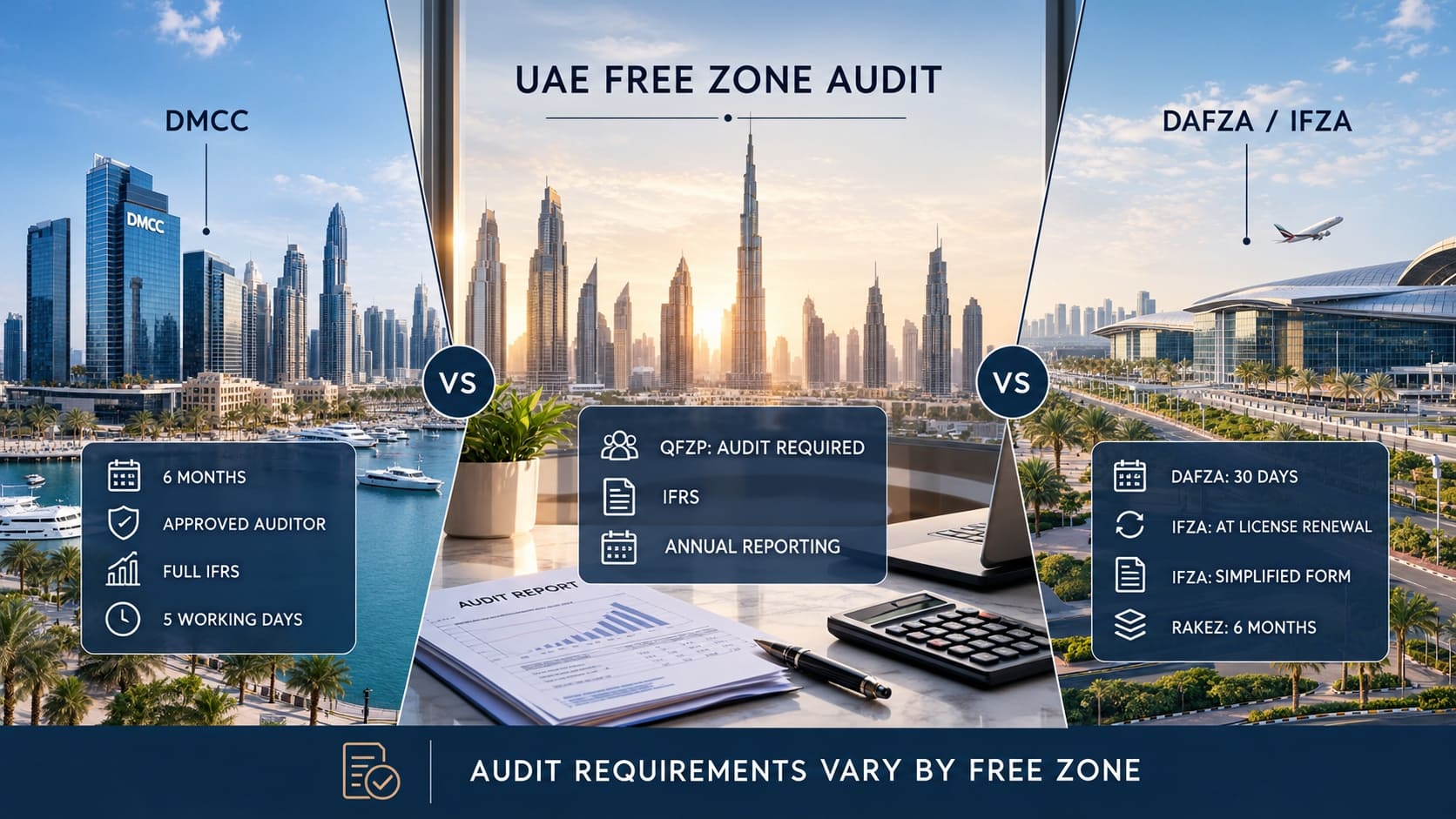

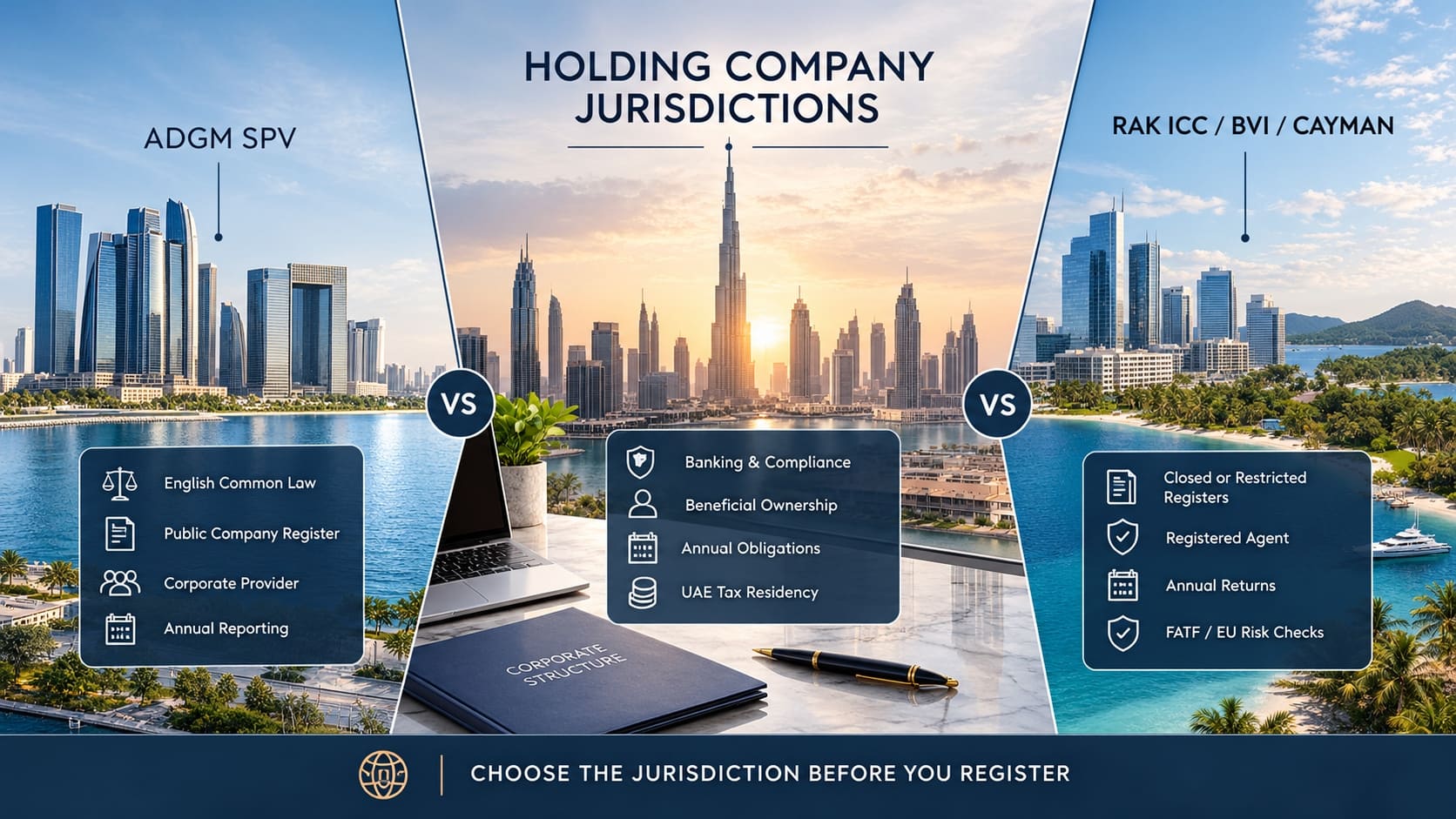
First-time founders of a holding structure almost always start with price. A few months later it turns out a different question decided everything: will a bank open an account for the entity, and how will a counterparty react to its country of registration. The gap in government fees is a thousand dollars or two. A refusal to open an account costs months, and sometimes the whole deal. So let us compare ADGM SPV vs BVI, Cayman and RAK ICC the way a compliance officer looks at them, not the way a brochure does.
What a Bank Checks First: Two Lists

The first source is the FATF lists. In the edition of 19 June 2026, the call for action covers North Korea, Iran and Myanmar. The grey list — jurisdictions under increased monitoring — includes Virgin Islands (UK), the British Virgin Islands. Under its action plan, the territory must strengthen supervision of corporate service providers, investment business and virtual asset service providers, and ensure that accurate beneficial ownership information is available. Neither the UAE nor the Cayman Islands appears on either FATF list.
The second source is the EU lists. As at 17 February 2026, Annex I, the list of non-cooperative jurisdictions, holds ten entries, among them Panama and the US Virgin Islands. Annex II — jurisdictions under monitoring — holds nine, including the British Virgin Islands. The UAE and Cayman are in neither annex.
Table 1 — Where each jurisdiction stands on the international lists
| Jurisdiction | FATF grey list (19.06.2026) | EU annexes (17.02.2026) |
|---|---|---|
| UAE (ADGM, RAK ICC) | No | No |
| Cayman Islands | No | No |
| British Virgin Islands | Yes | Annex II |
ADGM: English Law and an Open Register
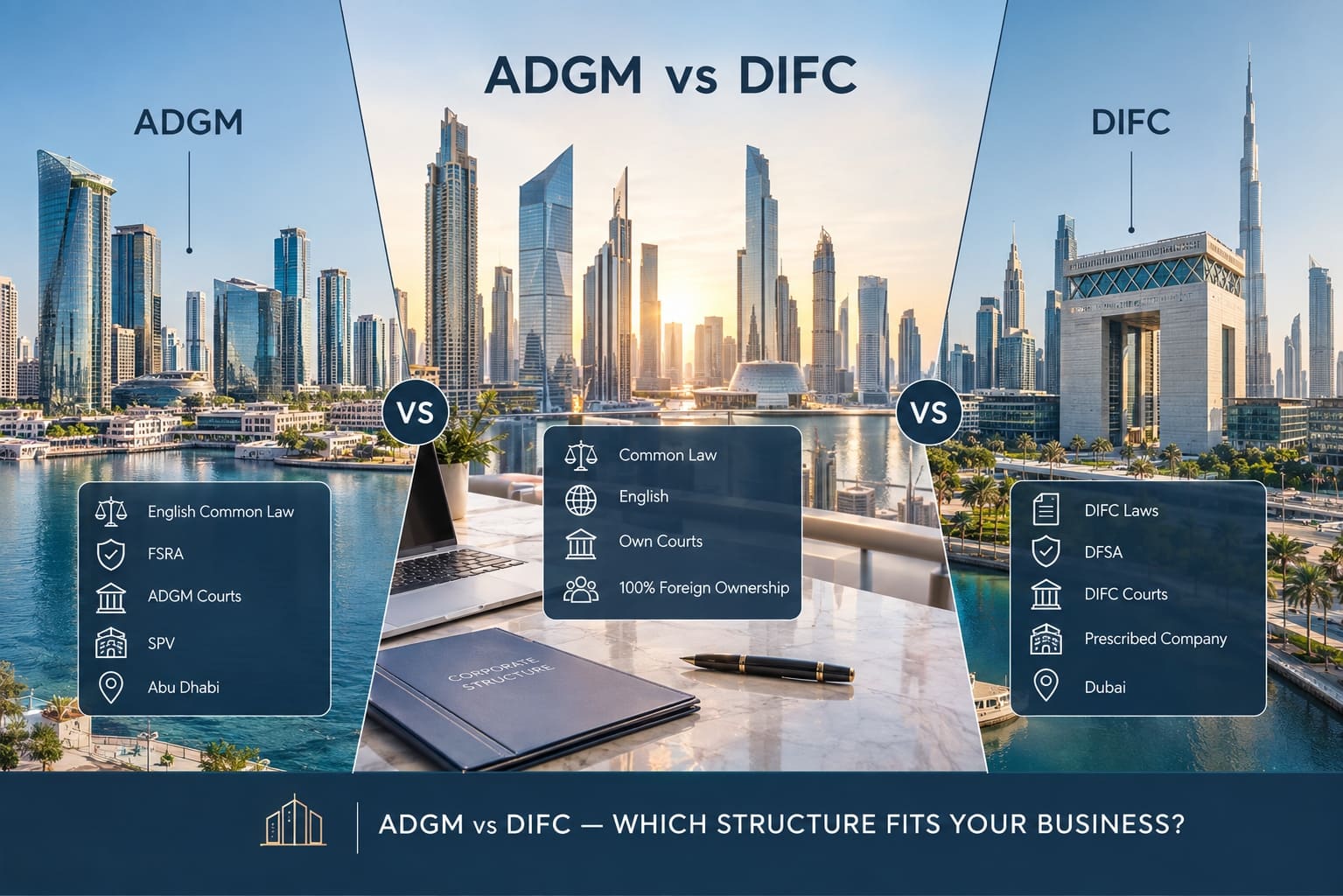
Abu Dhabi Global Market is a financial centre in Abu Dhabi with its own legal system. The Application of English Law Regulations 2015 make English common law, including the rules and principles of equity, directly applicable in ADGM; English statutes apply in the form they had on the date the regulations were adopted. Disputes go to ADGM’s own courts.
An SPV in ADGM is a passive holding company. The Registrar puts it plainly: an SPV cannot be used for operational activity and cannot hire staff. Government fees on incorporation start from $1,900 and cover name reservation, registration, the commercial licence and the data protection fee. Annually: accounts within nine months of the end of the reporting period, free of charge and without public disclosure; a confirmation statement within one month of the registration anniversary, $100; licence renewal together with data protection, $1,400. A registered address inside ADGM is mandatory and is paid for separately, as are the provider’s own services.
A corporate service provider is required at all times for a non-exempt SPV, and since 12 July 2021 it is the provider that files applications. Certain categories of applicant can use a Restricted Scope Company with limited disclosure, but from 26 June 2026 its directors’ details are disclosed on the same footing as everyone else’s.
The key difference from a classic offshore company is the public register. Search is open without registration and shows a company’s status, its type, the validity of its licence, the appointed provider, its directors and its shareholders. The annual accounts themselves and beneficial ownership data are not published.
Tell us which assets you are packaging and who will sit in the cap table — we will map the jurisdictions against your actual task before you pay a single government fee.
RAK ICC: A UAE Company With a Closed Register

RAK ICC is the international corporate centre of Ras Al Khaimah, operating under the RAK ICC Business Companies Regulations 2018. Formally this is a UAE company — the country of registration on the documents is the same one that appears for ADGM — but the machinery is closer to that of an international business company.
A registered agent is required at all times: under regulation 265, only the agent or a liquidator may file documents with the Registrar. The registers are closed. Regulation 266 allows inspection by the company itself and by anyone the Registrar regards as its director, member or agent. There is no public search of companies, directors or shareholders: RAK ICC publishes a directory of agents, a document verification service and a notifications portal.
The annual obligation is an annual return within 30 days of the registration anniversary, filed together with payment of the annual fee. It is a confirmation of particulars, not a set of financial statements. Regulation 103 requires the company to keep records and underlying documents sufficient to explain its transactions and determine its financial position, and to retain them for five years from the date the transaction was completed.
The regulations themselves contain no concept of a beneficial owner — that regime is federal. RAK ICC publishes Cabinet Decision No. 109 of 2023 on beneficial owner procedures and No. 132 of 2023 on penalties. Any change in the data must be reported within 15 days.
Redomiciliation works in both directions: regulations 186–189 describe the entry of a foreign company with its legal personality and all its assets and liabilities preserved, and regulation 190 covers the exit.
BVI: Annual Return, Beneficial Ownership Register and the Grey List
Since 1 January 2023, section 98A of the BVI Business Companies Act has been in force: a company must file an annual return — a financial return — with its registered agent within nine months of the end of its financial year. Exempt from this are listed companies, companies regulated by the supervisor and already reporting to it, those filing a tax return with financial statements to the Inland Revenue Department, and companies in liquidation that began before the filing deadline fell due. The old penalty scale of $300 and $200 with a $5,000 ceiling was scrapped on 2 January 2025: failure to file now carries a fine of up to $50,000, and the agent must notify the Registrar.
Section 96A has applied since 2 January 2025: a company must keep beneficial ownership information current and file it with the Registrar within 30 days of incorporation or continuation. The Registrar maintains the Register of Beneficial Ownership; the statute treats a person holding 10% or more as a beneficial owner.
There is no free public access to that register. Authorities receive the data with no threshold, and from 1 July 2025 a “legitimate interest” route was added: a written application to the Registrar for anyone who can justify their purpose by reference to countering money laundering or to their status as an obliged entity carrying out customer due diligence. For everyone other than the authorities, disclosure is limited to holdings of 25% or more.
The register of members has been filed with the Registrar since 2025 but is not published unless the company opts into open access. The list of directors’ names, by contrast, is released by the Registrar to any person on request. An agent is mandatory, only a licence holder may act as one, and acting without a licence carries a fine of up to $75,000. The net result: the compliance load has grown, yet as at June 2026 the jurisdiction has not come off the FATF grey list.
Cayman Islands: Transparency Built Out, No Direct Taxes

The Beneficial Ownership Transparency Act came into force on 31 July 2024. It requires beneficial ownership registers to be maintained and creates a searchable platform held by the competent authority. Access is given to the police, the financial intelligence unit, the monetary authority, the anti-corruption, tax and customs services and a number of others, and on a limited basis to licensed financial institutions and certain non-financial professions.
Here too there is no general public access. Since 28 February 2025, legitimate interest access regulations have applied: an application may be made by a journalist, a bona fide academic researcher, a civil society organisation that counters money laundering, or a counterparty to a transaction. The Cabinet may open a basic data set to the public with the approval of Parliament; no such regulations exist yet.
There are no direct taxes on the islands. The government states expressly that there is no income tax, no company or corporation tax, no inheritance tax, no capital gains tax and no gift tax.
In January of each year after the year of registration, an exempted company files a declaration: that there have been no changes to its constitutional document, stating the nature of its business, and confirming that operations were carried on mainly outside the islands. The annual fee is paid with it — from CI$925 (about US$1,130) where capital is up to 42,000, rising to CI$2,793 where capital exceeds 1,640,000. The late-payment penalty climbs from 33.33% of the fee in the second quarter to 66.67% and then to 100% in the fourth.
The register of members of an exempted company that holds no licence to carry on business on the islands is not open to inspection. The list of directors’ names is shown by the Registrar to anyone for CI$50, and the registered office address matches that of the licensed service provider.
Table 2 — Transparency and disclosure
| Jurisdiction | Beneficial ownership data | Company register |
|---|---|---|
| ADGM | To the regulator | Public |
| RAK ICC | Through the agent, federal regime | Closed |
| BVI | Authorities; legitimate interest from 25% | Directors on request |
| Cayman Islands | Authorities; legitimate interest | Directors for CI$50 |
Economic Substance: Who Files Every Year
The BVI applies the Economic Substance (Companies and Limited Partnerships) Act 2018, in force since 1 January 2019: an entity carrying on a relevant activity must meet the substance requirements for each of them, and holding business is one of the nine relevant activities. Cayman applies the International Tax Co-operation (Economic Substance) Act, where holding business is likewise on the list, but a pure equity holding company faces a reduced test — confirm compliance with filing requirements and the presence of adequate human resources and premises on the islands. The notification is filed annually and the report no later than twelve months after the end of the financial year.
In the UAE the regime has been wound down: under Cabinet Decision No. 98 of 2024, the requirements ceased to apply to financial years ending after 31 December 2022. For earlier periods, notifications, reports and passing the test are still required.
Tax Residency and Treaty Access
A company incorporated in the UAE is a tax resident under Article 3 of Cabinet Decision No. 85 of 2022, and the Federal Tax Authority confirms that the rule applies to free zone persons as well. Such a company may obtain a tax residency certificate valid for no more than 12 months. An application for the current period may be filed no earlier than three months after that period begins, while a newly formed company that has not yet filed a corporate tax return may apply after 12 months of existence.
The certificate opens the door to double tax treaties: the Ministry of Finance reports that the UAE has concluded 137 such agreements, and 193 counting investment protection agreements.
Add two provisions of the corporate tax law. Article 22 takes dividends received from a UAE resident juridical person out of the tax base, along with the related expenses, with no conditions on the size or duration of the holding. Article 23 gives a participation exemption: a holding of 5% or more of the capital, subject to conditions on the holding period, the level of taxation of the subsidiary, the composition of its assets, and an entitlement to at least 5% of distributable profits and liquidation proceeds.
Table 3 — Annual obligations and government payments
| Jurisdiction | Filed every year | Government payments |
|---|---|---|
| ADGM SPV | Accounts and confirmation statement | from $1,500 per year |
| RAK ICC | Annual return within 30 days | Annual fee through the agent |
| BVI | Annual return to the agent within 9 months | Fine up to $50,000 for late filing |
| Cayman Islands | January declaration | from CI$925 per year |
What to Choose When It Is Your First Structure
ADGM works when banking, bringing an investor in and a predictable body of law matter most. The price is the ban on operational activity and hiring, a mandatory provider and real discipline around filings. RAK ICC makes sense when you need a UAE company to hold assets with minimal publicity.
The BVI remains a working tool wherever the jurisdiction is familiar to the parties to a deal, but for a first structure the FATF grey list and EU Annex II are a serious argument against it. The Cayman Islands are clean on the lists and the disclosure regime is properly built out: a strong platform for funds, though for a family holding company banking in the UAE the advantages are less obvious.
Decide first where the account will be and who is going into the cap table. Only then decide where to register.
How We Select a Jurisdiction
We do not start from a register. We start from a map: which assets are being packaged, who is joining the cap table and where the account is meant to be. Then we check the jurisdictions against the FATF and EU lists as at the current date, review the disclosure and reporting requirements, and calculate the full cost of ownership rather than the incorporation fee alone.
After that comes registration and ongoing support: constitutional documents, ownership structure, working with the provider, filing with the Registrar, the bank account and tax accounting in the UAE.
Write to us if you are choosing a jurisdiction for the first time: we will go through your situation and show you how a bank will read it, before you register anything.
Get a consultation
*This material is for information only and is not legal or tax advice. The rules, lists and fee levels are given from official sources as at the date of publication and are subject to change. Take decisions on a specific structure only after checking the current versions of the documents and consulting a specialist.*