When an investor buys a company, joins a deal alongside a fund or brings partners together for a large acquisition, they rarely do it directly. A special purpose vehicle (SPV) sits between the investors and the asset: it signs the purchase agreement, takes the acquisition loan, holds the shares and later sells them on exit. An SPV for M&A in ADGM is a convenient choice: English common law, its own courts, Registrar fees from $1,900 and a status banks understand. Below we cover the structures used for M&A, co-investment and club deals, what to put in the documents, and how share pledges, tax and merger control work.
Why Use an SPV for a Deal
- Risk ring-fencing. Liabilities under the purchase agreement and the loan stay in the SPV and do not pass to the investors.
- One counterparty for the seller and the bank. The seller signs with one company, not with ten investors.
- Exit by selling the SPV’s shares. You can sell the asset itself or the shares of the SPV, and the second option is often simpler.
- Neutral jurisdiction. Investors from different countries can agree on English law and on the ADGM courts or arbitration.
- Clean reporting. Each deal has its own company, its own accounts and its own results.
Three Typical Structures
| Structure | Who takes part | Who controls | Key document |
|---|---|---|---|
| M&A (acquiring a company) | A buyer or group of buyers, a bank | The buyer | Share purchase agreement (SPA) |
| Co-investment | A fund and its co-investing investors | The fund as lead investor; co-investors have minority rights | Co-investment agreement and shareholders’ agreement |
| Club deal / joint venture | Several investors or companies on equal terms | Jointly, through the board of directors | Shareholders’ agreement |
Deals where a syndicate of passive investors backs a single sponsor are covered separately in Deal-by-deal SPVs for syndicates and club deals.
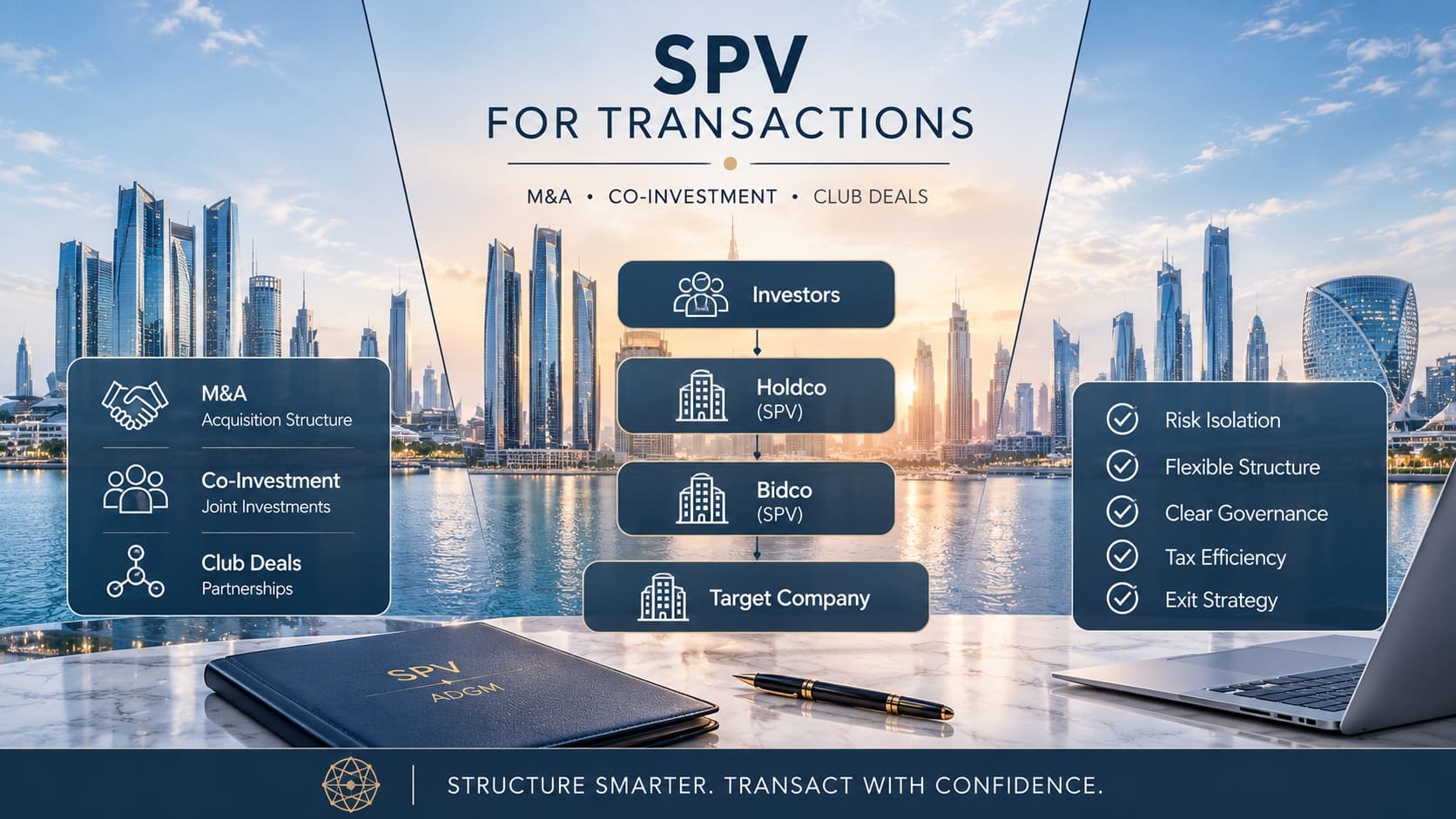
M&A Structure: Holdco and Bidco
To acquire a company, two SPVs are often used:
| Level | Role |
|---|---|
| Investors | Contribute capital to the holdco |
| Holdco (SPV) | Holds the bidco; dividends are distributed and the exit takes place through it |
| Bidco (SPV) | Signs the SPA, takes the acquisition loan and becomes the shareholder of the target |
| Target company | The operating business |
Why two levels:
- the bank takes a pledge over the bidco’s shares, while the investors have a separate level where their own arrangements apply;
- on exit, the holdco can be sold as a whole without touching the chain below it;
- mezzanine financing can be raised at holdco level without mixing it with the bank loan.
For smaller deals, a single SPV is enough.
Keep in mind that an ADGM SPV is a passive company. It does not hire staff or run an operating business (official ADGM page on SPVs). Operating activity stays in the target company.
Co-Investment Alongside a Fund
A fund often offers its investors the chance to put money directly into a large deal, on top of their share in the fund. A separate co-investment SPV is set up for this:
- the fund and the co-investors become its shareholders;
- the fund usually controls it and appoints the majority of directors;
- co-investors get minority rights: information, a veto on key matters and the right to join a sale (tag-along);
- management fees on a co-investment are usually lower than in the fund or not charged at all; this is a matter for negotiation.
The main risk is regulatory. If the fund manager makes decisions on behalf of the co-investors and their money is pooled, the SPV may fall within the definition of a collective investment fund (section 106 of the Financial Services and Markets Regulations). If the manager is already licensed by the FSRA, check whether its permission covers this activity. How to set up a fund is explained in GP/LP structure in ADGM: how to set up a fund.
Club Deals and Joint Ventures
In a club deal, several investors with comparable stakes buy an asset together and manage it jointly. In a joint venture, companies combine in the same way. The governance rules are what matter most here:
- board composition: who appoints directors and how many;
- reserved matters: decisions that need unanimity or a qualified majority, such as selling the asset, admitting new shareholders, borrowing and the budget;
- deadlock mechanism: escalation, a mediator and, as a last resort, a buy-sell clause (shotgun or Russian roulette);
- share transfer restrictions: a right of first refusal and a ban on selling to competitors for a set period;
- non-compete obligations for the parties if they operate in the same industry..
Deal Documents
| Document | What matters most |
|---|---|
| SPV articles of association | Share classes, voting rights, share transfer rules |
| Shareholders’ agreement (SHA) | Reserved matters, board, drag-along and tag-along, deadlock, exit, non-compete |
| Share purchase agreement (SPA) | Price and price mechanism, seller’s representations and warranties, indemnities, closing conditions |
| Subscription agreement | Investor contributions, deadlines, consequences of non-payment |
| Facility agreement and security agreement | Financing terms, pledge over the SPV’s shares and accounts |
| Distribution waterfall | Order of payments: return of capital, preferred return, carried interest |
Governing law and disputes: for the documents of an ADGM SPV it makes sense to choose ADGM law (based on English common law) and the ADGM courts or arbitration. The agreement with the seller may be governed by another law; this is settled in negotiations.
Financing and Share Pledges
- The acquisition loan is usually taken by the bidco. The bank receives a pledge over the bidco’s shares, its accounts and its rights under the SPA.
- Registering the charge. A charge created by an ADGM company must be registered with the Registrar within 21 days of its creation (sections 784–785 of the Companies Regulations 2020). If it is not registered, the charge is void as security and the debt becomes immediately repayable.
- Shareholder financing. Part of the investment is often contributed as a loan rather than equity. This is more flexible on exit, but loans from related parties are subject to tax restrictions (see below).
Tax
An ADGM SPV is a UAE taxpayer. The key rules for deals:
| Rule | What it means |
|---|---|
| Rate | 0% on profit up to AED 375,000, 9% above that amount |
| Dividends from UAE companies | Exempt (Article 22 of the Corporate Tax Law) |
| Participation exemption (Article 23) | Dividends and gains on the sale of shares can be exempt: a holding of at least 5% (or an acquisition cost from AED 4 million), held for at least 12 months, the target taxed at a rate of at least 9%, plus other conditions |
| General interest limitation | Net interest is deductible up to 30% of tax EBITDA; if net interest does not exceed AED 12 million, the limitation does not apply. The disallowed part is carried forward for 10 tax periods |
| Specific interest limitation | Interest on loans from related parties is not deductible if the loan was used to acquire a stake in a company that becomes related as a result, to pay dividends to related parties and for a number of other purposes. The exception is where the lender pays tax on that interest at a rate of at least 9% |
| Qualifying Free Zone Person status | A 0% rate on qualifying income is possible if the conditions are met, including audited financial statements |
Asset transfers within a group and restructurings can be carried out tax-free if the conditions for group relief and business restructuring relief are met. The tax model of the deal, including taxes in the countries of residence of the investors and the seller, is worked out before the SPA is signed.
Merger Control
If the deal affects the UAE market, check whether an economic concentration filing is required:
- Thresholds (Cabinet Resolution No. 3 of 2025): combined annual sales in the relevant UAE market above AED 300 million or a combined market share above 40% in the last financial year. The threshold can be exceeded by one party alone.
- Timing: the notification must be filed no later than 90 days before closing (Article 12 of Federal Decree-Law No. 36 of 2023). In an acquisition the buyer notifies; in a merger or joint venture all parties do.
- Review: 90 days from the date the application is deemed complete, with a possible 45-day extension. If no decision is issued, the application is deemed rejected.
- Penalties for closing without approval or failing to notify: 2–10% of annual sales of the relevant goods or services or, if these cannot be calculated, AED 500,000–5,000,000.
- The Executive Regulations to the law (Cabinet Resolution No. 59 of 2026) have been in force since 30 July 2026.
Make obtaining approval a condition precedent to closing in the SPA.
When an SPV Becomes a Fund

If an SPV pools the money of several passive investors while a single sponsor makes the decisions, it may fall within the definition of a collective investment fund. The indicators under section 106 of the Financial Services and Markets Regulations: participants share in the income from the property, have no day-to-day control over its management, and their contributions are pooled or the property is managed as a whole. In M&A and club deals where investors are actively involved, this risk is usually lower, but it should be checked in writing before any money is raised. Details in Deal-by-deal SPVs for syndicates and club deals.
Timing and Cost
| Stage | Indicative timing |
|---|---|
| ADGM SPV registration | Usually from 3–5 business days after the full package is submitted; the timing is not guaranteed by the Registrar |
| Investor KYC | In parallel with registration |
| Opening a bank account | From 2–6 weeks, depending on the bank |
| Merger control approval (if required) | From 90 days before closing |
| ADGM Registrar fee (January 2025) | Amount |
|---|---|
| SPV registration | From $1,900 |
| Renewal | From $1,400 per year |
| Restricted Scope Company status (if privacy is needed) | Around $3,100 extra |
Legal and tax work on the deal, as well as CSP services, depend on the complexity of the transaction. The cost of Dynasty Business Adviser services is calculated individually for your structure. Contact us for a personal consultation. On private status, see Restricted Scope Company: When You Need Privacy.
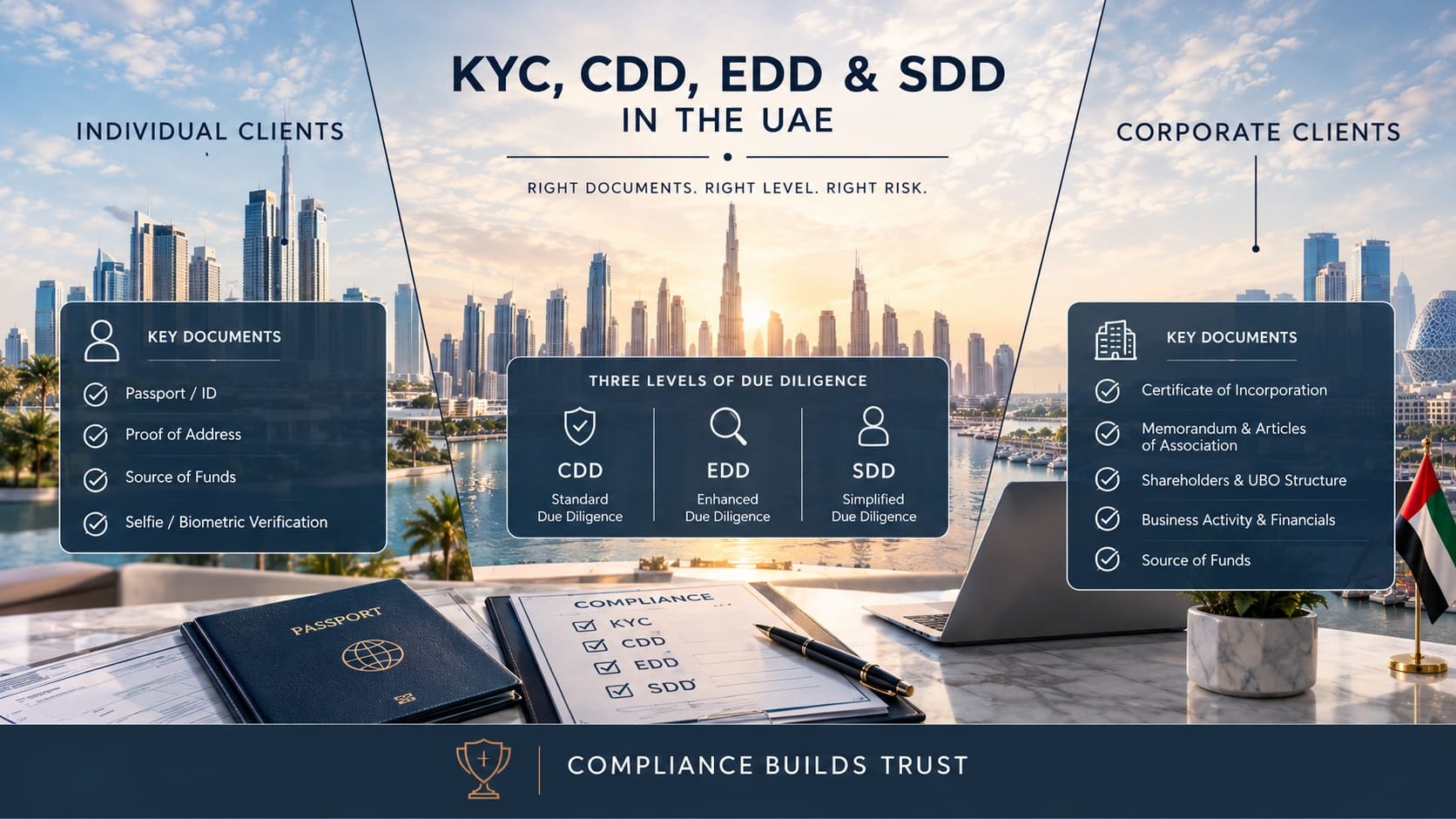
Bank. Under UAE Central Bank rules, the bank will identify every beneficial owner of the SPV with a stake or control of 25% or more (Cabinet Resolution No. 134 of 2025, Article 10) and will verify each investor’s source of funds and the purpose of the deal. Prepare the deal package (SPA, structure chart, sources of financing) in advance.
Conclusion
An ADGM SPV is a practical tool for M&A, co-investment and club deals: it ring-fences deal risk, gives the seller and the bank a single counterparty and allows an exit through a sale of shares. For a leveraged acquisition, a holdco and bidco structure is used; for co-investment, an SPV alongside the fund with minority rights for co-investors; for club deals, a shareholders’ agreement with well-designed deadlock and exit provisions. Before signing, check three things: the tax model including the interest limitations, the merger control thresholds and the risk of the SPV being treated as a fund.
The Dynasty Business Adviser team will help you choose the structure, register the SPV in ADGM, run investor KYC, open a bank account and, together with partner law firms, prepare the deal documents. More on the page.
Get a consultation
Information current as of October 2026. Sources: ADGM, Overview of Fees (January 2025); ADGM, Special Purpose Vehicles page; ADGM Companies Regulations 2020 (sections 784–785); ADGM Financial Services and Markets Regulations (section 106); Federal Decree-Law No. 47 of 2022 on Taxation of Corporations and Businesses (Articles 22, 23 and the interest limitation rules); PwC Worldwide Tax Summaries, United Arab Emirates, Deductions; Federal Decree-Law No. 36 of 2023 on Competition; Cabinet Resolution No. 3 of 2025; Cabinet Resolution No. 59 of 2026; Gibson Dunn, UAE Competition Law Executive Regulations Now in Force (August 2026); DWF, Proposed Changes to Company Charges in the ADGM (2024); Cabinet Resolution No. 134 of 2025 (Article 10). This article is not legal or tax advice.
Author: Dynasty Business Adviser team