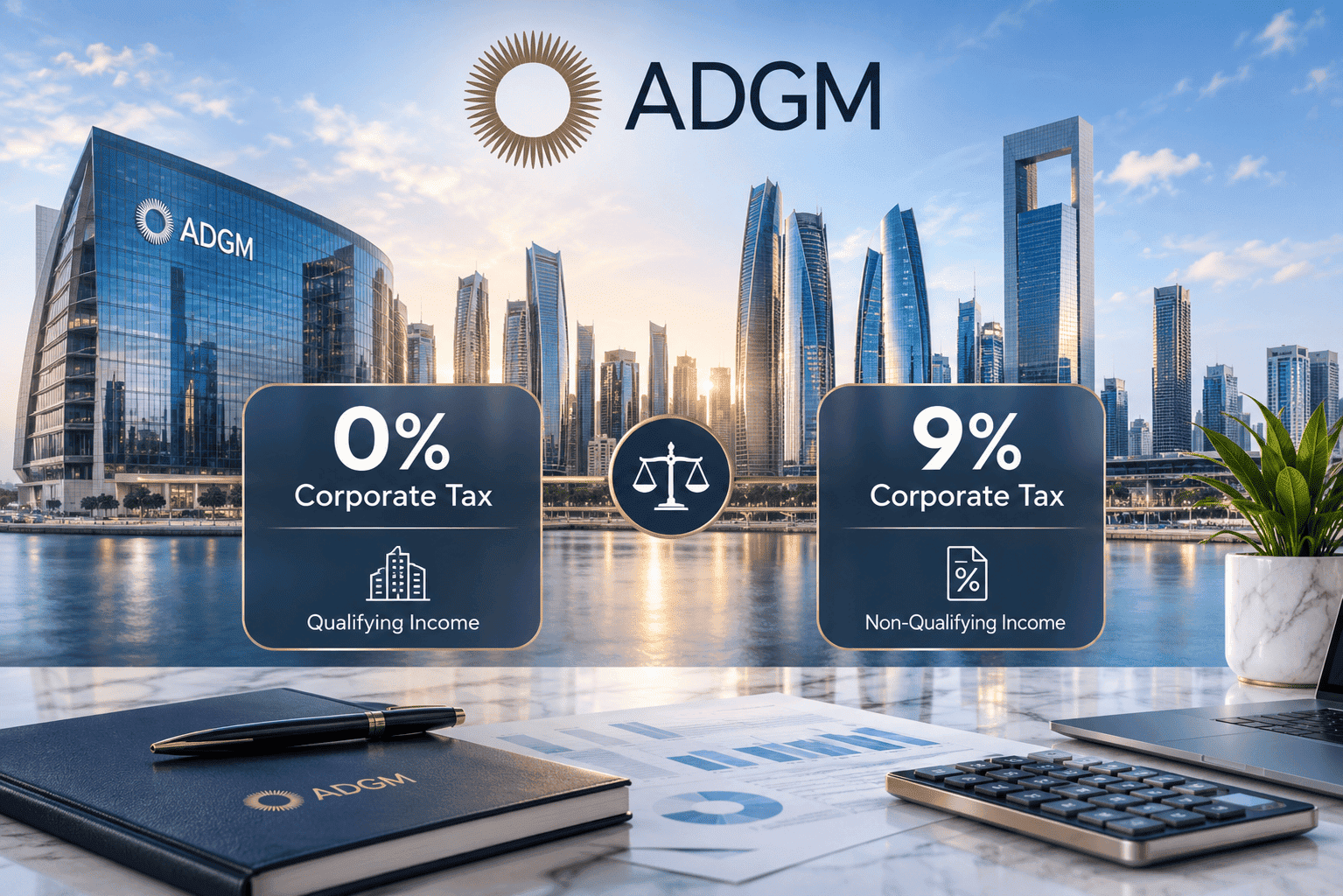
Someone always says the same thing first: “We heard ADGM is zero tax.” That line kicks off half the conversations about choosing a jurisdiction. Then it turns out the company will be selling services onto the mainland, holding an apartment in Dubai, and collecting royalties on a trademark — and none of those three income streams qualifies for zero.
ADGM tax doesn’t work as a discount tied to an address. It’s a regime tied to conditions. Zero doesn’t go to a company because it’s registered in a free zone; it goes to a company that has met the conditions in the law and keeps its income inside a defined perimeter. Everything outside that perimeter is taxed at the 9% corporate tax rate — in the very same company.
What follows is a walk through the current rules: the two rate scales, the conditions for status, what counts as Qualifying Income, what breaks it, and what a mistake costs.
Zero is a regime, not a property of an address
UAE corporate tax law sets out two separate rate scales, and confusing the two is where most wrong expectations come from.
For an ordinary company, Article 3 of the law sets a 0% rate on taxable income up to a threshold fixed by a Cabinet decision, and 9% on the excess. The law itself does not name the figure — it currently stands at AED 375,000.
For a free zone company the scale is different: 0% on Qualifying Income and 9% on taxable income that isn’t Qualifying Income. The AED 375,000 threshold does not apply here at all. What applies instead is a split between streams inside one company.
Table 1 — Two rate scales
| Parameter | Ordinary company | Free zone company with status |
|---|---|---|
| 0% rate | Up to the income threshold | On Qualifying Income |
| 9% rate | Above the threshold | On non-qualifying income |
| AED 375,000 threshold | Applies | Does not apply |
| What decides the rate | Size of profit | Source and nature of income |
Conditions for the status
The law calls the status that unlocks the 0% rate a Qualifying Free Zone Person. Article 18 lists the conditions, and they are cumulative — drop any one of them and the whole regime falls away.
The company must maintain adequate substance in the country. It must earn Qualifying Income as defined by a Cabinet decision. It must not have elected to be taxed under the ordinary rates. It must comply with transfer pricing rules and the related documentation. And it must meet any further conditions the Minister sets — an open-ended list. Tax authority guidance adds a separate requirement: audited financial statements, prepared regardless of revenue size. And one more point status doesn’t change: every Free Zone Person must register with the tax authority and file a return.
The right to opt out voluntarily deserves a word. The law lets a free zone company elect to be taxed under the ordinary scale instead; the election takes effect from the start of the current or the following tax period. Sometimes that’s the sensible move — when Qualifying Income is close to negligible, separate accounting and mandatory audit can cost more than the tax itself would.
And on the question people ask most often — the time limit. The law ties the 0% rate to the tax incentive period under the free zone’s own legislation and allows an extension by Cabinet decision. There is one ceiling: no such period can exceed fifty years.
What Qualifying Income is made of
The structure is set by Cabinet Decision No. 100 of 2023; the lists of activities by Ministerial Decision No. 265 of 2023. Tax authority guidance breaks Qualifying Income down into four sources.
- The first is transactions with other Free Zone Persons, subject to two conditions: the counterparty must be the Beneficial Recipient of the goods or services, and the transaction must not relate to an Excluded Activity. The Beneficial Recipient condition targets pass-through arrangements — the recipient has to actually be entitled to use the goods or service, not be under an obligation to hand them on to someone else.
- The second is income from Qualifying Activities that isn’t tied to an Excluded Activity.
- The third is income from owning and exploiting Qualifying Intellectual Property.
- The fourth is any other income, but only where the de minimis rule is satisfied.
Qualifying Activities

The list is set by a ministerial decision, not by the law itself — worth noting, because secondary legislation gets amended more often than the law does.
It covers manufacturing of goods or materials; processing of goods or materials; trading of qualifying commodities; holding of shares and other securities for investment purposes; ownership, management and operation of ships; reinsurance; fund management under the supervision of a competent UAE authority; wealth and investment management under the same supervision; headquarter services to related parties; treasury and financing services to related parties; financing and leasing of aircraft, including engines and rotable components; distribution of goods or materials from a Designated Zone; and logistics services.
Ancillary transactions count as Qualifying Activities too — those that are necessary for the main activity, or make only a minor contribution to it while being closely tied to it.
On distribution there’s a detail worth flagging: a «Designated Zone» is defined by reference to Cabinet Decision No. 59 of 2017 on Designated Zones for VAT purposes. That’s a separate status, and whether a given zone is on the list needs to be checked, never assumed.
Two lines on that list are why most structures come to ADGM in the first place: holding shares and securities for investment purposes, and treasury services to related parties.
What knocks income out of zero
The mirror image of that list is Excluded Activities. Income from them is never Qualifying Income, full stop.
- First on the list: transactions with natural persons. There are four exceptions — ships, fund management and wealth management under the supervision of a UAE regulator, and financing and leasing of aircraft. Anything else sold to an individual falls straight out of the 0% perimeter.
- Second is banking.
- Third is insurance, other than reinsurance and captive insurance that forms part of headquarter services.
- Fourth is finance and leasing activities, other than ships, treasury and financing services to related parties, and aircraft leasing.
- Fifth is owning or exploiting immovable property. The exception is narrow: Commercial Property located in a Free Zone, and only where the income arises from a transaction with a Free Zone Person. Residential property never falls inside the perimeter, on any terms.
Table 2 — Typical income streams and how they land
| Income stream | Usually falls under 0% |
|---|---|
| Dividends and capital gains on shareholdings | Yes, as holding of securities |
| Loan to a related group company | Yes, as treasury services |
| Services to a mainland client | No |
| Services sold to an individual | No, with four exceptions |
| Renting out an apartment in Dubai | No |
| Trademark royalties | No — a marketing asset |
Intellectual property: not everything is excluded
There’s a common shortcut here that leads people to build structures wrong.
Income from intellectual property isn’t blanket-excluded. The regulations carve out Qualifying Intellectual Property specifically: patents, copyrighted software, and rights that are functionally equivalent to a patent — utility models, plant variety protection, orphan drug designations, and patent term extensions.
Marketing assets, trademarks named explicitly among them, sit outside that definition. Royalties on a brand don’t get to zero.
And even for Qualifying Intellectual Property, zero doesn’t apply to all the income it generates: the qualifying share is calculated by reference to the company’s own development expenditure, and the company has to track that expenditure by product. No tracking, no qualifying share.
The de minimis rule: five percent or five million
The law doesn’t demand a spotless income statement. A small slice of non-qualifying revenue doesn’t bring the status down.
The condition is met as long as non-qualifying revenue for the period doesn’t exceed the lower of two figures: 5% of total revenue, or AED 5 million.
Read that literally. At AED 200 million of revenue, 5% would be AED 10 million — but the ceiling stays at AED 5 million. At AED 20 million of revenue, the ceiling is AED 1 million, not five.
Three things fall into non-qualifying revenue: income from an Excluded Activity; income from a non-qualifying activity where the counterparty isn’t a Free Zone Person; and transactions with a Free Zone Person who isn’t the Beneficial Recipient.
One more point: the threshold is measured against revenue, not profit. A loss-making line eats into the limit exactly the way a profitable one does.
Tell us what your company’s revenue will be made up of — which part lands at zero, which part at nine, and whether you’re inside the de minimis limit.
Permanent establishment: 9% without losing status
There’s a nuance here that often gets passed on wrong.
A Permanent Establishment arises on the same markers that apply to a non-resident: a fixed place of business outside the free zone, or a person who habitually exercises authority to conduct business on the company’s behalf outside the zone. The second marker is the more dangerous one — an office gets leased deliberately, while a manager signing contracts on the mainland tends to happen on its own.
But the consequence isn’t the one people usually fear. Income of a Permanent Establishment — whether a Domestic Permanent Establishment or a Foreign Permanent Establishment — is never Qualifying Income and is always taxed at 9%. At the same time, it’s excluded from the de minimis calculation altogether: not counted in non-qualifying revenue, and not counted in total revenue either. In other words, a Permanent Establishment on its own doesn’t cost the company its status; it simply creates a separate slice of income taxed at 9%.
Income from immovable property outside the narrow exception, and IP income above the qualifying share, work the same way.
The cost of a mistake: the current period, plus four more
When a condition is breached, the consequences aren’t proportionate to the breach.
A company that stops meeting a condition at any point in a tax period loses its status from the start of that period — not from the date of the breach. The whole year gets taxed retroactively.
Then duration kicks in: if the de minimis condition is breached, the company stops being a Qualifying Free Zone Person and applies the ordinary rules and rates from the start of that tax period and for each of the following four. Five years in total, over one deal that fell outside the perimeter.
Small Business Relief passes free zones by
People ask about this relief constantly, and the answer is almost always no.
The relief is set by Ministerial Decision No. 73 of 2023: companies with revenue up to AED 3 million can elect it for tax periods ending on or before 31 December 2026.
But only resident companies that aren’t part of a multinational group and aren’t a Qualifying Free Zone Person can use it. The choice is binary: either the free zone regime, or Small Business Relief. Not both.
A 15% minimum tax for large groups
For large multinational groups, the 0% free zone rate has stopped being the end of the calculation.
Cabinet Decision No. 142 of 2024 introduced a minimum top-up tax. The threshold for coverage is consolidated revenue of EUR 750 million. The regime applies to financial years starting on or after 1 January 2025. The Corporate Tax Law states directly that for such groups, the combined effective rate is brought up to 15%.
For most companies choosing a jurisdiction for the first time, this doesn’t apply. But if the structure sits inside a large group, it’s worth modelling against this figure from day one.
Table 3 — Which rate applies to whom
| Company profile | Rate |
|---|---|
| Free zone, all income Qualifying Income | 0% |
| Free zone, part of income outside the perimeter | 0% and 9% split |
| Free zone, status lost | 9% on everything |
| Ordinary UAE company | 0% up to the threshold, then 9% |
| Part of a group above EUR 750 million | Topped up to 15% |
What to decide before registration
- First: what the revenue will actually be made up of. List each income stream and tag the counterparty for it — a Free Zone Person, a mainland company, a foreign entity, an individual. That alone is usually enough to see the split between zero and nine.
- Second: where the people and the decisions sit. Adequate substance is a condition of the law, and authority to sign contracts outside the zone creates a Permanent Establishment and a separate 9% base.
- Third: whether the regime is worth it at all. Where Qualifying Income is a small share of the total, the ordinary scale with the AED 375,000 threshold sometimes costs less than separate accounting plus a mandatory audit.
How we check a structure
We don’t start with registration. First we break down the projected revenue by stream and match each one against the Qualifying and Excluded Activities lists — that one exercise alone shows what share of income actually lands at zero.
Next we run the de minimis calculation on your own numbers, and separately flag the streams that will never reach zero: permanent establishments, real estate, non-qualifying IP. What comes out is a three-year picture of the tax load and a list of what to change before you register.
Tell us about the revenue streams you’re planning — we’ll come back with the numbers and show you exactly where your structure’s line between zero and nine falls.
Get a consultation
This material is for information only and is not tax advice. Corporate tax rules apply to specific facts, and the lists of Qualifying and Excluded Activities are set by secondary legislation that gets updated. The regime has to be checked against your own structure. Data current as of September 2026.