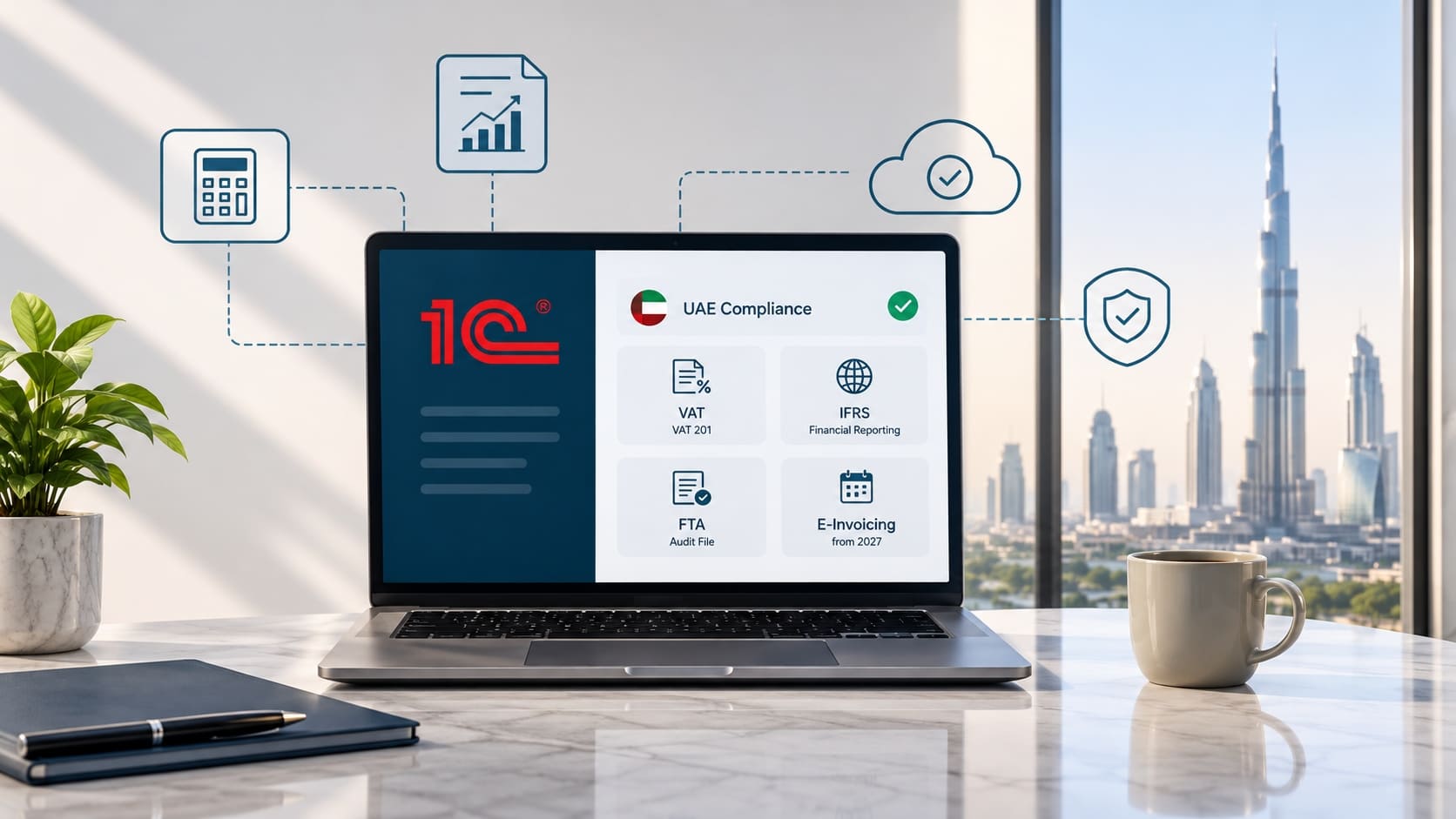
An entrepreneur sets up a company in Dubai and wants to keep a familiar tool. 1C — an ERP and accounting platform widely used across CIS countries — has run the books of their Russian or Kazakh business for years, the accountant knows it inside out, and the management reports are already set up. The first question is obvious: does 1C accounting work in the UAE, or will the tax authority insist on different software?
The short answer: UAE law does not require any particular accounting software, so you can use 1C in the UAE. But the standard Russian configurations are built for a different legal system. For 1C accounting to stand up to a Federal Tax Authority (FTA) review and an external audit, the software has to be adapted — or the statutory accounts have to be kept in another system. Here is what to consider.
What the Law Says About Accounting Software

Neither the VAT Law, nor the Corporate Tax Law, nor the Tax Procedures Law names the software a company must use for its accounts. The requirements concern the outcome: records must be complete and accurate, kept for the prescribed period and made available to the FTA on request.
The FTA maintains a Tax Accounting Software Register. It lists vendors that have confirmed their software meets FTA requirements — for example, that it produces the VAT return and the FTA Audit File in the prescribed format. Businesses are not required by law to choose software from this register; it simply helps them find a tested solution. A company may use other software, provided its accounting meets the legal requirements.
So the right question is not “Is 1C allowed in the UAE?” but “Can my 1C produce everything the FTA, the auditor and the bank will ask for?”
Accounting Requirements Your Software Must Meet
Whatever software you use, a UAE company’s accounting has to meet several requirements.
- Reporting standard. Ministerial Decision No. 114 of 2023 of the Ministry of Finance provides that, for corporate tax purposes, financial statements are prepared under IFRS. Businesses with revenue of no more than AED 50 million may apply IFRS for SMEs, and those with revenue of no more than AED 3 million may use the cash basis.
- VAT. Tax invoices show the supplier’s Tax Registration Number (TRN) and the VAT amount in UAE dirhams. Where a transaction is in a foreign currency, the VAT amounts are converted into AED at the Central Bank of the UAE rate on the date of supply. The VAT return is filed on the VAT 201 form, and the software must collect data for its boxes: supplies by emirate, zero-rated and exempt supplies, the reverse charge and input VAT.
- Record keeping and access. Corporate tax records must be kept for at least seven years after the end of the tax period, and VAT records for at least five; the period is extended where there is a dispute, an audit or an unresolved refund application. Records may be kept in English, but on the FTA’s request the company must provide an Arabic translation — failing to do so carries a penalty of AED 5,000. From 30 July 2026, FTA rules on electronic and scanned copies apply: a copy must match the original exactly, and the FTA may request access to the accounting system itself. Record keeping can be outsourced to a contractor, but the company remains responsible.
- FTA Audit File (FAF). During an audit, the FTA may request an export of accounting data in its own format — the FTA Audit File. Software on the FTA register can produce it in the prescribed format; in other systems, the export has to be configured or prepared manually.
Table 1 — UAE accounting requirements and what they mean for your software
| Requirement | What the software must do |
|---|---|
| IFRS / IFRS for SMEs | Chart of accounts and reports under international standards |
| 5% VAT | Tax invoices with TRN, VAT amount in AED |
| VAT 201 return | Map transactions to the return boxes |
| Foreign currency transactions | Convert VAT at the Central Bank of the UAE rate |
| Record keeping | 7-year archive for corporate tax, 5 years for VAT |
| FTA audit | FAF export or an equivalent report |
| External audit | General ledger in English that the auditor can follow |
Where Standard 1C Falls Short of UAE Requirements
The popular Russian configurations — 1C:Accounting (Enterprise Accounting) and 1C:Trade Management — are built around Russian Accounting Standards (RAS), the Russian chart of accounts, Russian VAT rates and Russian Federal Tax Service forms. For a UAE company, this creates several practical problems.
- The first is the reporting standard. The Russian chart of accounts and statutory reports do not produce IFRS. Financial statements will need to be converted manually, or you will need a configuration with an IFRS module.
- The second is UAE VAT. The standard configuration has no VAT 201 form, no breakdown of supplies by emirate and no reverse charge logic under UAE rules. All of this has to be built by a developer, and the customisations need updating with every change in the law — and there were plenty of VAT amendments in 2025–2026.
- The third is language and audit. Auditors in the UAE generally work with documents in English. A journal in Russian, with Russian account names, adds to the time and cost of the audit.
- The fourth is ongoing support. Standard Russian configurations are not updated for UAE legislation, so the customisations are maintained by a partner or an in-house developer. Whether your accounts are still up to date a year from now depends on their skills and availability.
There are also international solutions on the 1C:Enterprise platform, such as 1C:Drive and 1C:ERP. 1C partners in the UAE offer them in English, and some have their own localised products. This is a workable route, but its cost and timeline are comparable to implementing a full ERP system.
E-Invoicing From 2027: A New Factor in the Choice
From 2027, the UAE is introducing mandatory e-invoicing for B2B and B2G transactions; sales to end consumers (B2C) are excluded from the system. Companies with revenue of AED 50 million or more must appoint an Accredited Service Provider (ASP) by 30 October 2026 and switch to e-invoices from 1 January 2027. Companies with revenue below AED 50 million must appoint an ASP by 31 March 2027, and their switch is from 1 July 2027. Ministerial Decision No. 197 of 2026 did not postpone these deadlines, but it exempted transactions within a tax group from e-invoicing for 24 months and removed the requirement to store e-invoice data only in the UAE.
An e-invoice is generated in the structured PINT AE format and transmitted via the Peppol network through an ASP. Your accounting software must either integrate with the provider directly or export data in the required format for transmission. Zoho states that it is itself accredited by the UAE Ministry of Finance as an ASP, while Xero states that e-invoicing can be connected directly from the software through an accredited provider. For 1C, this integration is usually set up separately by a partner — something to factor into your budget and timeline now. For more, see e-invoicing in the UAE.
Three Workable Options for a UAE Company
In practice, companies used to 1C choose one of three set-ups.
Option 1. Adapted 1C. An international configuration or a customised Russian one with IFRS, UAE VAT, English and integration with an e-invoicing provider. Suits holding structures and companies with high transaction volumes, a warehouse or manufacturing, where 1C is already linked to other processes.
Option 2. Statutory accounts in Zoho Books or Xero, management accounts in 1C. Tax and financial accounting under UAE rules is kept in local cloud software, while 1C remains in use for group management reporting. This is the most common set-up for companies whose main business is in Russia, Kazakhstan or another CIS country, with a holding or trading company in the UAE.
Option 3. Full move to cloud software. For small companies, start-ups and freelancers. Zoho Books, Xero and QuickBooks support UAE VAT, are familiar to local auditors and cost less than an ERP implementation.
Table 2 — Accounting options compared
| Criterion | Adapted 1C | Zoho Books + 1C | Zoho Books / Xero only |
|---|---|---|---|
| UAE VAT and VAT 201 | After set-up | Yes | Yes |
| IFRS | Module or conversion | Chart of accounts set-up | Chart of accounts set-up |
| E-invoicing 2027 | Separate integration | Via cloud software | Via cloud software |
| Auditor-friendliness | Depends on set-up | High | High |
| Implementation cost | High | Medium | Low |
| Best for | Holdings, warehouse, manufacturing | Groups of companies | Small businesses, start-ups |
The choice depends less on habit than on transaction volumes and on who will use the reports. If the reports are only needed by the FTA, the bank and an auditor in the UAE, local software is almost always simpler. For a comparison of cloud systems, see Xero, QuickBooks or Zoho Books in the UAE.
How Much Does Accounting in the UAE Cost?
Dynasty Business Adviser works with the accounting software popular in the UAE — Xero, QuickBooks, Zoho Books and Tally — and sets up Zoho Books on a turnkey basis for a one-off fee of AED 129. Whether data can be migrated from 1C, and at what cost, should be confirmed with our specialists when you get in touch. Ongoing accounting support is priced by the number of transactions per month:
- up to 10 transactions — AED 1,100 per month;
- up to 25 transactions — AED 1,500 per month;
- up to 50 transactions — AED 2,100 per month;
- 50 to 100 transactions — AED 3,100 per month;
- over 100 transactions — priced individually.
VAT registration costs AED 2,000, corporate tax registration AED 1,300, filing nil returns AED 1,500 per year, and audit support from AED 5,000 per year. All prices exclude VAT, and the final fee is fixed in the contract. A combined accounting and tax package costs less than the same services bought separately.
Conclusion
You can use 1C in the UAE: the law does not dictate your choice of software. But your accounts must be kept under IFRS, support UAE VAT and the VAT 201 return, provide data on the FTA’s request and, from 2027, handle e-invoices. Standard Russian 1C cannot do this without customisation. For most companies, the sensible approach is to keep statutory accounts in local cloud software and use 1C for management reporting.
If you are unsure which option fits your company, the team at Dynasty Business Adviser can review your processes, help you set up accounting in Zoho Books or other software, and handle your reporting.
Get a consultation
This article is for information only and does not constitute individual tax advice. Information is current as of October 2026; requirements and deadlines may change — check them at the time of your enquiry on the FTA portal (tax.gov.ae) or with an adviser.
Expert: Natalia, Chief Accountant at Dynasty Business Adviser.