
The Electronic Invoicing System (EIS) is the largest reform of tax administration in the UAE since VAT was introduced in 2018. A pilot and voluntary phase begins on 1 July 2026, and from 1 January 2027 issuing structured electronic invoices becomes mandatory for large businesses in B2B and B2G transactions.
| MODEL | FORMAT | OBLIGATION STARTS |
|---|---|---|
| Peppol, 5-corner DCTCE | PINT-AE (structured XML) | 01.01.2027 (turnover ≥ AED 50M) |
Sources: UAE Ministry of Finance (mof.gov.ae), Federal Tax Authority (FTA), Deloitte, EY, KPMG, PwC.
What e-invoicing is and why it is being introduced

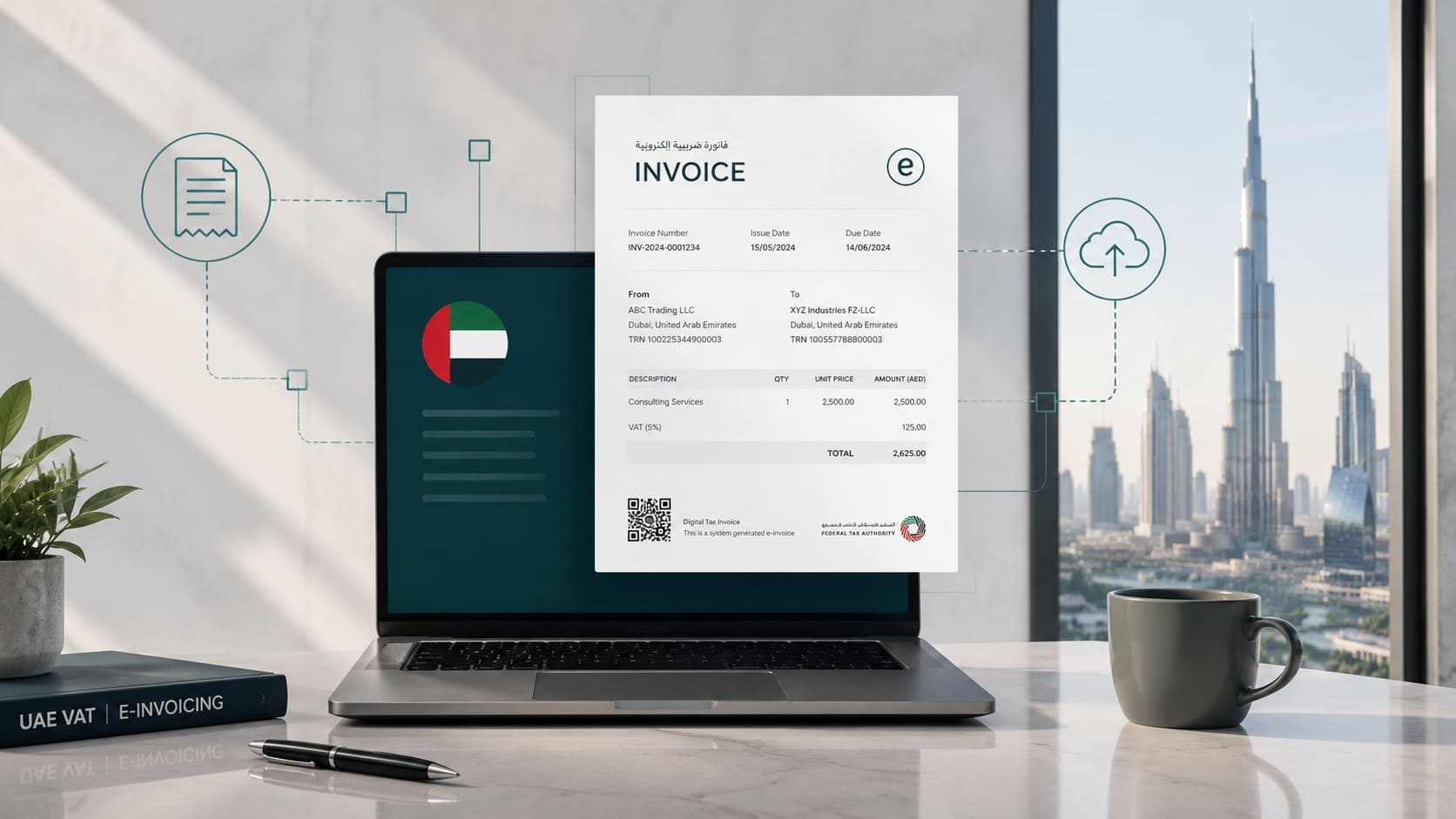
Electronic invoicing in the UAE is not a ‘PDF by email’ or a scanned invoice. An electronic invoice means a structured, machine-readable XML document that is created, transmitted, validated and stored through dedicated government infrastructure. Paper invoices, PDFs, images and Excel files are not legally valid tax invoices for transactions covered by the mandate.
The reform is run jointly by the Ministry of Finance (MoF) and the Federal Tax Authority (FTA) and pursues three goals: greater transaction transparency, stronger VAT compliance and a shift from post-audit to a model of continuous transaction control (CTC) with near-real-time reporting.
Key point for business
At the moment an invoice is issued it simultaneously reaches the FTA in the same form, with the same data and at the same time. This means invoice issuance becomes a system-driven process rather than a manual operation. Any discrepancies in accounting, revenue recognition or internal controls become immediately visible to the regulator.
Technology model
- Peppol network — an international standard for exchanging electronic documents, already used in the EU and a number of countries.
- DCTCE / 5-corner model (Decentralised Continuous Transaction Control and Exchange): seller → its accredited provider (ASP) → buyer’s provider → buyer, with the fifth corner being the transmission of data to the FTA.
- PINT-AE format (Peppol International Invoice — UAE), based on UBL 2.1 — the only legally valid electronic-invoice format.
- Accredited Service Provider (ASP) — a mandatory link: it validates, converts and transmits invoices. A business must appoint an ASP from the official MoF list.
Legal and regulatory framework (laws and subordinate acts)
The legal architecture is built on two levels: first, federal decree-laws established legal recognition of electronic invoices; then the 2025 ministerial and cabinet decisions filled the system with specific rules, deadlines and penalties.
Primary legislation (decree-laws of 2024)
| Act | Subject matter | Status / date |
|---|---|---|
| Federal Decree-Law No. 16 of 2024 | Amendments to the VAT Law (FDL No. 8 of 2017). Articles 1, 55, 65, 70 and 76 amended. Introduced the definitions of ‘electronic invoice’, ‘electronic credit note’ and ‘electronic invoicing system’; updated rules on input VAT recovery and on issuing documents. | Published in the Official Gazette on 30.09.2024; in force from 30.10.2024 |
| Federal Decree-Law No. 17 of 2024 | Amendments to the Tax Procedures Law (FDL No. 28 of 2022). Introduces the definition of the ‘electronic invoicing system’ and empowers the Minister of Finance to issue decisions on implementation, dates and the persons in scope. | Announced 30.10.2024; in force from 30.10.2024 |
Subordinate acts — the working basis of the system (2025)
| Act | What it establishes |
|---|---|
| Ministerial Decision No. 243 of 2025 | The Electronic Invoicing System itself: scope, requirements and the list of excluded transactions. Applies to all persons conducting business in the UAE in respect of their business transactions, unless otherwise excluded. |
| Ministerial Decision No. 244 of 2025 | The implementation framework and phased timeline (waves by turnover and entity type). Pilot launch, voluntary phase, ASP appointment deadlines and mandatory go-live dates. |
| Ministerial Decision No. 64 of 2025 | Eligibility criteria and accreditation procedure for service providers (ASPs) — who may act as an accredited provider and on what terms. |
| Cabinet Decision No. 106 of 2025 | Administrative fines for e-invoicing violations (in particular, for failure to appoint an ASP and to implement the EIS). This is published law, not an estimate. |
Additional technical document
The UAE Electronic Invoicing Guidelines v1.0 (published 23 February 2026) and the PINT-AE Data Dictionary define the structure of invoice fields (around 50 mandatory fields: TRN, participant identifiers, goods/services codes, etc.). This is not a separate law but a mandatory technical specification referenced by Decisions No. 243 and No. 244.
Rollout timeline (including the extension of 10 May 2026)
On 10 May 2026 the Ministry of Finance extended the ASP appointment deadline for businesses with turnover of AED 50M or more — from 31 July 2026 to 30 October 2026. The mandatory go-live date remained unchanged — 1 January 2027. The current schedule by phase is below.
| Category / event | Appoint ASP by | Mandatory go-live |
|---|---|---|
| Pilot (Taxpayer Working Group) + voluntary phase for all | 01.07.2026 — start | Voluntary |
| Business with turnover ≥ AED 50M | 30.10.2026 (extended from 31.07.2026) | 01.01.2027 |
| Business with turnover < AED 50M | 31.03.2027 | 01.07.2027 |
| Government entities | 31.03.2027 | 01.10.2027 |
| B2C transactions (sales to end consumers) | — | Outside the mandate for now |
The highlighted row is the most urgent: large businesses must prepare first. ASP appointment should be preceded by an impact assessment, provider selection against identified requirements, and a project plan.
Scope and exclusions

The determining criterion is annual turnover (revenue), not the place of registration. The mandate applies to all persons conducting business in the UAE in respect of their B2B and B2G transactions. Where a company is registered — on the mainland or in a free zone — does not matter: only turnover per the financial statements for the most recent accounting period counts.
Who is obliged — by wave (criterion = turnover):
- Wave 1 — turnover ≥ AED 50M: appoint an ASP by 30.10.2026, mandatory go-live from 01.01.2027.
- Wave 2 — turnover < AED 50M: all other persons in scope, including those registered for VAT; ASP by 31.03.2027, go-live from 01.07.2027.
- Government entities: go-live from 01.10.2027.
Also applies, regardless of turnover:
- The mandate covers business regardless of VAT registration — including those not registered for VAT (who will need to obtain a TIN from the FTA).
- Non-residents with taxable supplies in the UAE who are required to issue invoices under UAE rules.
Key point: mainland or free zone is not the criterion
Belonging to a free zone does not take a company out of the mandate and is not in itself a ground for registration. The system applies by turnover: a company with turnover ≥ AED 50M must onboard in the first wave regardless of whether it is registered on the mainland or in a free zone.
Excluded from the mandatory mandate (Decision No. 243/2025):
- B2C transactions — sales to end consumers (outside the system for now; may be included by a separate decision in the future).
- Sovereign activities of government entities not competing with the private sector.
- Certain international passenger and goods transport services by airlines (a temporary 24-month exclusion, with transitional rules).
- Certain exempt financial services, including those subject to the zero rate.
Data retention
All electronic invoices and credit notes must be stored within the UAE for at least the prescribed retention period (under tax law — around 10 years), ensuring integrity and retrievability. Any system failure must be reported to the FTA within two business days.
Liability for violations
Penalties are set out in Cabinet Decision No. 106 of 2025 and the general administrative penalty regime for tax violations (Cabinet Decision No. 40 of 2017, as amended by Decisions No. 49 of 2021 and No. 129 of 2025).
| Violation | Penalty |
|---|---|
| Failure to implement the EIS / appoint an accredited ASP | AED 5,000 per month — from the first day of non-compliance |
| Failure to issue a tax/electronic invoice or credit note within the prescribed period (e.g. the 14-day period) | AED 2,500 per detected case |
| Failure to meet record-keeping requirements for tax records and e-invoicing data | AED 10,000 per violation; AED 20,000 on repetition within 24 months |
The ‘zero-risk’ window
Companies that implement electronic invoicing before their mandatory deadline are fully exempt from penalties during the voluntary period. Early adoption is the most effective way to eliminate the risk of penalties while testing the integration in a live environment without consequences.
Analytical conclusion
What changes fundamentally
The main shift is not ‘electronic document flow’ but a move to real-time control. Until now the FTA saw transactions after the fact, when returns were filed. Now invoice data reaches the regulator at the moment of issuance. This brings the UAE closer to the global ‘VAT in the Digital Age’ agenda and the CTC/DRR models in force in the EU and a number of countries. For business this means that data quality, correct revenue recognition and invoicing discipline cease to be an internal matter — they become subject to immediate verification.
Who will be affected most
- Large businesses (≥ AED 50M) — the first wave; time for ERP integration and testing is objectively short: an ASP must be appointed by 30 October 2026, go-live 1 January 2027.
- SMEs and businesses not registered for VAT — for them the news is that the mandate covers them too (with a TIN). Many are not organisationally ready.
- Any business with turnover ≥ AED 50M — falls into the first wave purely on turnover, regardless of whether it is registered on the mainland or in a free zone.
Practical risks
- Technology gap. A ‘messy ERP’ — inconsistent reference data, manual invoices, fragmented systems — becomes visible to the regulator. Integration with an ASP and PINT-AE field mapping take time and often require accounting-system rework.
- Tight deadlines. Preparation (impact assessment → ASP selection → integration → testing) takes months. Starting ‘at the last minute’ practically guarantees go-live
- Business continuity. After go-live, the ability to issue and receive e-invoices becomes a critical continuity requirement: without a working ERP–ASP link a company cannot legally issue an invoice.
Recommended steps (order of actions)
- Determine phase and scope. Check turnover and transaction type (B2B/B2G), establish which wave the company belongs to and which transactions fall under the mandate.
- Run an impact assessment. Audit current invoicing processes, data and ERP; identify gaps against the 50 mandatory PINT-AE fields.
- Select and appoint an ASP. Choose an accredited provider from the official MoF list against identified requirements; complete onboarding via EmaraTax on the FTA portal.
- Integrate and test. Configure ERP → PINT-AE XML data mapping, connect to the Peppol network, test end-to-end exchange in the voluntary phase from July 2026.
- Go live voluntarily, early. Going live before the mandatory deadline provides exemption from penalties and ‘live’ testing without risk.
Position for Dynasty clients
For entrepreneurs who have registered companies in the UAE, the key practical takeaway is simple: e-invoicing is not a one-off setup but a redesign of the invoicing process. Companies with turnover of AED 50M or more would be wise to start preparing now; everyone else should use the voluntary phase from July 2026 for a smooth transition. After go-live, paper invoices and PDFs cease to be legally valid for B2B and B2G transactions.
This document is for information and analysis only and does not constitute legal or tax advice. Before making decisions, verify against the official publications of the UAE Ministry of Finance and the Federal Tax Authority and engage a qualified adviser. © Dynasty Business Adviser.
Get advice