
The first thing any entrepreneur discovers when choosing a jurisdiction for international business is that Cyprus tax rates are among the lowest in the European Union. Registering a company here, you can optimize your taxes down to as low as 0%, or at the very least to 15%. It sounds tempting — after all, potentially almost all of the money stays within the company. However, there are nuances: only certain preferential categories, engaged in investment activity, are fully or partially exempt from payments, and even then only under specific conditions. If your business operates in trade or services, the rate will be different.
In this article, we take a detailed look at Cyprus taxation: where the 0% rate applies, when the 2.5% preferential rate kicks in, and in which cases the standard 15% is used. We’ll also cover why even correctly registered structures sometimes lose their benefits.
How the Cyprus Tax System Works

To understand how taxes are paid in Cyprus, you first need to determine your tax status and source of income, since the conditions differ for companies, individuals, residents, and non-residents.
Cyprus: Taxes for Business
Since 2004, Cyprus has been a full member of the EU, which grants access to the European Parent-Subsidiary and Interest & Royalties Directives. These allow dividends and interest to be paid within a European group of companies without withholding tax at source. However, there are conditions regarding the participation share (at least 10%) and the holding period of the subsidiary (at least 2 years).
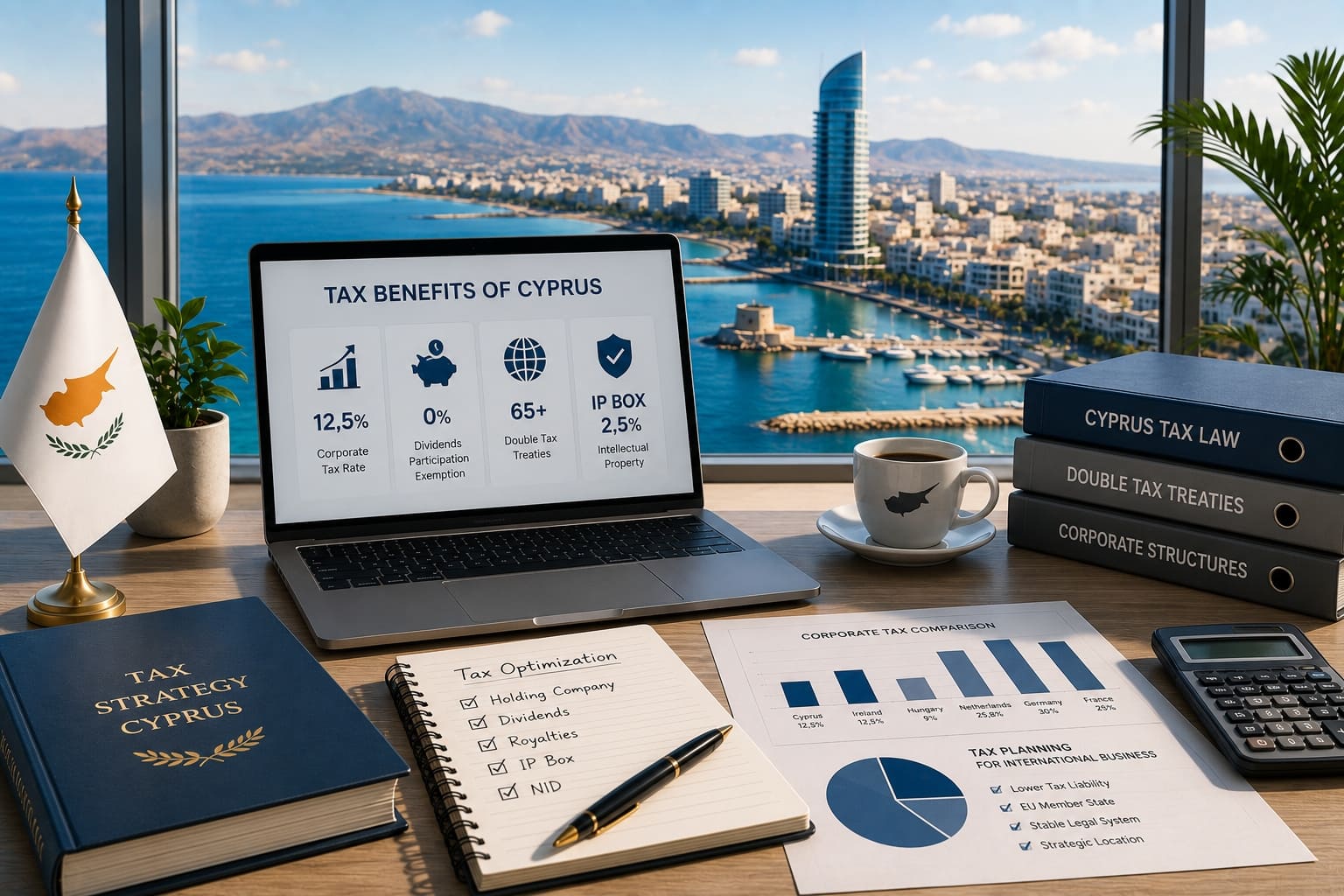
Cyprus has also signed 65 Double Tax Treaties (DTTs) to avoid double taxation — with the UK, Germany, the UAE, India, China, and dozens of other countries. Thanks to these, holding structures can reduce withholding tax on dividends, interest, and royalties received from other countries.
In addition, the standard corporate tax rate is 15% (although until 2026 it was still 12.5%). Still, by EU standards this is genuinely low. For comparison:
- Germany taxes at 30%,
- France at 25%,
- the Netherlands at 25.8%.
Only Ireland (still 12.5%) and Hungary (9%) have lower rates, but these countries have higher rates elsewhere — in particular VAT and capital gains tax are among the highest in Europe.
Taxes for Cyprus Residents
It’s worth separately mentioning SDC — Special Defence Contribution, a special levy charged on passive income:
- ollowing the 2026 reform, 5% on dividends;
- 17% on bank deposit interest;
- from 5% to 70% on rental income from real estate (abolished from 2026).
An important detail — SDC applies only to individuals who are tax residents of Cyprus. Non-resident companies and their owners who do not permanently reside in Cyprus are not subject to SDC. Still, it’s worth knowing about these charges if you’re considering obtaining Cyprus resident status.
It’s also interesting that Cyprus income tax is levied on individuals only once annual income exceeds €22,000. And if that individual also happens to be an IT specialist, then on a salary of €60,000, only half of the income is taxed at a rate of 20% (with €22,000 exempt from payment).
By the way, Cyprus taxes for IT are also attractive because of preferential rates, especially when it comes to software development. Such companies can apply the IP Box (Intellectual Property) regime, with a real effective legal rate of up to 3%. More on that below.
Taxes in Cyprus for Non-Residents
For most payments made to non-resident companies, Cyprus maintains one of the softest tax regimes in Europe. However, certain types of income are still taxed at the following rates:
- 0% — dividends, interest, and royalties when the IP is used outside Cyprus.
- 10% — royalties when the IP is used within Cyprus.
- 15-20% — capital gains tax on the sale of Cyprus real estate. This also applies to the sale of shares in companies whose value is derived more than 20% from Cyprus real estate.
Since 2026, additional restrictions apply to payments made to low-tax and certain “blacklisted” jurisdictions. In such cases, preferential rates do not always apply and require separate verification.
Which Businesses Operate at a 0% Rate
Under Cyprus law, only two categories of income are exempt from tax in the country:
- Dividends from subsidiary structures: provided the company has obtained resident status and the foreign enterprise pays tax in its own country at a rate no lower than half the Cyprus rate (currently 7.5%).
- Profit from the sale of shares and securities: for such activities there is no capital gains tax, with the exception of companies engaged in the purchase and sale of real estate.
Important! Many entrepreneurs in the first category overlook the tax rates in the countries where their subsidiaries operate. They assume that if an offshore jurisdiction allows a 0% rate, then thanks to the treaties they won’t have to pay anything in Cyprus either. But a DTT does not automatically cancel taxes — it merely allows the payments to be credited when calculating the Cyprus tax liability.
Who Is Taxed at the 15% Rate

The standard corporate rate of 15% applies to all taxable income less allowable expenses. The latter include costs related to running the business, such as:
- employee salaries;
- rent for offices, warehouses, and other premises;
- purchase of goods, raw materials, and equipment;
- advertising, marketing, and promotion;
- accounting, legal, and other professional services;
- interest on loans, provided they meet the requirements of tax legislation;
- depreciation of fixed assets and intangible assets.
The more legitimate expenses that can be documented, the smaller the profit on which the tax is calculated.
Legitimate Mechanisms for Reducing Rates
Taxes in Cyprus for legal entities include not only Corporate Income Tax but also special regimes that allow rates to be legally reduced. One of these is the Notional Interest Deduction (NID) — a notional interest deduction on new equity capital.
Why is this needed? Imagine two identical companies.
Company A took out a $1 million bank loan.
It pays interest on the loan. This interest is an expense and reduces taxable profit — meaning the business pays less CIT.
Company B did not take out a loan. The owner simply invested $1 million.
It might seem this is even better — no debt. But the problem is that no one pays interest to anyone. That means there are no expenses. The profit ends up the same, but the tax is higher.
As a result, both companies received the same amount of money for business development. It’s just that one borrowed it from a bank, while the other received it from the owner. And the latter ends up paying more, which feels unfair.
So the Cyprus state essentially says: “Fine. If the owner contributed their own capital to the business, we will allow you to calculate as if interest had been paid for the use of that money” — even though in reality no one paid anyone anything.
This deduction is calculated on new share capital contributed to the company after January 1, 2015, provided that this capital is used to generate taxable income. The amount of the deduction is calculated according to a formula set out in the legislation and depends on the yield of 10-year government bonds of the country from which the capital originated, plus an additional 3% margin.
In practice, this works as follows:
The company earned a profit of €500,000.
The owner had previously contributed €2 million in new capital.
Using the formula, the state calculated notional interest of €100,000.
The tax is then calculated not on €500,000, but only on €400,000.
Why does the state allow a rate reduction at all if no interest was actually paid to anyone? Because it encourages financing businesses with equity capital, rather than only with loans. Otherwise, it would be more advantageous for an owner to keep taking out loans rather than investing their own funds.
IP Box: A Regime for Intellectual Property
The Cyprus IP Box is one of the most interesting and widely discussed tools in tax planning. It applies to qualifying IP assets, including patents, software copyrights, and certain other intangible assets. The main feature of the regime is that only 20% of qualifying profit from such intellectual property is subject to tax.
What “Only 20% of Profit Is Taxed” Means
Suppose a company earns €1,000,000 in profit from licensing its own software.
Under the standard regime, the entire amount would be taxed at 15%.
Under the IP Box regime, the following happens:
- qualifying intellectual property profit — €1,000,000;
- 80% of this profit is exempt from taxation;
- the tax is calculated only on the remaining 20%, i.e. on €200,000.
As a result, the business pays:
€200,000 × 15% = €30,000.
In effect, this amounts to 3% of the original profit (€30,000 out of €1,000,000).
However, not every company can take advantage of this regime. Cyprus applies the nexus approach, under which the tax benefit depends on R&D expenses directly related to creating the intellectual property. The greater a company’s own development spending, the larger the share of profit that can be shifted to the preferential regime.
So it’s not possible to simply purchase a ready-made patent, software product, or other IP asset and immediately apply the IP Box. The company must be able to demonstrate a genuine link between development expenses and the income generated from using that asset.
Important! The IP Box is a powerful tool for supporting innovative business, but it should not be viewed as a way to formally reduce taxes.
Conditions for Preserving Tax Benefits

Simply registering a company in Cyprus is not enough to enjoy preferential rates. To do so, the business must be a tax resident of the country — meaning it must actually be managed from the island. This is usually confirmed by:
- holding board of directors meetings in Cyprus;
- making key management decisions within the jurisdiction;
- resident directors with genuine authority;
- an office, accounting records, and other signs of actual presence (substance).
Formally meeting these requirements does not always protect against challenges from regulatory authorities. If key decisions are made in another country, the company may be deemed a tax resident of that country instead.
As a result, there is a risk of losing Cyprus resident status and of additional tax assessments in the country from which the company is actually managed. That’s precisely why it’s important for international structures not only to register a business in this jurisdiction, but also to ensure its genuine presence there.
Double Tax Treaties
If a Cyprus company receives dividends, interest, or royalties from another jurisdiction, the source country has the right to withhold tax at source (withholding tax). Without international treaties, this rate can reach 15–30%, significantly increasing the tax burden.
That’s why Double Tax Treaties (DTTs) are so important for international structures. As mentioned, Cyprus has already signed 65 such treaties, allowing withholding tax on dividends, interest, and royalties to be reduced — in some cases down to zero.
For example, royalties transferred from India to a Cyprus company would, without a DTT, be taxed at a 20% withholding rate at source, whereas the treaty currently in force between Cyprus and India reduces this to 10%.
If no treaty exists between Cyprus and the country from which the income originates, withholding is applied at standard rates. It’s therefore best to assess the effectiveness of a Cyprus structure taking into account the legislation of both jurisdictions.
An additional advantage is access to EU directives. The Parent-Subsidiary Directive exempts dividends paid between a parent and subsidiary company from withholding tax, subject to certain conditions — for example, a participation share of at least 10% and a holding period of at least one year. The Interest & Royalties Directive works on a similar principle, eliminating withholding tax on interest and royalties paid within a group.
Why Companies Lose Tax Benefits
Even if a business is registered in Cyprus, this does not guarantee entitlement to tax benefits. Violating legal requirements can lead to additional tax assessments, fines, and claims from tax authorities both in Cyprus and in other countries. The most common mistakes include:
- Management is not actually carried out from Cyprus. If a director makes key decisions and signs documents from another country, regulatory authorities may deem the company a tax resident of that jurisdiction and require it to pay taxes under its rules.
- Misclassification of income. Attempting to classify operating profit as tax-exempt income can lead to additional penalties and fines.
- Applying the IP Box without complying with the nexus principle. If the intellectual property was not developed by the Cyprus company, or there is no link between development expenses and the income received, the tax benefit may be fully revoked.
- Using NID for capital contributed before 2015. The notional interest deduction applies only to new share capital. Incorrect calculation can lead to reassessment.
- Dividends from a foreign subsidiary taxed at below 7.5%. If a controlled enterprise receives around 50% of its income as passive income while being located in a jurisdiction with a 0% tax rate, or at least half the Cyprus rate, the exemption is unlikely to apply.
Important! Before distributing profit, it’s worth understanding how dividend tax is paid by Cyprus companies and which benefits can be applied.
Who Cyprus Is Right For — And Who It Isn’t
Cyprus can be a very advantageous jurisdiction, but only with the right business model. In some cases, the tax advantages genuinely work, while in others the cost of maintaining the company ends up exceeding any potential savings.
| Type of Business | Suitable or Not | Why |
|---|---|---|
| Holding structures | ✔ | Subject to conditions, dividends and capital gains may be tax-exempt. |
| IT companies and IP owners | ✔ | The IP Box allows the effective rate to be reduced to around 3%. |
| Investment structures | ✔ | 0% on capital gains from the sale of shares, bonds, and ETFs. |
| Trading companies without IP or investments | Partially | 15% on operating profit with no special tax preferences. |
| Companies not ready for substance | ✖ | Without genuine presence, the benefits may be lost. |
| Small business with low turnover | ✖ | Compliance costs may exceed the tax savings. |
In other words, the main tax advantages of Cyprus are available to holding structures, investment structures, and IT companies. For an ordinary business, the 15% rate remains competitive, but rarely becomes the main argument for choosing the jurisdiction. Individuals have their own tax benefits, including a 17-year exemption from dividend tax for non-domiciled residents — but these deserve separate discussion.
How Much a Cyprus Company Costs

Cyprus taxes are indeed attractive compared to other EU offerings. But to understand whether doing business through this jurisdiction will actually be profitable, it’s important to calculate not only the cost of setting up the company, but also the cost of annual maintenance.
Company registration usually costs €1 300–2 200. After that, mandatory annual payments arise:
- audit — from €1 300;
- corporate secretary, bookkeeping, and reporting — €700–1 300;
- resident director — from €2 600;
- registered office and address — from €1 700 per year.
Even for a small company, annual costs typically run to €7 000–13 000. Savings are possible, but forgoing genuine presence in Cyprus increases the risk of losing tax benefits.
Because of this, at an annual turnover of €45 000–90 000, a Cyprus company rarely turns out to be worthwhile. The situation is quite different for holding companies, investment structures, IP owners, or companies with passive income from €270 000 per year. In such cases, the tax savings often outweigh the maintenance costs.
Conclusion
The answer to the question of which taxes apply in Cyprus always depends on the business structure and the conditions for using available benefits. The country offers several legitimate mechanisms for reducing the tax burden, but each one only works if the established conditions are met. Rates of 0% and 3% are available for dividends, intellectual property, and certain investment income, while 15% with NID applied remains one of the most competitive rates for operating businesses in Europe.
To take advantage of these benefits, genuine presence in Cyprus, a properly structured setup, and compliance with legal requirements are all required. Without these, tax benefits may be unavailable, and the annual cost of maintenance may fail to justify the expected savings.