
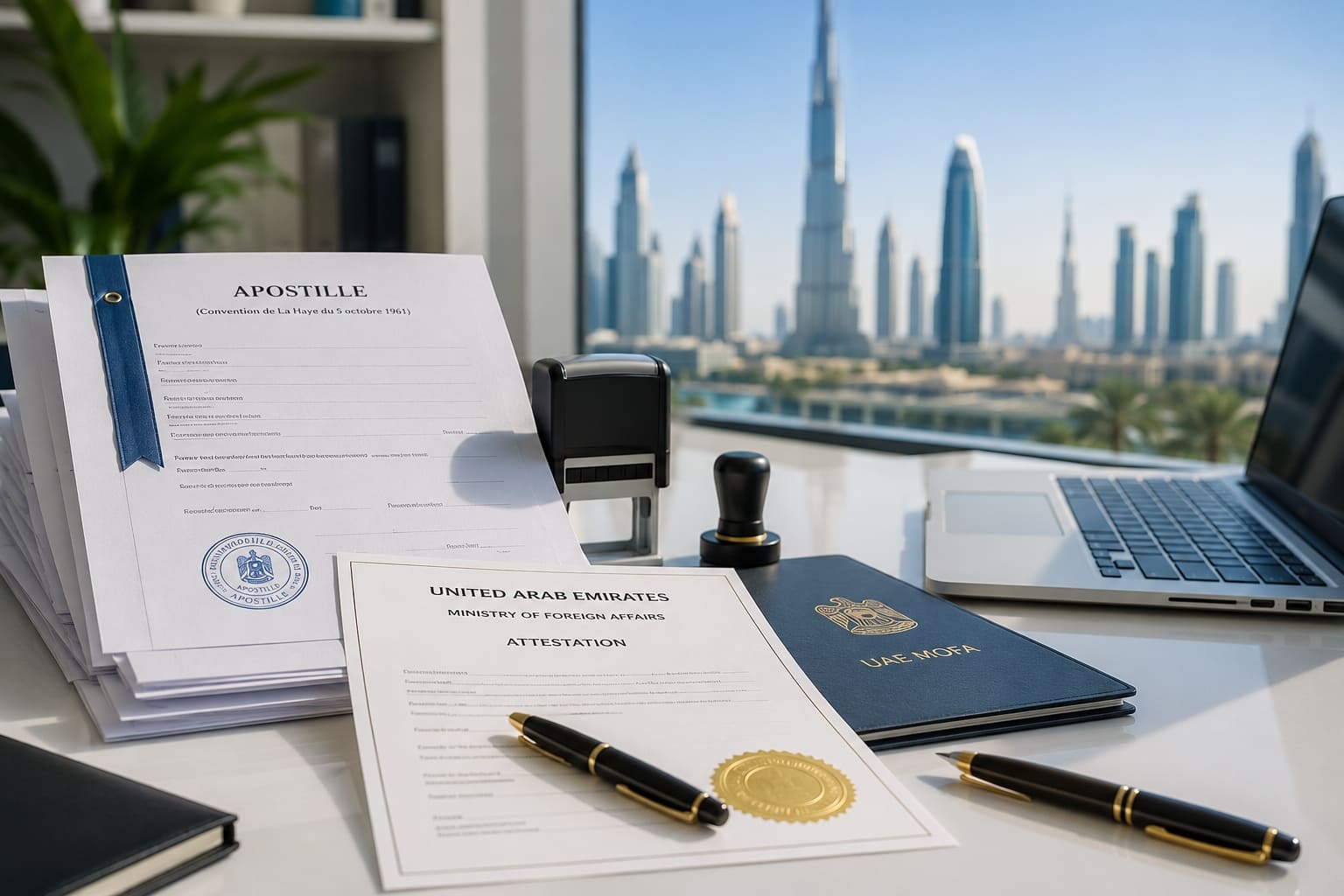
A diploma, a marriage certificate, a power of attorney or a company’s articles issued abroad carry no legal weight in the Emirates “as is” — they have to be legalized first. And this is where the confusion usually starts. Plenty of people go looking for an apostille in the UAE, yet in practice an apostille is not used here. The reason is simple: the UAE is not a party to the Hague Apostille Convention of 1961 (per the official status table of the Hague Conference on Private International Law, HCCH). So instead of an apostille, the country relies on consular legalization — a chain of certifications routed through foreign ministries and embassies. For anyone who needs document legalization in Dubai or any other emirate, that chain is the only route that works.
In this guide we’ll unpack how an apostille differs from legalization, why the Emirates require attestation rather than an apostille, how the process runs for both incoming and outgoing documents, which papers actually need to be attested, why a certified Arabic translation matters, and what drives the timelines and cost.
Apostille or legalization: what applies in the UAE

An apostille is a streamlined form of certification — a single stamp from a designated authority that every member of the 1961 Hague Convention recognizes. The catch is that it only works between countries that have signed the Convention. The UAE has not, so an apostille on its own will never make a document valid in the Emirates, and no apostille is ever placed on a document issued inside the UAE.
What replaces it is consular legalization (attestation) — a multi-step process that verifies the authenticity of the signatures and seals on your paperwork. For a little regional context: within the Gulf, Saudi Arabia, Bahrain and Oman have joined the Convention, while the UAE, Qatar and Kuwait have not. So when a provider promises you an “apostille for Dubai,” they almost always mean legalization, not a genuine apostille. Understanding the apostille vs attestation UAE distinction upfront saves you a rejected document later.
Apostille vs legalization
Table 1 — Apostille vs consular legalization
| Parameter | Apostille | Legalization (for the UAE) |
|---|---|---|
| Where it applies | Hague Convention member states (1961) | Non-member states, including the UAE |
| Format | A single stamp/certificate | A chain of certifications via MOFA and embassies |
| Number of steps | One | Several |
| Accepted in the UAE | Not accepted | Mandatory |
The process itself differs depending on direction — documents you bring into the UAE follow one path, and documents issued in the Emirates for use abroad follow another. Let’s take each in turn.
Legalizing foreign documents for use in the UAE
Before a foreign document is accepted in the Emirates, it moves through a sequence of certifications — first in the country where it was issued, then in the UAE:
- Notarization and attestation in the issuing country (a notary, followed by the relevant body — for example, the ministry of education for diplomas).
- Attestation by the Ministry of Foreign Affairs of the country where the document was issued.
- Legalization at the UAE embassy or consulate in that country.
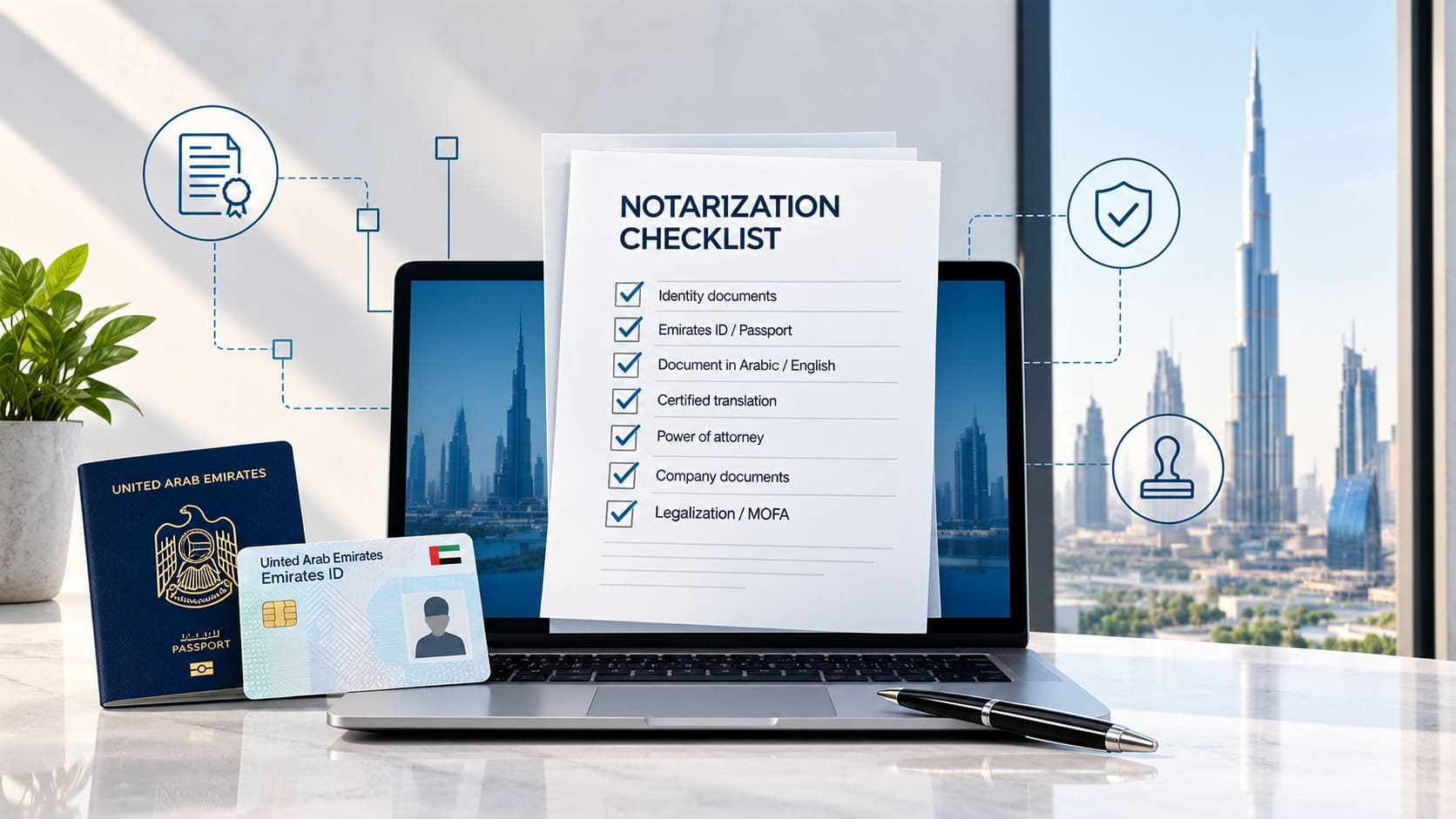
- Final attestation by the UAE Ministry of Foreign Affairs (MOFA, formerly MoFAIC) once the document is inside the Emirates — the step people mean when they talk about MOFA attestation Dubai.
- A certified legal Arabic translation — usually mandatory, and often attested in the UAE by the Ministry of Justice.
Skip any single stage and the earlier ones are wiped out: without the complete chain, the Emirates simply won’t accept the document. That’s exactly why it pays to run legalisation of documents UAE through specialists who keep the order and the deadlines under control.
Legalizing UAE documents for use abroad
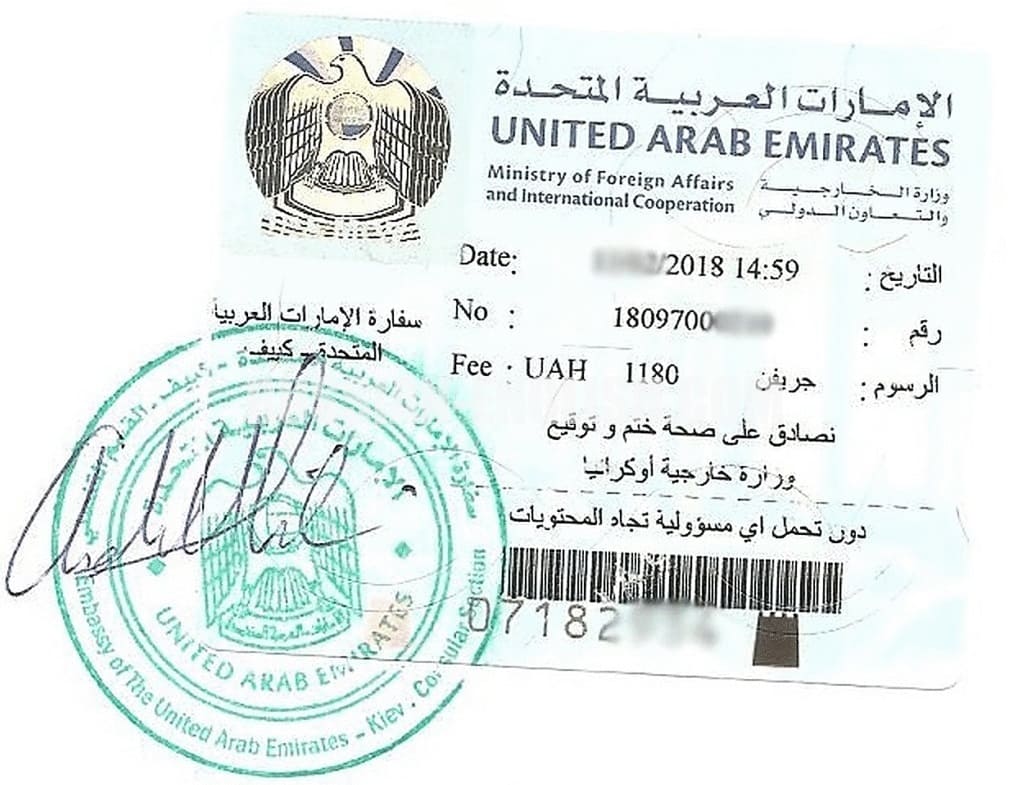
The reverse scenario is when a document issued in the Emirates — a certificate, a power of attorney, corporate paperwork — is needed in another country. The order looks like this:
- Attestation by the relevant UAE authority — a Notary or the Ministry of Justice for legal documents, the Ministry of Education for educational ones, the Chamber of Commerce for commercial ones.
- UAE MOFA attestation.
- Legalization at the destination country’s embassy or consulate in the UAE.
- Where required, a further attestation by the destination country’s Ministry of Foreign Affairs on arrival.
And here’s a point that trips people up: even if the destination country is a Convention member, an apostille is still not placed on a UAE document. Because the Emirates are not a party to the Convention, the same full legalization route applies.
Which documents need legalization
Three broad groups of documents get legalized, and each one has its own first-stage authority:
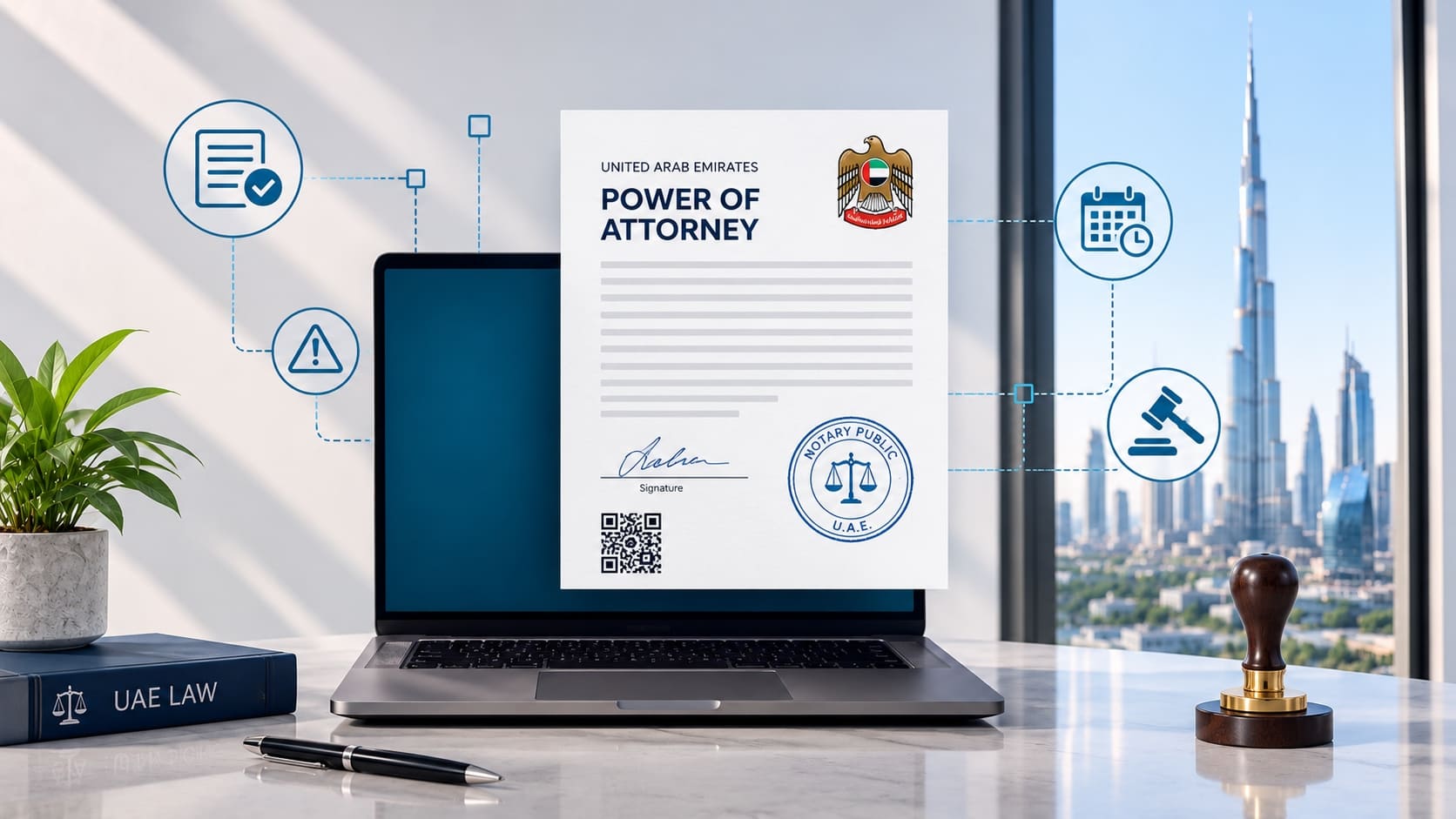
- Personal: birth, marriage, divorce and death certificates, police clearance certificates, powers of attorney.
- Educational: diplomas, transcripts and other papers from academic institutions.
- Commercial: incorporation documents, articles of association, contracts, certificates of origin, invoices.
The requirements shift from group to group. Commercial documents typically pass through the Chamber of Commerce, while educational ones go via the ministry of education in the issuing country. That’s why the route to attest documents for UAE use is always built around the specific type of paper in front of you.
Arabic translation
Even a fully legalized document in a foreign language will, as a rule, need a certified legal Arabic translation to be accepted in the UAE. A licensed translation office produces it, and where necessary it’s attested by the UAE Ministry of Justice. Without a correct translation, government departments, courts and banks can refuse the document outright — so a certified Arabic translation isn’t a formality, it’s a required part of the process.
Timelines and cost
Timelines hinge on the issuing country, the type of document and how busy the relevant authorities are. Attestation at the UAE MOFA usually moves quickly, while a full international chain involving embassies can take anywhere from a few days to a few weeks. On the UAE side there are official government fees (roughly around AED 150 for a personal document and noticeably higher — up to AED 2,000 — for a commercial one), on top of which come the destination country’s consular fees and the cost of translation.
Here’s the honest part: every case is individual. The final cost and timeline depend on the specific consulate, the document type, how urgent it is and the requirements of the receiving party, and embassy and authority fees change periodically. So service charges can differ from one project to the next, and we give an exact quote for your particular set of documents after a short consultation — once the country, the document type and the intended use are clear.

How we help
Dynasty Business Adviser handles document legalization in the UAE end to end. We identify the correct route (incoming or outgoing), check that your set of documents is complete, run the attestation through the relevant authorities, the UAE MOFA and the embassies, arrange the certified Arabic translation and stay on top of the deadlines. Our own office in Dubai and an online notary service let us close most of the procedure without the client having to appear in person at every stage. And we flag the quirks of a particular consulate in advance, so your document clears its checks the first time around.
Need to legalize documents for the UAE?
Legalization is a chain in which every step — and the order of the steps — matters. One mistake along the way, and you’re starting the whole route over. To make sure your documents are accepted the first time — by government departments, courts or banks — hand the procedure to specialists. Get in touch with Dynasty Business Adviser: we’ll map the route to your document and country, arrange the attestation and translation, and carry the legalization through to a result.
Get a consultation: ☎️ +971 52 634 1022 · info@dynasty-uae.com
Get a consultation
Disclaimer: this material is for information only and does not constitute legal advice. Legalization requirements, the steps involved and the fees depend on the country and the type of document, and they can change. Confirm the current procedure for your situation in an individual consultation and through official sources (the UAE MOFA, embassies).