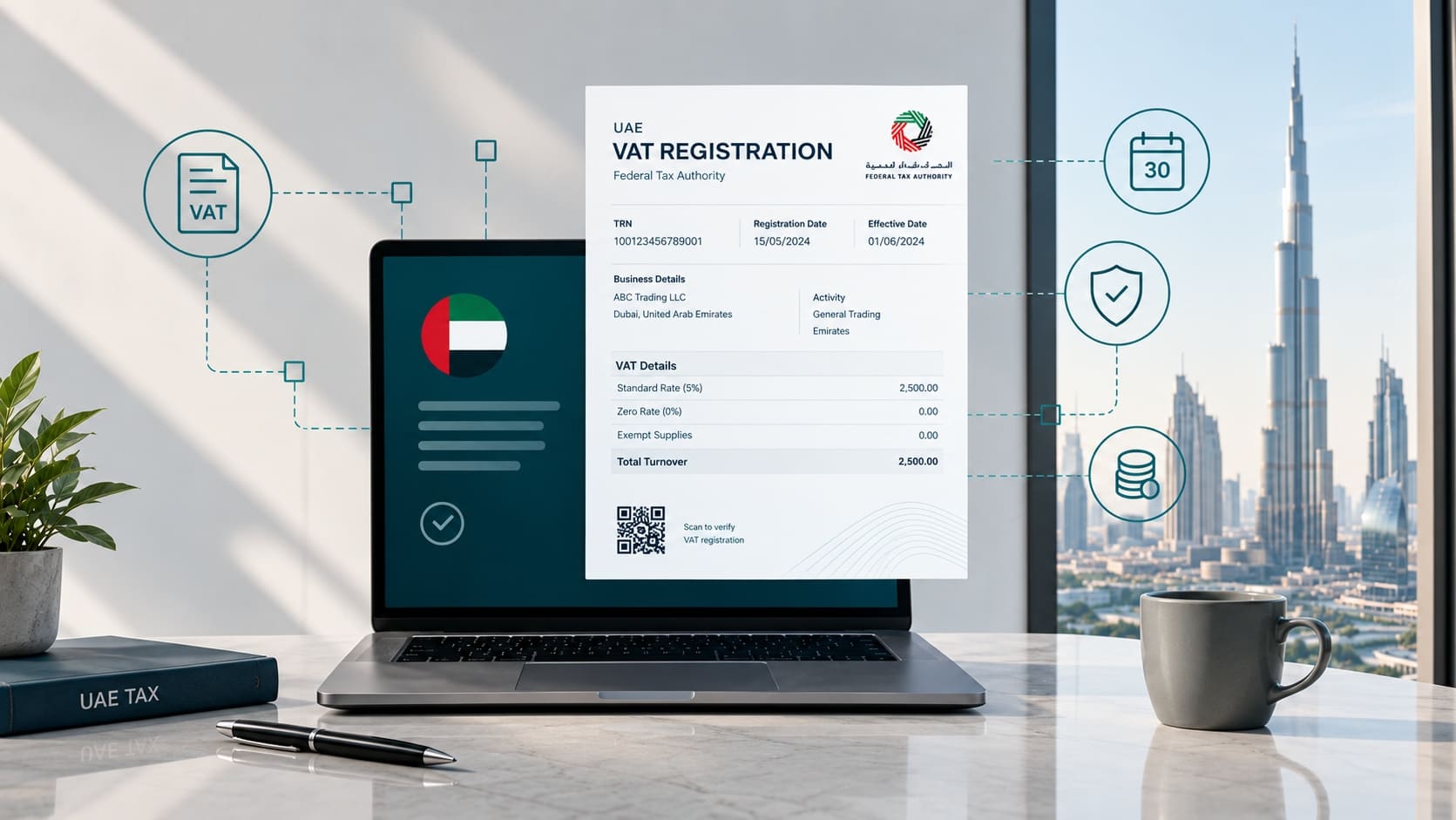

Many entrepreneurs set up a company in the UAE and put accounting off until later: turnover is small, the tax rate is 0%, and the return can be filed at the end of the year. A year on, it turns out there is nothing to support the figures in the return, the bank is asking for financial statements, and the Federal Tax Authority (FTA) is imposing penalties. So what happens if you don’t keep accounting records in the UAE?
Below we look at whether accounting is mandatory in the UAE, which penalties apply in 2026, and why keeping the books from the first month costs less than dealing with the consequences.
Is Accounting Mandatory in the UAE?
Yes. The obligation to keep accounting records and retain documents is set out in several laws, and it applies to both mainland and free zone companies.
- Commercial Companies Law. Federal Decree-Law No. 32 of 2021 on Commercial Companies requires companies to keep accounting records that reflect their true financial position and to retain them for at least 5 years after the end of the financial year (Article 26).
- Corporate Tax. Federal Decree-Law No. 47 of 2022 on the Taxation of Corporations and Businesses requires taxpayers to keep the records and documents supporting their tax return for 7 years after the end of the tax period (Article 56). Financial statements are prepared under the standards set by Ministerial Decision No. 114/2023.
- VAT. VAT registrants keep records of supplies, tax invoices and input tax recovery under Federal Decree-Law No. 8 of 2017 on VAT (Article 78) and retain them for at least 5 years after the end of the tax period.
- Free zones. Free zone regulations separately require companies to keep accounts, and many free zones also require audited financial statements every year.
- Electronic copies. FTA Decision No. 4 of 2026 clarifies that electronic copies and photocopies of documents must be complete, identical to the original, legible and available to the FTA on request. If a third party keeps the books, responsibility still remains with the taxpayer.
Having no turnover does not exempt a company from bookkeeping requirements in the UAE. Even a dormant company files a Corporate Tax return, and a VAT registrant files VAT returns.
FTA Penalties for Missing Records and Other Breaches
VAT penalties are set by Cabinet Decision No. 40 of 2017, as amended by Cabinet Decision No. 129 of 2025, effective from 14 April 2026. Corporate Tax penalties are set by Cabinet Decision No. 75 of 2023, as amended by Cabinet Decision No. 10 of 2024.
Table 1 — Key FTA administrative penalties in 2026
| Breach | VAT | Corporate Tax |
|---|---|---|
| Failure to keep records and documents | AED 10,000; AED 20,000 for a repeat within 24 months | AED 10,000; AED 20,000 for a repeat within 24 months |
| Late registration | AED 10,000 | AED 10,000 |
| Late filing of a return | AED 1,000; AED 2,000 for a repeat within 24 months | AED 500 per month for the first 12 months, then AED 1,000 per month |
| Late payment of tax | 14% per annum, charged monthly | 14% per annum, charged monthly |
Penalties add up. A company that has not kept accounts usually breaches several requirements at once: it registered late, filed late and cannot support its figures. If the FTA finds errors in a return that has been filed, a penalty for an incorrect return, the additional tax due and penalties calculated on the amount of that additional tax are added on top.
The late Corporate Tax registration penalty is waived automatically if the first return is filed within 7 months of the end of the first tax period. This relief applies only to the first tax period and only helps those who manage to prepare their financial statements in time.
Tax Consequences: Reassessments and Lost Reliefs
Penalties are not the biggest cost. Without accounting records, a company loses what it is entitled to by law.
Input VAT recovery. Without tax invoices and records, the FTA will not accept input tax recovery. From 1 October 2026, before recovering input tax, businesses must also verify the supplier and the supply itself, document the check and set out the procedure in an internal company policy (FTA Decision No. 13 of 2026). Without accounting records this cannot be demonstrated, and the VAT on expenses has to be paid from the company’s own funds.
Small Business Relief. A resident person with revenue of no more than AED 3 million in the current and previous tax periods may elect not to pay Corporate Tax. The relief applies to tax periods ending no later than 31 December 2029 (Ministerial Decision No. 73/2023, extended by Ministerial Decision No. 131/2026). It must be claimed in the return and the revenue must be supported by records. Qualifying Free Zone Persons cannot use this relief.
Qualifying Free Zone Person (QFZP) status. One of the conditions for the 0% rate on qualifying income is audited financial statements. Without accounting records the auditor will not sign an opinion, and the company will pay 9% on taxable income above AED 375,000. Once lost, the status cannot be regained for the current tax period and the following four tax periods.
Tax losses. Tax losses can be carried forward indefinitely and may offset no more than 75% of taxable income (Article 37 of the Corporate Tax Law). But the loss must be reported in the returns and supported by the accounts; otherwise it cannot be used.
Tax assessment. If the amount of tax or the accuracy of a return cannot be established, the FTA may determine the tax by estimation and issue a tax assessment (Article 23 of Federal Decree-Law No. 28 of 2022 on Tax Procedures). Challenging such an assessment without documents is close to impossible.
Bank, Licence and Audit
The consequences go beyond tax.
- Bank. UAE banks regularly update client data and request financial statements, especially when turnover grows or the company makes international payments. No financial statements can mean a restricted or closed account.
- Licence. Many free zones, such as DMCC, JAFZA and DAFZA, require audited financial statements for licence renewal. Under the Commercial Companies Law, mainland LLCs appoint an auditor and are audited every year.
- Audit. An auditor reviews accounts that have already been kept. If there are no accounts, they first have to be reconstructed, and only then can the audit begin.
- Deals and investors. Selling a stake, bringing in an investor or obtaining a loan is not possible without financial statements.
- Liability. The Tax Procedures Law requires a company’s legal representative to file returns on its behalf and to comply with tax legislation (Article 7). Tax evasion, as well as deliberately concealing or destroying documents, is punishable by imprisonment and/or a fine (Article 25).
Table 2 — Accounting from month one vs retroactive reconstruction
| Criterion | Accounting from month one | Retroactive reconstruction |
|---|---|---|
| Return deadlines | Met | Often missed |
| FTA penalties | Do not arise | Possible for several breaches at once |
| Input VAT recovery | Supported by documents | Some documents lost |
| Cost | Monthly fee | Work for the entire missed period at once |
How Much Accounting Services Cost

If no accounts have been kept, they will have to be reconstructed: every bank statement, invoice and contract for the missed period has to be processed, reconciled with the returns, and financial statements prepared. The scope of this work depends on the number of transactions and the length of the period, which is why keeping accounts from the first month works out cheaper.
The cost of accounting services at Dynasty Business Adviser depends on the number of transactions per month:
- up to 10 transactions per month — AED 1,100 per month;
- up to 25 transactions — AED 1,500 per month;
- up to 50 transactions — AED 2,100 per month;
- 50 to 100 transactions — AED 3,100 per month;
- over 100 transactions — priced individually.
FTA registration for Corporate Tax costs AED 1,300 and for VAT AED 2,000, as a one-off fee. Filing of nil returns costs AED 1,500 per year. Audit support starts from AED 5,000 per year. All prices are excluding VAT. The final cost is set individually when the contract is prepared and signed. A package covering accounting and tax services costs less than the same services bought separately.
For comparison, a single penalty for failing to keep records is AED 10,000 — more than nine months of accounting on the basic plan.
Conclusion
Skipping accounting in the UAE costs more than the accounting itself. It means FTA penalties (AED 10,000 for missing records alone, AED 20,000 for a repeat), lost input VAT recovery, unavailable Corporate Tax reliefs, and problems with the bank and licence renewal. Reconstructing accounts retroactively is harder and more expensive than keeping them from the first month.
The Dynasty Business Adviser team keeps your accounts and files returns on time. Book a free consultation: we will review your situation and recommend the right plan.
Get a consultation
This article is for information only and does not constitute individual advice. Information is current as of October 2026.