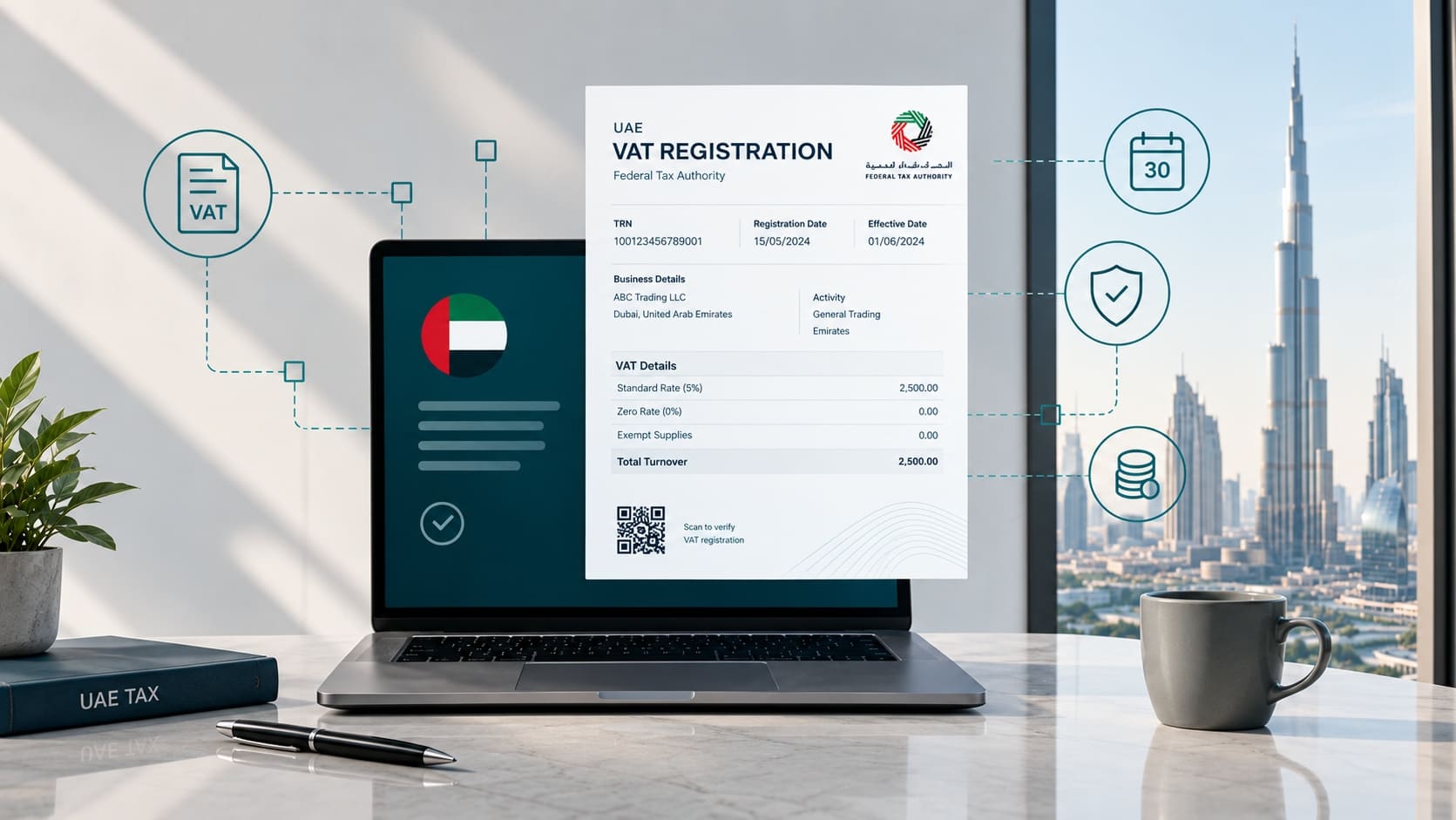
A company in Dubai is in its second year of trading, turnover is growing, and one month its sales over the previous 12 months pass AED 375,000. From that point it has 30 days to apply for VAT registration. Miss the deadline and the Federal Tax Authority (FTA) will impose a fine of AED 10,000 and demand VAT on sales on which the company never charged it.
VAT registration in the UAE is simple and free in itself, but mistakes in calculating turnover and in identifying the date the obligation arose are common. Below we explain how to calculate the threshold, the deadlines for applying, which documents you need and what to do as soon as you receive your tax registration number.
Who must register for VAT

VAT registration in the UAE is governed by Federal Decree-Law No. 8 of 2017 on Value Added Tax (the VAT Law) and its Executive Regulation, approved by Cabinet Decision No. 52 of 2017 — both as amended. The law covers three situations:
- Mandatory registration for residents (Article 13 of the VAT Law). If taxable supplies and imports over the previous 12 months exceeded AED 375,000, or are expected to exceed that amount in the next 30 days, a company or an individual doing business must register.
- Registration of non-residents (Article 13 of the VAT Law). A foreign company making taxable supplies in the UAE must register regardless of the amount if no other party to the transaction is required to pay the VAT on those supplies — for example, a customer registered for VAT in the UAE under the reverse charge mechanism.
- Voluntary registration (Article 17 of the VAT Law). If taxable supplies, imports or taxable expenses over the previous 12 months exceeded AED 187,500, or will exceed that amount in the next 30 days, a business may register by choice.
Table 1 — VAT registration thresholds in the UAE
| Situation | Threshold | Registration |
|---|---|---|
| Supplies and imports over 12 months, or expected in the next 30 days | Over AED 375,000 | Mandatory |
| Supplies, imports or taxable expenses | Over AED 187,500 | Voluntary |
| Non-resident making taxable supplies in the UAE | No threshold | Mandatory unless the customer pays the VAT |
| Below AED 187,500 | — | Not permitted |
How to calculate the registration threshold
The VAT registration threshold in the UAE is measured against taxable supplies, not total revenue. This is the distinction businesses most often get wrong.
Under Article 19 of the VAT Law, the calculation includes taxable supplies — both standard-rated at 5% and zero-rated (such as exports of goods and services) — imports of goods and services on which the recipient accounts for VAT itself (reverse charge), taxable supplies of a business wholly or partly acquired from another person and, in the cases set out in the Executive Regulation, taxable supplies of related persons.
Exempt supplies — such as residential property leases and certain financial services — and out-of-scope transactions are excluded, because they are not taxable supplies. In addition, Article 20 of the VAT Law expressly excludes sales of the company’s own capital assets (fixed assets) from the calculation.
The calculation uses a rolling period: each month, the company looks at the total for the previous 12 months, not for the calendar year. A forward-looking test applies at the same time: if supplies expected in the next 30 days — for example, under a large contract — will on their own exceed AED 375,000, the company must register straight away, without waiting for the money to arrive.
Companies that make only zero-rated supplies can apply to the FTA for an exception from mandatory registration (Article 15 of the VAT Law). If the exception is approved, the company does not receive a VAT TRN, but it also cannot recover input VAT. In addition, it must notify the FTA of any change that removes, or may remove, the grounds for the exception within 10 business days of the date of a standard-rated supply or import (Clause 3 of Article 16 of the Executive Regulation). This is a decision worth running the numbers on first.
Registration deadlines and the date VAT starts to apply
The registration application must be submitted within 30 days of the date the obligation to register arose (Clause 2 of Article 7 of the Executive Regulation). Under the historical test, the obligation arises at the end of the month in which the 12-month total exceeded the threshold. Under the forward-looking test, it arises on the day there were reasonable grounds to expect the threshold to be exceeded in the next 30 days.
The effective date of registration is not the same as the date of application. Under the historical test, registration takes effect from the first day of the month following the month in which the obligation to register arose. Under the forward-looking test, it takes effect from the date there were reasonable grounds to expect the threshold to be exceeded. An earlier date may be agreed with the FTA (Clauses 4 and 5 of Article 7 of the Executive Regulation). From the effective date of registration, the company must charge VAT, even if its TRN has not yet been issued.
Example: at the end of July, turnover for the previous 12 months exceeded AED 375,000. The obligation to register arose on 31 July, the application must be submitted by 30 August, and VAT applies from 1 August. If VAT was not added on top of invoices issued to customers from that date, the tax will have to be carved out of the amounts received and paid from the company’s own funds.
Table 2 — VAT registration deadlines
| Stage | Deadline |
|---|---|
| Submitting the application once the obligation arises | Within 30 days |
| FTA review of a complete application | Around 20 working days |
| VAT starts to apply (historical test) | 1st day of the month after the threshold is exceeded |
| First VAT 201 return | By the 28th day of the month after the end of the first tax period |
Late registration costs AED 10,000 (Cabinet Decision No. 40 of 2017, as amended by Decision No. 129 of 2025). On top of the fine, the FTA may register the company retrospectively — from the date the obligation arose — and require it to pay VAT on all taxable supplies and imports for the missed period (Clauses 3 and 7 of Article 7 of the Executive Regulation). From 14 April 2026, late payment of tax attracts a penalty of 14% per annum.
Voluntary VAT registration

Voluntary VAT registration in the UAE is available where taxable supplies, imports or taxable expenses exceed AED 187,500 over 12 months or are expected to do so in the next 30 days. The company must show that it carries on business in the UAE. This route is chosen by businesses that benefit from recovering input VAT: start-ups that have not yet begun selling but plan to make taxable supplies, trading companies with large purchases, and businesses whose customers are VAT registrants.
Voluntary registration takes effect from the first day of the month following the month of application, or from an earlier date agreed with the FTA (Clause 2 of Article 8 of the Executive Regulation). When registering on the basis of expenses, the FTA asks for at least five tax invoices from suppliers. Bear one limitation in mind: a voluntarily registered person cannot apply for deregistration within 12 months of registration (Article 23 of the VAT Law). Read more in accounting for start-ups in the UAE.
Step by step: registering on EmaraTax
Registration is online only, through the FTA’s EmaraTax portal. You log in with UAE PASS, and registration itself is free of charge.
- Log in to EmaraTax with UAE PASS and create a taxpayer profile.
- Select the VAT registration service.
- Enter the company’s details as shown on the trade licence, its business activity and contact details.
- Enter turnover figures: taxable supplies for the past 12 months and expected supplies for the next 30 days, plus imports and exports.
- State whether the company deals with customs and, if so, provide its customs registration number.
- Upload the documents and submit the application.
- Respond to any FTA queries within the set deadline.
- Once approved, download the VAT registration certificate showing your TRN.
You will usually need the trade licence, constitutional documents, passports and Emirates IDs of the owners and the authorised signatory, evidence of turnover (such as a signed turnover declaration or financial statements) and supporting documents — contracts, invoices and a forecast of expected sales. All files must be uploaded in PDF format only, with a maximum size of 15 MB per file.
According to the FTA, a complete application takes around 20 working days to review. The most common causes of delay are incorrectly calculated turnover (for example, leaving out zero-rated supplies), inconsistencies with the licence and failure to respond to an FTA query. For more on the tax number itself, see what is a TRN in the UAE.
What to do after registration
Once it has a TRN, the company becomes a VAT registrant with ongoing obligations:
- issue tax invoices showing the TRN and the VAT amount in dirhams;
- file a VAT 201 return by the 28th day of the month following the tax period — usually a quarter;
- pay the VAT by the same deadline;
- keep VAT records for at least five years (longer for real estate transactions);
- check suppliers and the supplies themselves before recovering input VAT — required from 1 October 2026 under FTA Decision No. 13 of 2026.
If registration was late, the first step is to work out which sales after the effective date of registration went out without VAT, and to settle the matter with customers and the FTA. Errors in returns already filed are corrected through a voluntary disclosure. For why a return must be filed even with no sales, see nil VAT return in the UAE.
How much VAT registration costs
At Dynasty Business Adviser, FTA registration for VAT costs a one-off fee of AED 2,000. FTA registration for corporate tax costs a one-off fee of AED 1,300.
After registration, you will need ongoing bookkeeping. The cost depends on the number of transactions per month:
- up to 10 transactions — AED 1,100 per month;
- up to 25 transactions — AED 1,500 per month;
- up to 50 transactions — AED 2,100 per month;
- 50 to 100 transactions — AED 3,100 per month;
- over 100 transactions — on request.
Filing nil returns costs AED 1,500 per year. All prices exclude VAT. The final cost is determined individually when the contract is prepared and signed. A package covering accounting and tax services costs less than the same services bought separately.
Conclusion
VAT registration in the UAE is mandatory where taxable supplies and imports exceed AED 375,000 and available on a voluntary basis above AED 187,500. You have 30 days to apply, and VAT applies from the effective date of registration, not from the date the TRN is issued. The threshold is measured over a rolling 12 months and includes zero-rated exports. Registering late costs AED 10,000 plus VAT on sales already made.
The specialists at Dynasty Business Adviser will register your company with the FTA and take care of your bookkeeping and return filing.
Get a consultation
This article is for information only and does not constitute individual tax advice. Information is current as of October 2026; thresholds, deadlines and penalties may change — check them at the time of your enquiry on the FTA portal (tax.gov.ae) or with an adviser.