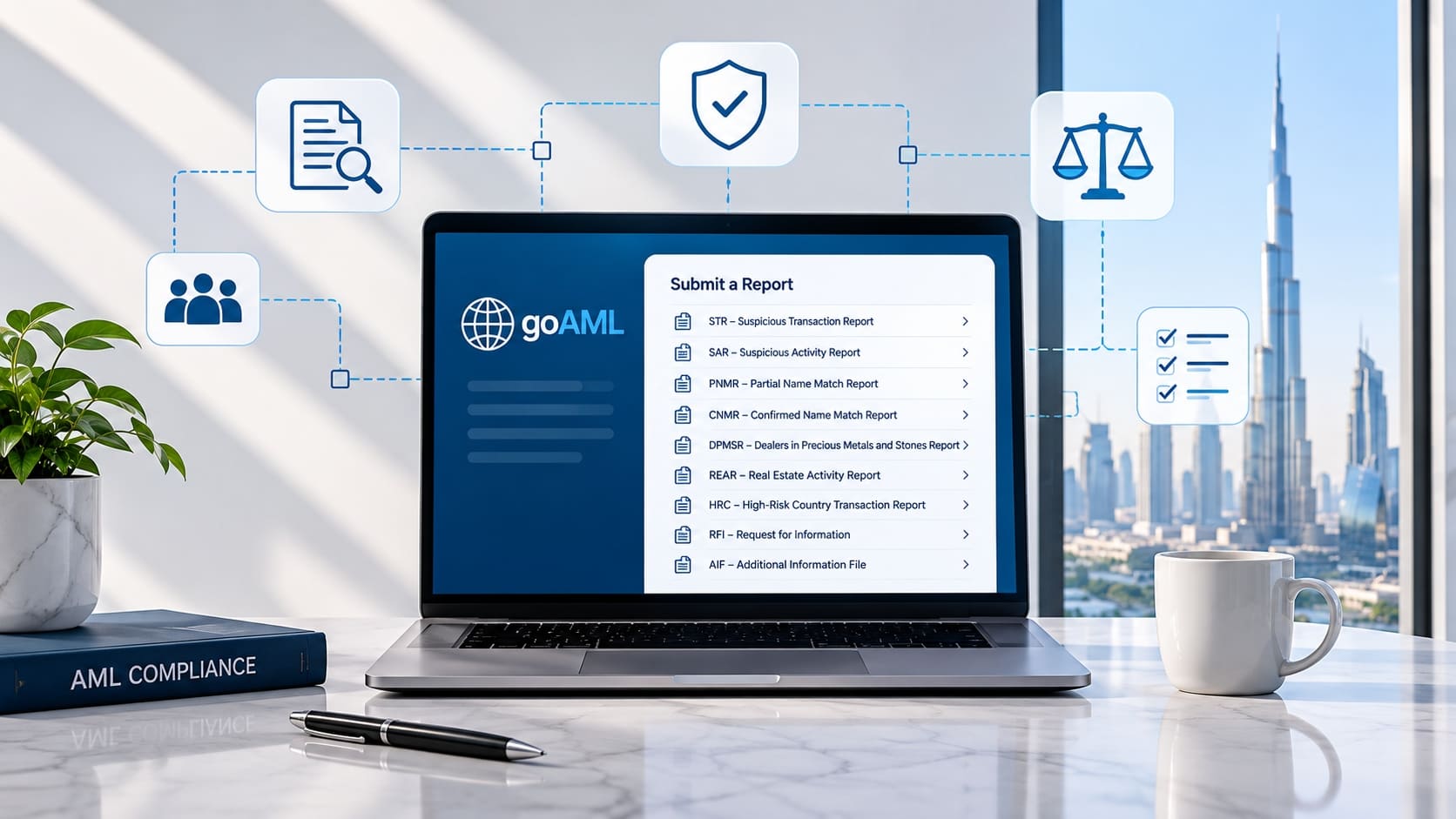
Registering in goAML only gets you through the door. What the system exists for comes next: reporting. A UAE company with AML obligations files not one but nine types of report through goAML — from a suspicious transaction report (STR) to a Partial Name Match Report (PNMR) against the sanctions lists. Each has its own trigger, form and consequences, and failing to file an STR is a criminal offence under Article 28 of Federal Decree-Law No. 10 of 2025.
This guide to goAML STR reporting in the UAE puts every goAML report type in one table, explains SAR vs STR, walks through the process from an employee’s internal disclosure to submission, shows how to file an STR in goAML step by step, covers PNMR filing after a sanctions-list hit and sets out what happens once a report is in. It is written for MLROs and DNFBP managers who file their own reports; if an external compliance officer does this for you, it shows exactly what they are doing.
What goAML is and who files the reports
goAML is a platform developed by the United Nations Office on Drugs and Crime that the UAE Financial Intelligence Unit (FIU) uses to receive reports from financial institutions, DNFBPs and VASPs. A company gains portal access once registered; reports on its behalf are filed by the appointed compliance officer (MLRO), who is also the account administrator, creates additional users and may delegate filing to an external provider with the supervisory authority’s approval. Login is by SACM credentials and a one-time code from Google Authenticator.
How to register, and by when, is covered on our goAML registration page. This article is about what comes after.
All goAML report types
| Report | Full name | When it is filed | Who files |
|---|---|---|---|
| STR | Suspicious Transaction Report | There is a specific transaction — completed or attempted — that raises a suspicion of ML/TF | All obliged entities |
| SAR | Suspicious Activity Report | There is a suspicion but no specific transaction: the client’s behaviour, a request, a deal that was declined | All obliged entities |
| AIF / AIFT | Additional Information File — supplementary information without transactions / with transactions | The company adds to a previously filed report on its own initiative | All |
| RFI / RFIT | Request for Information — reply to an FIU request without transactions / with transactions | The FIU has requested information via the message board; the reply is due within the deadline set in the request | All |
| PNMR | Partial Name Match Report | A client’s or counterparty’s name partially matches a sanctions list and the match has not been confirmed | All |
| CNMR | Confirmed Name Match Report | The sanctions-list match is confirmed and the funds have been frozen | All |
| HRC / HRCA | High-Risk Country Transaction / Activity Report | A transaction or activity with a client from a high-risk country on the National Committee’s list | All |
| DPMSR | Dealers in Precious Metals and Stones Report | A cash transaction of AED 55,000 or more — single or linked | Dealers in precious metals and stones |
| REAR | Real Estate Activity Report | Payment in cash of AED 55,000 or more, or in virtual assets, in a real estate transaction | Real estate agents and brokers |
The goAML report types fall into four groups: suspicion-based (STR, SAR), supplements and replies to FIU requests (AIF, RFI), sanctions-based (PNMR, CNMR) and transaction-based reports filed without any suspicion (DPMSR, REAR, HRC). The last group are notifications: filing one does not mean the client is suspected. The sector report thresholds are in our article on AML thresholds in the UAE.
SAR vs STR in the UAE: what is the difference
Both are filed on suspicion of money laundering, terrorist financing or proliferation financing. The difference is whether there is a transaction:
| STR | SAR | |
|---|---|---|
| Is there a specific transaction? | Yes — completed, declined or attempted | No — the suspicion arises from behaviour, structure or a request |
| Examples | AED 80,000 in cash with no explanation of the source; a transfer to a third party’s account; payment from a company unconnected to the client | The client refuses to provide documents after being asked about the source of funds; asks to put the deal in a nominee’s name; tries to find out the reporting threshold |
| Data in the form | Transaction: amount, date, accounts, parties | Description of the activity and the persons involved, with no transactions block |
| Minimum amount | None | None |
The general rule: if the suspicion concerns money that moved or was meant to move, file an STR; if it concerns how the client behaves, file a SAR. When in doubt, file an STR describing the transaction — the FIU would rather have the information than a perfect classification.
When to file: red flags for a suspicious transaction report in the UAE

The law requires an STR where there are reasonable grounds to suspect that funds are linked to a crime — not certainty, not a proven fact. Red flags vary by sector; the most common ones from supervisory guidance:
- general: a transaction inconsistent with the client’s profile, reluctance to explain the source of funds, splitting amounts to stay under the threshold, third parties involved for no economic reason, questions about reporting rules;
- real estate: payment in cash or crypto-assets, purchase without viewing, rapid resale, payment from the account of someone who is not a party to the deal;
- precious metals: large cash sums from a non-resident, refusal of a receipt, purchases of identical items just under the threshold;
- corporate services: company formation through nominees with no clear purpose, frequent UBO changes, a client from a high-risk country with no connection to the UAE;
- accounting: fictitious invoices, turnover that does not match the business, loans from related parties with no paperwork.
The law describes the filing deadline as “without delay”. Federal law sets no fixed number of days for DNFBPs, but the internal policy must fix how long the MLRO has to decide — in practice, no more than a few working days from the internal disclosure.
The internal process: from employee to report
- An employee spots a red flag and sends an internal disclosure to the MLRO on the prescribed form, describing the situation, client and documents. The employee does not discuss it with the client.
- The MLRO logs the disclosure in the internal disclosure register with the date and time of receipt.
- The MLRO analyses the client file, transaction history, open sources and screening results. Where necessary, the MLRO asks the client for clarification — neutrally, as part of routine checks.
- The MLRO decides — file or do not file — and records the decision in writing with reasons. A decision not to file is documented too: the inspector will ask why.
- The report is filed through goAML — an STR or SAR with supporting documents attached.
- After filing: the tipping-off prohibition applies, a decision is taken on the relationship, the company stands ready to answer an FIU request, and all materials are retained for at least 5 years.
A Ministry of Economy and Tourism (MoET) inspector looks at precisely this chain: the internal disclosure register, the MLRO’s written decisions, the submission confirmations. No STRs filed is not a breach in itself if there were no suspicious transactions — but no register means the system is not working. How to set up the MLRO function is covered on our outsourced MLRO page.
How to file an STR in goAML: step by step
- Log in to the goAML portal under the MLRO account: SACM login and a code from Google Authenticator.
- New Reports → Web Report. Select the report type: STR or SAR. For sanctions reports, PNMR or CNMR; for sector reports, DPMSR, REAR or HRC.
- Complete the Report section: date, reason for filing (reason), suspicion indicators from the drop-down list, a brief account of the situation (action taken, description). The description is written in English, specifically and factually: who, what, when, how much, why it is suspicious.
- The Transactions section (for STR, DPMSR, REAR, HRC): transaction number and date, amount and currency, method (cash, transfer, crypto-assets), the “from” and “to” parties — a person, an account or a company.
- The Involved parties / Activity section (for SAR, PNMR, HRCA): details of the individuals and companies — full name, date of birth, nationality, passport or Emirates ID, address, role in the situation.
- Attachments: the KYC file, contracts, statements, correspondence, screening results — one or several files in a permitted format and size.
- Preview → Submit. Preview and print a copy for the file before sending. Once submitted, the report receives a number and a status.
- Check the status under Submitted Reports: accepted — taken in; rejected or reverted — returned with comments, to be corrected and resubmitted.
The form rejects a report where mandatory fields are empty or the format is wrong — most often a wrong date format, a missing indicator or an empty transaction-parties block. A rejected report counts as not filed until it is resubmitted.
PNMR and CNMR: sanctions-list reports in goAML
Screening clients and counterparties against the sanctions lists — the UN lists and the UAE local list — is mandatory for all obliged entities, before a relationship begins and on every list update notified by the Executive Office for Control and Non-Proliferation (EOCN). Screening produces one of three results:
| Result | What to do | Report |
|---|---|---|
| No match | Log the result in the screening register | Not required |
| Partial match: the name is similar, but the date of birth, nationality or other details make it impossible to confirm or rule out | Do not proceed with the transaction until clarified; request additional data; file a report | PNMR — via goAML, within 5 working days of detection under EOCN guidance |
| Confirmed match | Freeze the funds and assets immediately without notifying the client; file a report | CNMR — via goAML, within 5 working days of the freeze under EOCN guidance |
The PNMR is the most underrated report: companies either do not know it exists or assume a partial match can be “screened out” in-house. The regulator expects the opposite: if the data cannot rule out the match, the report is filed and the EOCN decides. False positives on common names happen all the time, and that is exactly what the Partial Name Match Report (PNMR) is for. Sanctions reports are filed independently of any STR: one event can give rise to both a CNMR and an STR.
Sector reports: DPMSR, REAR and HRC in goAML

- DPMSR — dealers in precious metals and stones file it for a cash transaction of AED 55,000 or more, single or a series of linked ones. It records the buyer, the goods, the amount and the payment method. No suspicion is required; where there is one, an STR is filed in addition.
- REAR — real estate agents and brokers file it for cash payments of AED 55,000 or more, and for any payment in virtual assets or in proceeds from their sale. It records the parties, the property, the amount and the payment method.
- HRC / HRCA — transactions and activities with clients from countries the National Committee classifies as high-risk. Filed regardless of amount, against the list the regulator circulates to obliged entities.
What happens after filing
- The tipping-off prohibition. Telling the client or any third party that a report has been filed or that a check is under way is prohibited — Article 29 of Federal Decree-Law No. 10 of 2025, a fine of at least AED 50,000 and imprisonment. Staff need to know which phrases are off limits even in casual conversation with a client.
- A decision on the relationship. Filing an STR does not oblige you to end the relationship, but the company must assess the risk: step up monitoring, move the client to high risk or decline the deal.
- FIU requests. Via the message board the FIU may ask for further information — the reply is filed as an RFI/RFIT within the deadline in the request. Non-compliance is a separate breach with a fine from AED 200,000 under the penalty schedule.
- FIU measures. The head of the FIU may suspend a transaction for up to 10 working days and freeze funds for up to 30 days without notifying the client.
- Record-keeping. The report, attachments, internal disclosure and MLRO decision are retained for at least 5 years.
- Immunity. Filing in good faith carries no liability towards the client for breach of confidentiality — even if the suspicion proves unfounded.
Liability for reporting failures
| Breach | Penalty | Legal basis |
|---|---|---|
| Failure to file an STR where there were grounds | Imprisonment and a fine of AED 100,000 to AED 1,000,000 | Art. 28, Federal Decree-Law No. 10 of 2025 |
| Tipping-off | Imprisonment and/or a fine of at least AED 50,000 | Art. 29, Federal Decree-Law No. 10 of 2025 |
| Failure to notify the FIU of a suspicious transaction (administrative) | From AED 200,000 | MoET penalty schedule |
| Late filing of an STR | From AED 100,000 | MoET penalty schedule |
| Failure to comply with an FIU request | From AED 200,000 | MoET penalty schedule |
| Failure to act on the sanctions lists, no PNMR/CNMR | From AED 1,000,000 | MoET penalty schedule |
The full scale is in our article on AML fines and penalties in the UAE.
Common mistakes
- Filing an STR “just in case” without analysis. The FIU returns reports that do not describe the grounds; mass defensive filing is a sign the system is not working.
- Not filing because “the amount is small”. There is no threshold for an STR.
- “Screening out” partial matches in-house without a PNMR.
- A description in another language or in vague terms. The form is completed in English and specifically: dates, amounts, names, why it is suspicious.
- No written MLRO decision on disclosures where no report was filed.
- Telling the client about a “delay due to compliance”. That is tipping off.
Practical scenarios
| Situation | Report | Action |
|---|---|---|
| A flat buyer pays AED 300,000 in cash and will not explain the source | REAR + STR | REAR for the cash payment; STR for the suspicion; EDD; decision on the deal |
| An accounting firm’s client asks to route a payment through the firm’s own account “for convenience” | SAR | Internal disclosure, refusal, SAR describing the request |
| Screening a new counterparty: name match, date of birth unknown | PNMR | Do not proceed, request the data, file a PNMR within 5 working days |
| Screening: full match with a person on the UN list | CNMR | Freeze the funds immediately, file a CNMR, do not notify the client |
| Jewellery shop: AED 70,000 in cash, the client is a tourist with a passport and has explained it all | DPMSR | CDD, DPMSR report; no STR required |
| The FIU sends a request via the message board about a previously filed STR | RFIT | Gather the documents, reply by the deadline in the request |
Conclusion
goAML STR reporting in the UAE is not a single STR but a system of nine report types with different triggers: suspicion (STR, SAR), sanctions (PNMR, CNMR), the fact of a transaction (DPMSR, REAR, HRC) and replies to FIU requests (RFI, AIF). It only works when the chain is in place: employee → internal disclosure → written MLRO decision → report → retention. There is no amount threshold for an STR, the deadline is without delay, and telling the client about the filing is a criminal offence.
If you need to set up an internal disclosure procedure, train staff on the red flags or hand report filing to an external MLRO, the specialists at Dynasty Business Adviser will take this function on. More on our «AML compliance in the UAE» page. Contact us: +971 52 634 1022
Get a consultation
Information correct as at 13 October 2026. This article is based on Federal Decree-Law No. 10 of 2025, Cabinet Resolution No. 134 of 2025 and FIU and EOCN guidance, and does not constitute a legal opinion. The goAML interface and list of report types are updated from time to time — check the current version of the portal.