

What are the advantages of registering an offshore company in the UAE?
- Possibility of owning 100% foreign capital. At the same time, registration of a local onshore company operating in the oil, gas, banking, hotel, and insurance sectors requires a partner – a UAE citizen owning 51% of the shares;
- Exemption from customs duties and almost all taxes, under certain conditions;
- Lack of government control over foreign exchange transactions and restrictions on capital repatriation;
- Lower cost of registration compared to onshore companies in free zones and local companies opened outside them;
- Minimum requirements for the authorized capital, the number of shareholders and directors when opening a company, as well as its rapid registration of an offshore company in the UAE;
- Complete confidentiality of the company’s activities, and information about its beneficiaries and directors. The reason is that the UAE is not a member of the OECD, so it does not share information with the tax departments of other countries, and the register of offshore companies registered in the UAE is non-public;
- The right to open an offshore account in any bank in a country whose banking system is distinguished by reliability, security, and low cost of services, as well as abroad.
An offshore company in the Emirates may have its own characteristics, depending on the free economic zone where it is registered.
What Is an Offshore Company in the UAE?
A UAE offshore company is an international commercial company that operates exclusively outside the Emirates. It cannot conduct business within the UAE domestic market, cannot rent commercial premises, does not entitle its owner to a UAE resident visa, and in most cases cannot hold real estate in the UAE. Banking, financial and insurance activities are also prohibited.
In every other respect it is a fully fledged company — with articles of association, a director, a shareholder and its own ownership structure, much like any company in any other jurisdiction. Its defining characteristic is an orientation toward international operations rather than activity inside the UAE.
Why Set Up an Offshore Company in the UAE: Use Cases?
An offshore company is almost always opened for a specific purpose. The most common scenarios we encounter are the following.
- Corporate structuring and confidentiality. The offshore company holds a stake in an operating company, while day-to-day management is handled by an appointed manager. As a result, the ultimate beneficial owner is not immediately visible and is far harder to identify through open sources. This is about protection from unwanted scrutiny — not concealment from the law.
- Separating business streams. Suppose you run a trading company and work with a major dealer, but want to service that dealer’s direct competitor at the same time. A single entity makes this awkward. A separate offshore company for the second stream solves the problem — and costs less to maintain than a free zone or mainland company.
- Intellectual property ownership and securities trading. Offshore companies are a practical vehicle for holding IP rights and for trading on financial markets through a legal entity rather than as an individual.
- Holding corporate rights. An offshore company may own shares and interests in other companies — both in the UAE and abroad.
One common question concerns real estate. The offshore company itself cannot hold property in the UAE, but workable structures exist. For example, a private foundation can acquire the asset — and here a key rule applies: the foundation must be registered in the same emirate where the property is located (a Dubai property requires a Dubai foundation; an Abu Dhabi property requires an Abu Dhabi foundation). Alternatively, a separate property-owning company managed by an appointed manager allows the beneficial owner’s name to remain out of transaction documents. Holding structures are a separate topic covered in dedicated materials.

Where to Register: Ajman Offshore and JAFZA
Dynasty Business Adviser works with two UAE offshore jurisdictions that cover the majority of client requirements.
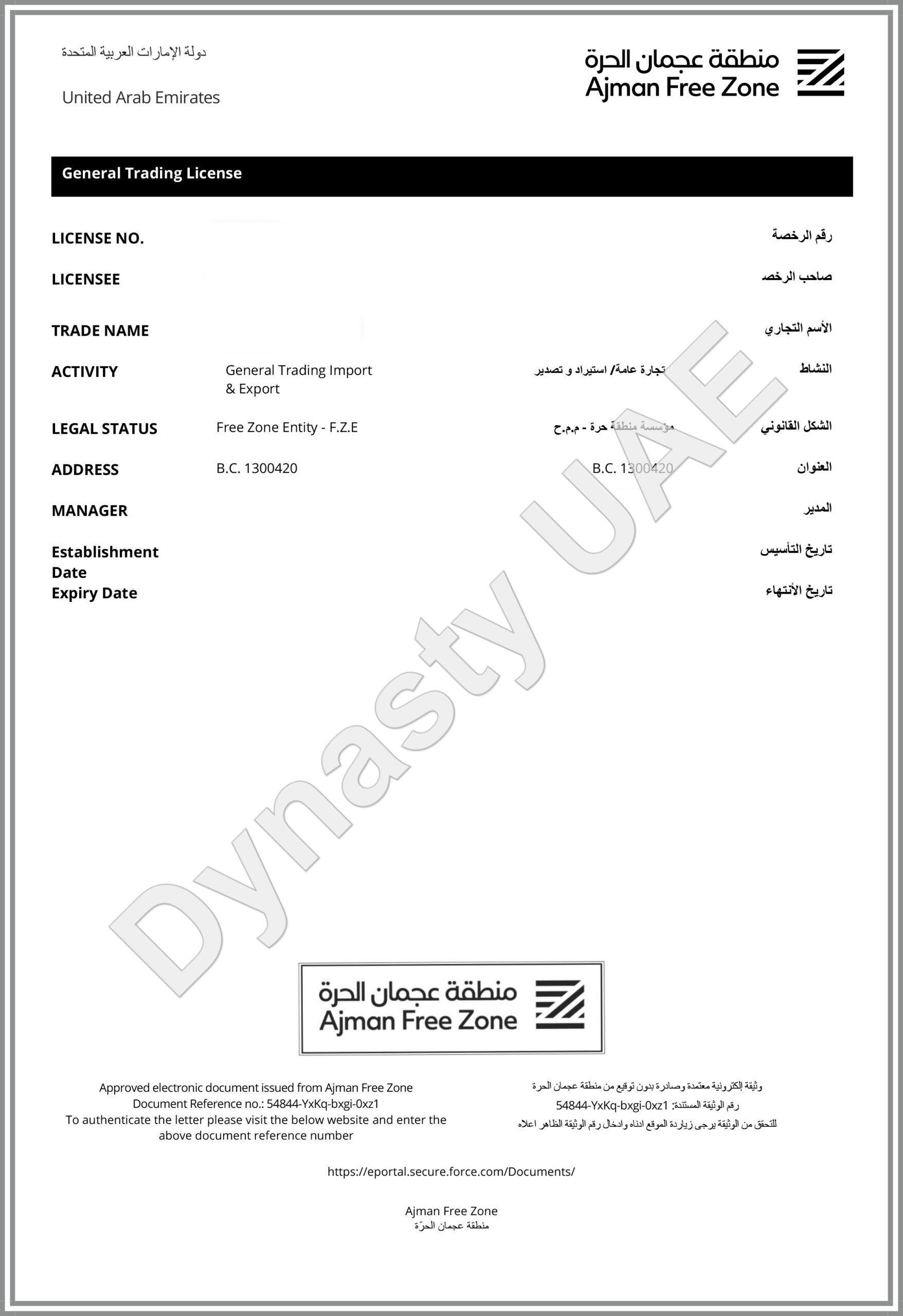
Ajman Offshore — the simplest and fastest option. Registration takes 2–3 days and costs USD 2,500; annual renewal is USD 2,000. Its key advantage is a closed registry: the company cannot be looked up by name, and the only way to verify its registration is via the QR code on the incumbency certificate. The limitation: this structure cannot hold real estate in the UAE.
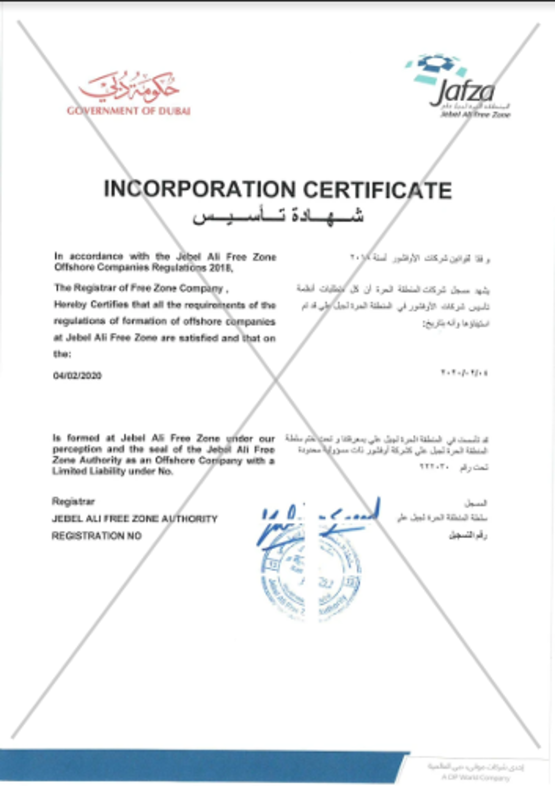
JAFZA Offshore (Jebel Ali) — a more involved jurisdiction. Registration costs USD 6,000 and takes 2–3 weeks. It enables ownership structuring for real estate in Dubai. Requirements are higher: two directors are needed, who may be the owner, third parties, or nominee directors supplied by our firm.
Ajman Offshore is the default recommendation for most tasks. JAFZA is chosen primarily when the offshore company needs to hold real estate in Dubai. By comparison, other offshore registries — such as RAK ICC — allow registration to be verified publicly, whereas the Ajman Offshore registry remains closed.
|
Parameter |
Ajman Offshore |
JAFZA Offshore |
|---|---|---|
|
Registration cost |
USD 2,500 |
USD 6,000 |
|
Registration timeline |
2–3 days |
2–3 weeks |
|
Annual renewal |
USD 2,000 |
Per zone tariff |
|
UAE real estate |
Not permitted |
Permitted (Dubai) |
|
Directors required |
1 |
2 (nominees available) |
|
Registry |
Closed — QR verification only |
Publicly verifiable |

Restrictions for offshore companies in Dubai and other emirates
Regardless of the free-zone in which an offshore company is registered in the UAE, it is subject to certain restrictions. Offshore companies in the UAE are prohibited from:
- conducting any activity in the country – an offshore company can engage in international trade and management of sea vessels, holding and consulting (except for the Jebel Ali free zone) activities, or providing professional services outside the UAE;
- cooperating with legal entities registered in the Emirates and receiving bank transfers from them. At the same time, an offshore UAE company can be a founder of local and foreign companies, companies in the free zone, or acquire their shares;
- renting a real (physical) office in the country;
- applying for a UAE resident visa;
- engaging in financial, media, and aviation activities, working with precious metals, gas, and oil.
All these restrictions must be taken into account if you are going to open an offshore company in the UAE.
Permitted Activities
A UAE offshore company may engage in virtually any commercial activity, subject to one condition — it must be conducted outside the UAE. This includes international trade, consulting, professional services and much else besides.
The main restriction concerns banking and licensed financial services, which are not available to offshore companies. That said, because the company is not regulated within the UAE and operates beyond its borders, certain activities — such as extending loans as part of international operations — remain permissible. The precise scope of permitted activities is always confirmed on a case-by-case basis.

Taxation: 0% or 9%?
The tax position of an offshore company depends on the specifics of its structure, so precision matters here.
If an offshore company is registered in the UAE and holds a UAE bank account, the law clearly requires registration with the UAE tax authority and payment of corporate tax at 9%.
If the company’s bank account is held outside the UAE, the founder does not reside in the UAE, and management is not conducted from the UAE, the company is generally treated as non-resident — in which case UAE tax registration may not be required. This is not a universal rule: it is a position that depends on the specific structure and circumstances, and should always be verified for your particular case.
On economic substance (ESR): for most offshore companies this does not become a practical obstacle. The exception involves specific scenarios such as IP ownership or holding activities, which may require board meetings to be held in the UAE. Where necessary, we as agents ensure that these requirements are met.
Confidentiality and the Beneficial Ownership Register (UBO)
Confidentiality is one of the primary reasons clients choose a UAE offshore. The Ajman Offshore registry is non-public: no third party can search for the company by name or identify its owner through open databases. The only way to verify the company’s registration is via the QR code on the incumbency certificate held by the owner.
This distinguishes UAE offshore companies from classic offshore vehicles such as BVI or Panama, and from a number of other jurisdictions where ownership information can be obtained for a fee. Beneficial owner data is administered through a licensed agent at the time of renewal; it remains inaccessible to third parties and is not publicly available.
Tax Information Exchange (CRS) and CFC Rules
It is important to understand exactly how information exchange works. The offshore company’s registrar does not exchange any tax information — it is not a financial institution. CRS reporting arises only when the company holds a bank account, and flows through the bank.
When opening an account, the bank collects the country of tax residence, the tax identification number (TIN), proof of address, and details of controlling persons. On this basis the bank reports to the relevant authority under CRS when the applicable conditions are met. The threshold of approximately USD 250,000 applies only to pre-existing accounts of legal entities and is treated as an option; new accounts are reportable without a threshold, and no threshold applies to individual accounts at all.
In many countries, controlled foreign company (CFC) rules apply. A company registered in the UAE will typically be treated as a CFC by its owner’s home jurisdiction. Whether to disclose that entity in the country of the owner’s tax residence is the owner’s own responsibility.
Bank Account for an Offshore Company
This is the most sensitive issue, and we address it directly. Opening a bank account for an offshore company at a UAE bank is difficult in practice when the founder is not a UAE resident. The bank will require documented source of funds, a clear business rationale, and typically a significant account balance — in the order of AED 5 million (approximately USD 1.35 million). Without these, a refusal is the likely outcome.
For this reason, a local bank account for a non-resident offshore is rarely the practical route. Our recommendation is a working alternative: foreign banks and electronic money institutions (EMIs), where accounts can be opened for an offshore company entirely remotely. This keeps the company fully non-resident. Further details on corporate account options are covered in a separate guide.
Documents Required for Registration
For an individual founder, the basic package is minimal:
- passport scan of the founder;
- utility bill (proof of residential address).
A video verification of the founder with their passport is also conducted. If the founder is a legal entity, the package is expanded to include the founding company’s corporate documents, duly legalised. Signed originals of the incorporation documents are sent to us after signing.
Procedure and Timeline
The process is designed so that no visit to the UAE is required:
- you send a passport scan and proof of address;
- we conduct video verification and reserve the company name;
- we prepare the incorporation documents; you sign and return scans, then send originals;
- the company is registered on the basis of scans; completion follows upon receipt of originals;
- a bank or payment account is then opened — typically with a payment institution.
Registration itself takes 2–3 days for Ajman Offshore and 2–3 weeks for JAFZA Offshore. Additional time may be needed for legalisation of original documents.
Documents You Receive
Upon registration you receive the certificate of incorporation and the company’s memorandum and articles of association. Additionally, you may order an incorporation certificate and an incumbency certificate, which sets out the owner, directors and share capital.
Cost of Opening an Offshore Company in the UAE
The all-inclusive registration fee is USD 2,500 for Ajman Offshore and USD 6,000 for JAFZA Offshore. Annual renewal of Ajman Offshore is USD 2,000. Company liquidation takes 2–3 weeks, requires a liquidation audit, and costs approximately USD 3,000–5,000 depending on whether the company conducted any activity.
Get a quoteNominee Services
We provide nominee directors. We do not offer nominee shareholders: under current rules, such an arrangement still requires disclosure and registration with the Ministry of Economy, which defeats the purpose. The required level of confidentiality is achieved through properly structured corporate arrangements rather than through nominee ownership.
Jurisdiction Reputation
The UAE is a reputable jurisdiction — not a blacklisted one. In February 2024 the country was removed from the FATF grey list (“Jurisdictions under Increased Monitoring”), and in 2025 the European Union removed the UAE from its list of high-risk jurisdictions. This strengthens the confidence that banks and counterparties place in companies registered in the Emirates.
Why Choose Dynasty Business Adviser?
We are a licensed agent for offshore company registration in the UAE. Our team has opened hundreds of offshore companies and has extensive experience building complex legal structures that protect founders from unwanted scrutiny. We select the right jurisdiction for your needs, handle registration remotely, assist with bank accounts through foreign banks and payment institutions, and provide ongoing company administration.
Ready to open an offshore company in the UAE? Contact Dynasty Business Adviser for a consultation — we will identify the right solution and manage the entire process.