
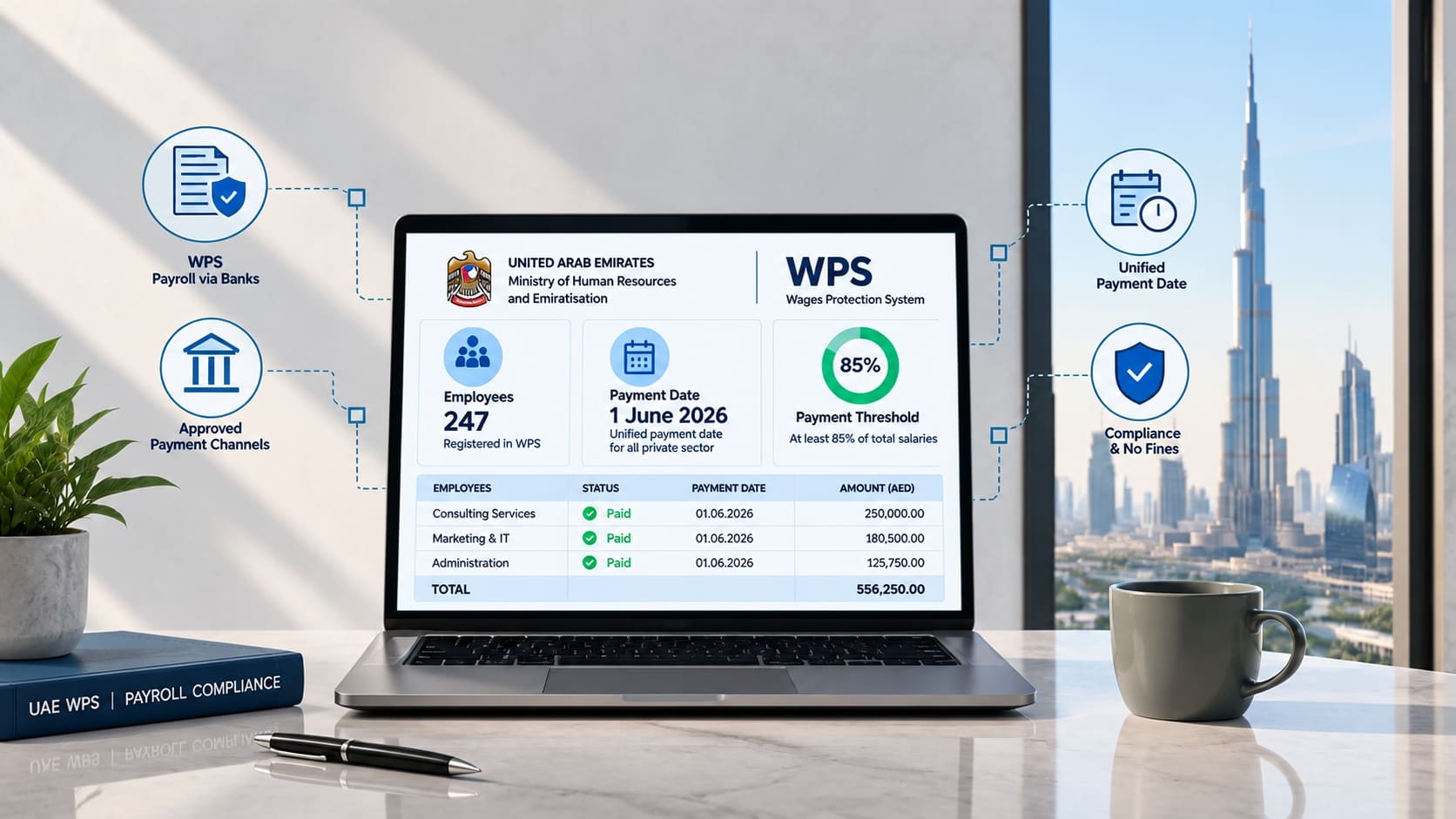
When a founder hires their first employee in the UAE, the first two things on their mind are usually the visa and the contract. Then it turns out that a salary cannot simply be sent to a bank card or handed over in cash: every payment has to pass through a government system that records the amount, the date and the recipient. That system is WPS UAE — the Wages Protection System, the backbone of paying salaries in the UAE for every private-sector employer.
More than AED 37 billion in wage payments moves through it every month, a figure published by the Ministry of Human Resources and Emiratisation. From 1 June 2026 the rules changed: the country now has a single due date for wages and a published day-by-day timeline of measures that apply to an employer who falls behind. Here is how the system works and what a company needs to rebuild around it.
What WPS Is and How It Works

WPS is the electronic system through which an employer transfers salaries to staff, and MoHRE sees that the transfer happened. Every registered worker is meant to receive their salary through WPS rather than through a personal transfer or a handshake arrangement. Money moves through banks, finance companies and exchange houses connected to the network; the ministry publishes the list of participating institutions on its own site.
The logic is straightforward. An employer registers each worker in the system, links the amount stated in the employment contract, and sends a payment file every month through its agent. The system checks how many people were due to be paid against how many actually received their wages. Once the gap crosses a set line, the timeline of measures switches on.
WPS is not a tax tool, and it is not there to police your spending. It exists to protect workers from delayed pay and from informal arrangements where the contract states one figure and the worker is handed another. That is also why forging receipts or entering false data under MoHRE WPS rules is punished more heavily than a plain delay — regulators treat it as a separate, more serious violation.
What Changed From 1 June 2026
The rule in force is Ministerial Resolution No. (340) of 2026 Concerning the Wage Protection System, signed on 12 May 2026 and effective from 1 June 2026. It repeals the earlier Ministerial Resolution No. 598 of 2022.
The main change is the unified due date. The first day of every Gregorian month is now the single due date for the previous month’s wages, for every private-sector employer. Any payment made after that date counts as a delay. Previously the starting point depended on what the contract said; now there is one date for everyone.
The second change is a transparent timeline of measures. Rather than simply announcing a fine, the ministry has spelled out what happens on which day. Its own commentary stresses that the resolution formalises procedures that already existed rather than creating new substantive duties — it makes predictable what used to be left to discretion.
The 85% Threshold: When a Company Has Met Its Obligation
This is the rule people ask about most. An employer is considered to have met its obligation to pay wages if, no later than the due date, it has transferred no less than 85% of the total wages, owed to its workers.
The same logic runs the other way: a worker is not treated as unpaid if they received no less than 85% of what is owed, provided the shortfall comes from lawful deductions under the labour law. This covers deductions the law allows, not an employer trimming pay on its own judgement.
It is easy to misread this rule. The 85% threshold is not permission to pay 15% less — the worker’s right to the full amount stands. The threshold exists for a different reason: so that a hitch in one payment out of twenty does not tip an entire company into non-compliant status.
What Happens Day by Day When Payment Is Late
The schedule attached to the resolution sets out six stages, counted from the due date — the first day of the month.
Table 1 — Measures when wages are paid late
| Day | What happens | Who it affects |
|---|---|---|
| From the due date | Electronic monitoring until payment is confirmed | All employers |
| From day 2 | Notifications and reminders to pay | Non-compliant employers |
| Day 5 | Suspension of new work permits, owner notified | Non-compliant employers |
| Day 11 | Administrative fine and move into the Third Category | On a repeated violation within six months |
| Day 16 | Automatic registration of a labour dispute, permits suspended | Establishments with 25+ workers, in all sectors |
| Day 21 | Executive instrument, precautionary attachment, travel ban on the person in charge | Depending on establishment size |
Day 5 hits a business before any fine does. Suspension of new work permits means the company cannot hire anyone else until the arrears are cleared, and for a growing company that is more costly than any penalty on this list.
Day 16 and day 21 are built on a risk-based logic, and this is where the rule is most often misread. The day-16 measures apply to any non-compliant establishment with 25 workers or more, in all sectors, with no exception for the type of activity. The sector list only comes into play under the second, alternative ground — a group of establishments under common ownership where the combined number of unpaid workers reaches 25; there, it matters whether the activity falls under construction, transport and storage, security services, cleaning services, recruitment agencies or domestic worker recruitment offices.
On day 21, establishments with fewer than 50 workers receive an executive instrument ordering payment; for 50 workers or more, collective labour dispute procedures begin instead. Precautionary attachment of assets and a travel ban on the person responsible for the company can also follow. On a repeated violation within two consecutive months, the file for establishments above 50 workers is referred to the Public Prosecution. A separate provision applies regardless of the establishment’s size wherever there is a risk to the stability of the labour market.
How Much This Costs

The fine amounts are not set by the WPS resolution itself but by Cabinet Resolution No. 21 of 2020 on fees and administrative fines of the ministry.
Table 2 — Fines connected to the WPS
| Violation | Amount | Cap |
|---|---|---|
| Failing to pay wages through WPS by the due date | AED 1,000 per worker | AED 20,000 |
| Signing simulated payment receipts or entering incorrect data into WPS | AED 5,000 per worker | AED 50,000 |
Employers searching for the fine for late salary payment UAE usually land on this table first. The fivefold gap between the two rows tells you where the regulator’s priorities sit. A delay is treated as a lapse and fined moderately. Trying to fool the system is a different matter, and its cap is two and a half times higher.
The most expensive sanction, though, is not on this table. Being moved into the Third Category under the employer classification system means paying the maximum tariff for work permits, with none of the discounts an establishment would otherwise earn, including those tied to Emiratisation. For a company with dozens of staff, that gap becomes far more painful than any single fine over the course of a couple of years.
Tell us how your workforce is structured — how many staff, in which zone, on what kind of contracts — and we will build a payroll process where the first of the month arrives without a scramble.
Who WPS Does Not Cover
The resolution lists eleven exclusions, and they turn on categories of worker and type of activity rather than on company size.
Excluded from the system are workers whose wage dispute is already before a court or subject to an executive instrument, within the amount and period of that dispute; workers reported absent from work, for the duration of that report; workers whose liberty has been restricted by a competent authority’s decision; and staff on unpaid leave.
Also named separately are seafarers on ships; foreign workers of foreign establishments and their branches in the UAE who are paid outside the country; and holders of mission work permits valid for up to three months. The list closes with citizen-owned fishing vessels and taxis, banks and financial institutions, and places of worship.
These exclusions are not automatic, and the conditions attached to each of them differ. Unpaid leave and restricted liberty require notifying the ministry with supporting documents. Seafarers require a request from the establishment and a decision from the ministry — genuine approval, in other words. For workers of foreign branches paid abroad, the establishment must submit a request, and the workers themselves must consent to it — not the state. A company that simply left someone out of the file is not relying on an exclusion; it is in breach.
Free Zones: Where WPS Applies and Where It Does Not

A Dubai mainland employer running WPS Dubai payroll follows the federal timeline above without variation. Free zones are where the picture splits, because employees of free zone companies are registered with the zone’s own authority rather than with the ministry. The answer depends on the specific zone, and its own regulations are what to check.
Table 3 — The WPS across UAE jurisdictions
| Jurisdiction | WPS position | Source of the requirement |
|---|---|---|
| Mainland | Mandatory for all employers registered with the ministry | Resolution No. 340 of 2026 |
| JAFZA | Mandatory: registration with WPS and salary transfer through it | Jafza Rules 2023, Article 11.7 |
| DMCC | No WPS requirement in the published Employment Rules | Employment Rules, version 3 |
| ADGM | No WPS of its own; its own employment regulations apply instead | ADGM Employment Regulations 2024 |
| DIFC | No WPS of its own; its own employment law applies instead | DIFC Employment Law No. 2 of 2019 |
JAFZA states its requirement directly: a zone client must be registered with WPS and must transfer employee salaries through the system, confirming payment of everything owed between the 1st and the 15th of every month. One subtlety worth flagging: this wording dates from 2023, before the federal unified due date existed. If your company operates in JAFZA, confirm the timing with the zone in writing rather than reconciling the two documents yourself.
For DAFZA and IFZA, the honest answer is that no publicly available official document confirms a WPS requirement. DAFZA publishes its rules only inside a client portal, and IFZA does not publish an open employment regulation at all. What third-party firms write about these two zones contradicts itself from one source to the next. If you are hiring in DAFZA or IFZA, get the zone’s position in writing before you make the hire.
ADGM and DIFC: A Different Kind of Protection
Federal labour law does not apply in these two financial free zones, and neither runs a WPS. That does not mean pay can be handled however an employer likes.
ADGM operates under its own Employment Regulations 2024, in force from 1 April 2025. The regulations set a pay period not exceeding one month, with wages paid within fourteen calendar days of the end of that period. Separate provisions limit unauthorised deductions and penalise a delayed final settlement on termination.
DIFC runs on Employment Law No. 2 of 2019. The deadline there is tighter: all remuneration earned during a pay period must be paid within seven days of its end. DEWS is often confused with WPS, and that is a mistake. DEWS is not a payment channel at all — it is a mandatory end-of-service savings scheme that replaced the old lump-sum gratuity.
Domestic Workers

A separate regime applies here. Under Ministerial Resolution No. 675 of 2022, employers could register domestic staff in WPS voluntarily from 1 January 2023, and from 1 April 2023 registration and payment through the system became mandatory for five professions: private agricultural engineer, private messenger, home care provider, private tutor and private trainer. For every other domestic role, registration remains optional rather than required.
The thresholds here differ too: no less than 80% of the registered wage for the mandatory professions, and no less than 75% for the rest.
Delegating Payment Does Not Remove Responsibility
This is worth knowing before signing a contract with any provider. A company can hand off the job of paying salaries to whoever it likes — an accounting firm, a PRO provider, a management company. To do so, the ministry receives the delegate’s details together with a copy of the power of attorney or contract describing the scope of authority and the boundaries of responsibility.
In every case, though, responsibility for paying on time stays with the company. If the delegate fails to transfer wages on schedule, every measure on the timeline lands on the employer, who is then left to settle matters with the delegate under their own contract. The wording of the resolution leaves no room to read it otherwise, and that is worth weighing before deciding who runs your payroll process.
How We Set Up Your Payroll Process
We start with where your staff are registered — mainland, a specific free zone, or a financial centre — because that determines whose rules apply and which date matters most for you. From there we check contract amounts against what actually reaches people, choose a payment agent, and set the calendar so the transfer lands before the due date rather than on it. Where a zone has no open document on the subject, we send a written request to its authority and work from the answer we get back.
Tell us how many staff you have and which jurisdiction they are registered under, and we will check your current payroll setup for compliance and show you exactly where you stand to hit day five.
Get a consultation
This material is for information only and reflects the state of regulation as of September 2026. Ministry resolutions and free zone rules change; check the current text of each document and with your zone’s authority before acting on it.