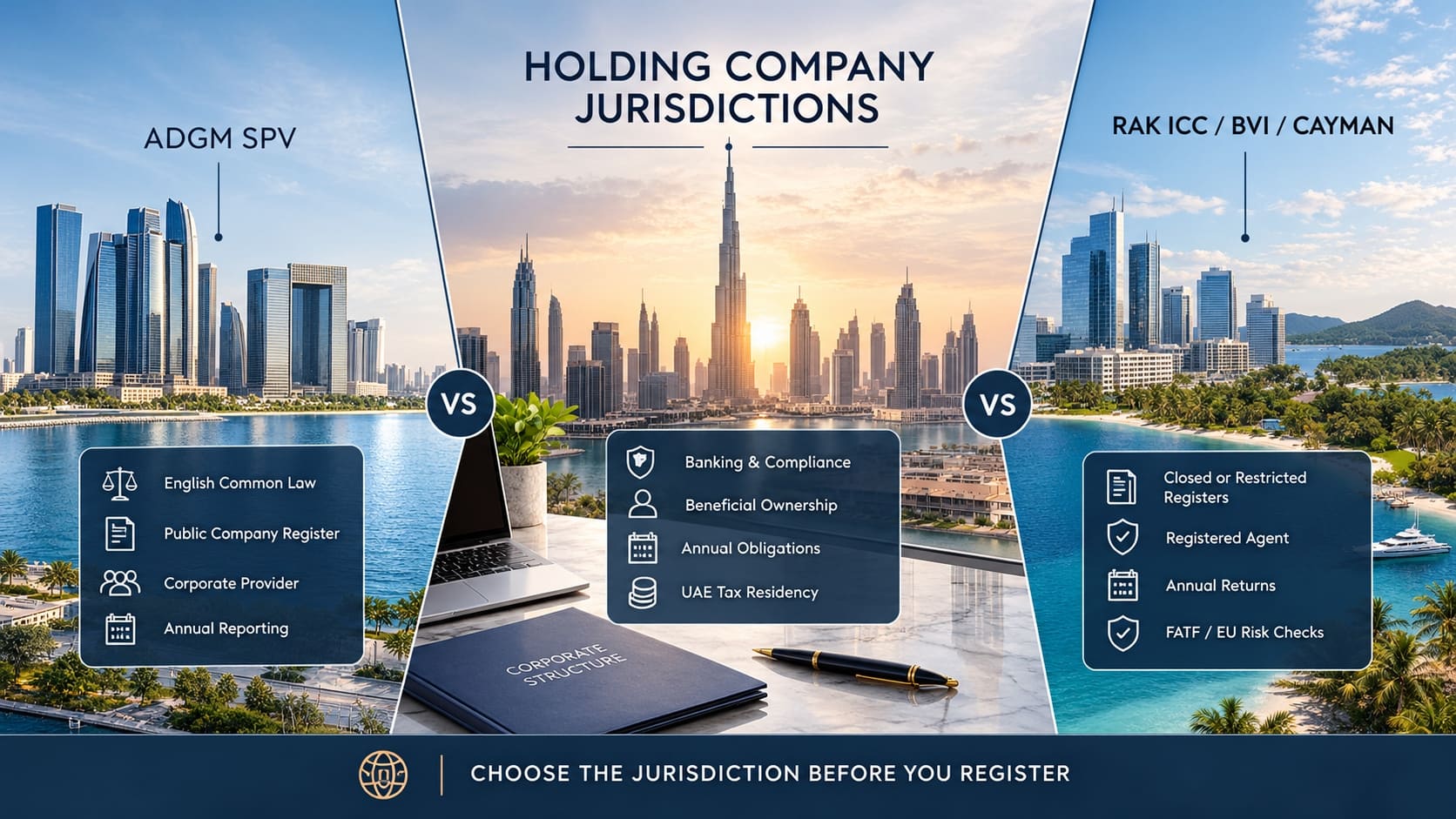


When choosing where to open a holding company, it is important to consider more than just tax rates. Otherwise, you risk building a weak structure that runs into difficulties opening a bank account, double taxation, or protecting assets. After all, a holding company is not only used to receive dividends: with the right choice of jurisdiction, it also allows you to manage assets, own property, and separate it from operational risks.
One of the best countries for building a holding structure is the UAE, especially for closing inheritance-related questions. But for certain tasks, Singapore, Hong Kong, Mauritius, or the BVI (British Virgin Islands) may be a better fit. That is why it is important first to define the business objectives, and only then look at ownership structure requirements, the jurisdiction’s reputation, access to the banking system, and international tax-planning opportunities.What to Consider When Choosing a Jurisdiction for a Holding

When setting up a holding, it is first important to understand what task it will perform within the structure. Some holding companies own stakes in an operating business, others accumulate dividends, own real estate, investment assets, or intellectual property objects. The choice of country of registration depends directly on this.
To determine the most suitable country, several factors are typically evaluated:
- the tax regime and the rules for taxing dividends, capital gains, and income from the sale of assets;
- the possibility of obtaining tax residency and using international tax treaties;
- the level of protection of assets and owners’ rights;
- reporting requirements, economic presence, and corporate governance requirements;
- access to banking infrastructure and international settlements;
- the convenience of owning and managing assets through the holding.
In practice, a good jurisdiction offers more than just tax advantages. It is important that the company can open a bank account, confirm tax residency, and operate under clear rules. That is why today many international holdings are set up in countries with a genuine business presence, rather than purely for the sake of low taxes.
Why the UAE Is Considered the Best Jurisdiction for a Holding
The UAE offers several advantages that rarely come together in a single jurisdiction:
- the owner or the company’s management team can obtain tax residency in the country;
- corporate tax is 9%, applied only to profit exceeding AED 375,000;
- qualified companies in free zones can access a 0% rate;
- holdings benefit from the qualifying shareholdings regime, which exempts dividends and income from the sale of stakes in other companies from tax;
- developed banking infrastructure allows working with dividends, investments, and settlements between group companies.
An additional advantage is asset protection. Through a holding company, ownership of assets can be separated from operational activity. Dedicated tools for capital management, inheritance, and share distribution are available in the DIFC (Dubai International Financial Centre), which operates on the principles of English common law. This is particularly important where assets, heirs, or partners are located in different countries and legal systems.
But there are also downsides to registering a holding in the UAE. Banks carefully check the origin of funds, so companies must comply with compliance requirements, keep records, and confirm genuine activity. Not every free zone company automatically qualifies for the 0% rate. On the other hand, UAE resident companies can combine tax efficiency with genuine activity, avoiding the restrictions of classic offshore structures.
Comparing the UAE with Other Jurisdictions
Although the UAE is today considered one of the most popular solutions for international holdings, it is far from the only option. Let’s compare the alternatives in the table below.
| Parameter | UAE | Singapore | Hong Kong | Mauritius | BVI |
|---|---|---|---|---|---|
| Taxes | Corporate tax 9%; a 0% rate is available for qualifying income in free zones | Up to 17%; certain types of foreign income benefit from relief | Territorial taxation, subject to established conditions | 15% with preferential regimes | Tax neutrality |
| Reputation | High and continuing to strengthen | One of the strongest in the world | High, especially for trade and investment in Asia | Good reputation for investment structures | Banks treat it with more caution |
| Banks | Account opening is possible but requires compliance checks | Strong banking system with high client requirements | Developed banking infrastructure and strict compliance | Banking services available through international banks | Banking services are often organised outside the jurisdiction |
| Main tasks | Asset protection, tax residency, family capital, international holdings | Structures with a genuine business presence, attracting investment, access to the Asian market | Trade, investment, and operating activity in Asia | Investment in Africa and India | Asset ownership and holding structures |
| Limitations | Corporate tax requirements, compliance, and free zone rules | High costs of company administration and maintaining substance | Difficult to confirm offshore income to apply territorial taxation | Substance requirements | Data disclosure and international information exchange |
Overall, Singapore suits international structures with a genuine business presence and high reputational requirements. Hong Kong remains an important tool for working with China and other Asian markets. Mauritius is traditionally used for investment in Africa and India, while the BVI suits simple asset-ownership structures.
Taxes and Tax Residency

A holding company usually does not carry out operating activity. Its main function is to hold stakes in other companies, manage assets, and receive dividends and investment income. Special taxation rules are therefore often applied to holding structures. They differ from those applicable to trading, manufacturing, or service businesses.
The final tax burden is affected by several factors at once: the tax residency of the owner and the company, double tax treaties, the way assets are managed through the holding, and the flow of funds within the group of companies. That is precisely why identical assets can produce different tax outcomes even when using the same jurisdiction.
How Taxes Work in Holding Structures
The main sources of holding income are dividends, interest, royalties, investment income, and profit from the sale of stakes in subsidiaries. Taxes in a holding structure can therefore arise at several levels at once.
- First, the operating company pays corporate tax in the country where it does business. In the UAE this is 9% on taxable profit exceeding AED 375,000, while a 0% rate may apply to qualifying income in free zones. For comparison, Hong Kong has a two-tier profits tax rate: 8.25% on the first HKD 2 million of profit and 16.5% on the amount above that threshold.
- Then, when dividends are paid to the holding, withholding tax may be deducted at source. In the UAE, the withholding tax rate is 0%. In Hong Kong there is also no tax on dividends, but the territorial principle of taxation and confirmation of the source of income are of great importance.
- After that, taxation rules apply at the level of the holding itself. In the UAE, dividends and income from the sale of stakes under qualifying shareholdings may be exempt from tax. In Hong Kong, foreign income may be untaxed only if established requirements are met and entitlement to the relevant regime is confirmed.
This is precisely why, for a holding company, not only the corporate tax rate matters, but the entire chain of income flow between the group’s companies.
Why Not Only the Size of the Tax Rate Matters
It is logical to want to look first at jurisdictions with low taxes for a holding. However, this approach can lead to mistaken conclusions.
For example, the standard corporate tax rate in Singapore is 17%, while in the UAE most companies are subject to a 9% rate. At first glance, the UAE looks significantly more advantageous. However, in Singapore dividends are also not subject to additional tax for the recipient, there is no classic capital gains tax, and certain types of foreign income may be partially exempt from tax subject to established conditions, reducing the effective rate to 8–10%.
| Jurisdiction | Nominal rate | Dividends | Capital gains | Foreign income | Effective burden |
|---|---|---|---|---|---|
| Singapore | 17% | Not taxed | None | Exempt under conditions | ~8–10% for holdings |
| UAE | 9% | Not taxed | None | Free zone can give 0% | 0–9% depending on structure |
Comparing Singapore or the UAE for a holding purely on taxes, as the table shows, is not entirely correct, because the conditions are similar. But Singapore, for example, has signed 70 double tax treaties, while the UAE has 140. That is why it is important to look at exactly which countries your subsidiaries are located in.
The Role of Tax Residency and Double Tax Treaties
For holding structures, the main tax burden often arises in the countries the income comes from, where taxes of 10%, 15%, or 20% may be withheld on international payments.
For this reason, the network of double tax treaties often has a greater impact on the final tax burden than the corporate tax rate of the holding itself. If a treaty is in force between the countries, the withholding tax rate is reduced by the corresponding percentage.
What matters most is that the structure can confirm tax residency, entitlement to apply the treaty, and the status of beneficial owner of the income. It is precisely these factors that determine which rates will apply in the countries where the subsidiaries are located.
For example, if the holding’s income is generated in the UAE, where the company obtains residency upon registration, the tax rate at the level of the holding itself may be 0%. But if the profit is generated outside the UAE, taxes initially arise in the countries where the business is conducted. In this case, the final tax burden will depend on the terms of international treaties and the rates applied in the source country of the income.
Why Taxes Depend on the Structure, Not Just the Country of Registration
Taxes do not depend only on the country of registration, because the jurisdiction itself only sets the “framework” — the base rates and rules. The actual tax burden is shaped by the structure of the company:
- Legal form — corporations, partnerships, foundations, or trusts are taxed differently.
- Level of taxation — in some structures the company pays the tax, in others the investors or owners do.
- Substance and management — if the structure is purely formal, without genuine presence, the tax authorities may deny relief.
- Beneficial ownership — what matters is who actually controls the income. If the company is not recognised as the beneficiary, treaty relief does not apply.
- Function of the structure — a holding, a trading company, or an investment fund have different tax regimes even within the same country.
In other words, the country sets the “rules of the game”, while the structure determines exactly how these rules apply to a specific business.
Asset Protection and Ownership Structure
A holding is an effective tool for asset protection, allowing ownership to be separated both from the owner’s personal property and from the assets of operating companies. After all, when real estate, business stakes, or intellectual property rights belong to a legal entity, they are harder to reach in litigation or the division of property. This means operating companies, for example, can take out loans or become involved in disputes while putting less property at risk than without such separation.
For estate planning, a holding opens up the possibility of using trusts and foundations. Through them, the owner sets the rules for transferring control so that heirs receive specific rights: ownership, participation in management, and access to income. This reduces the future risk of conflicts and litigation.
In international practice, dedicated jurisdictions such as the DIFC in the UAE are used to strengthen the reliability of the structure. It provides tools for creating private foundations, family offices, and trusts that allow the rules for owning and transferring assets to be fixed at an international level.
A holding is not only a tax instrument. It serves as a “legal shield”: it moves assets into corporate ownership, fixes the rules for their inheritance and management, and allows the use of international solutions for long-term protection.
Which Jurisdiction Suits Whom Best

UAE
The Emirates have become a platform where international holding structures can obtain tax residency and manage assets effectively. For owners of international businesses and family capital, this is an opportunity to establish a presence in the region and use a developed banking system. Here it is important to take into account corporate tax and genuine-presence requirements: banks check substance and pay close attention to compliance.
Singapore
This jurisdiction is valued by investors and funds because transparency and strict reporting build trust. Singapore is chosen by technology companies, financial structures, and projects with genuine operating activity. High maintenance costs and strict banking due-diligence requirements make it the choice for those who want to demonstrate maximum reliability to partners.
Hong Kong
For trade and international operations, Hong Kong remains a working tool. It is convenient for conducting export-import transactions and managing contracts in Asia. Its reputation as a financial centre helps in closing deals, but mandatory audit and reporting require genuine activity. Without this, banks will not open accounts, and the structure itself loses its purpose.
Mauritius
This jurisdiction is used for investment structures, especially in Africa and India. It is chosen by funds and holdings working with portfolios in several countries. Mauritius offers tax treaties and international recognition, but requires substance and compliance with OECD standards. It is a solution for those building long-term investment strategies.
BVI
The British Virgin Islands remain a tool for simple asset holding. They are chosen by owners who need only the formal registration of ownership without complex operating activity. Simplicity and low costs make the BVI attractive, but a weaker reputation and limited access to banking infrastructure are gradually reducing their value for serious projects.
How to Choose a Jurisdiction for a Holding Company
It is more logical to start choosing a country for a holding company by analysing your assets. Analyse where the shares, real estate, intellectual property, accounts, and investments are located, and how they are connected to one another.
The next step is the beneficiaries. Their place of residence and tax status determine what obligations arise when dividends are paid, stakes are sold, or inheritance occurs. The jurisdiction must take into account not only corporate but also the owners’ personal taxes.
After that, the banking model is checked. The holding must be able to receive dividends, invest, extend loans, and pay expenses through an account. A country that looks convenient at the registration stage may turn out to be problematic if banks do not accept the structure or demand explanations for every transaction.
Next comes the question of substance. In 2026, a holding company must look like (and be) genuine: it needs directors (local, in some cases), minutes of decisions, an address, records, and confirmation of the source of funds. Without this, the structure will not be recognised as sustainable.
The final selection criterion is capital protection. If your only goal is tax savings, you can use Hong Kong or the BVI, but the holding will be fragile. If you set objectives around capital management, inheritance, and risk separation, you can build a reliable structure. For such purposes, the UAE is often more convenient and reliable than the BVI, more practical than Mauritius for family capital, and more flexible than Singapore in terms of the cost of presence.
Conclusion
The UAE can today be considered a universal jurisdiction for a holding: it provides tax efficiency, the possibility of obtaining tax residency, a developed banking system, and capital protection. At the same time, the UAE is not the only solution, and there is no single answer to the question of where it is more advantageous to open a holding. If you want to work with investors and the Asian market, Singapore will be a convenient choice. For tasks related to trade and international operations, Hong Kong is suitable. Mauritius is used for investment projects, while the BVI remain an option for simple ownership that requires caution due to banking practice and reputation.
The decisive factor remains the architecture of the holding itself: it must protect assets, pass banking checks, take into account the beneficiary’s tax obligations, and confirm the genuine economic presence of the business. Only with this approach does the company become a tool of control, continuity, and long-term capital protection.
Disclaimer: this material is of a general informational nature and does not replace professional advice. Before registering a holding, it is worth checking the requirements and conditions in the countries where the assets, beneficiaries, and operating companies are located.
Get advice