
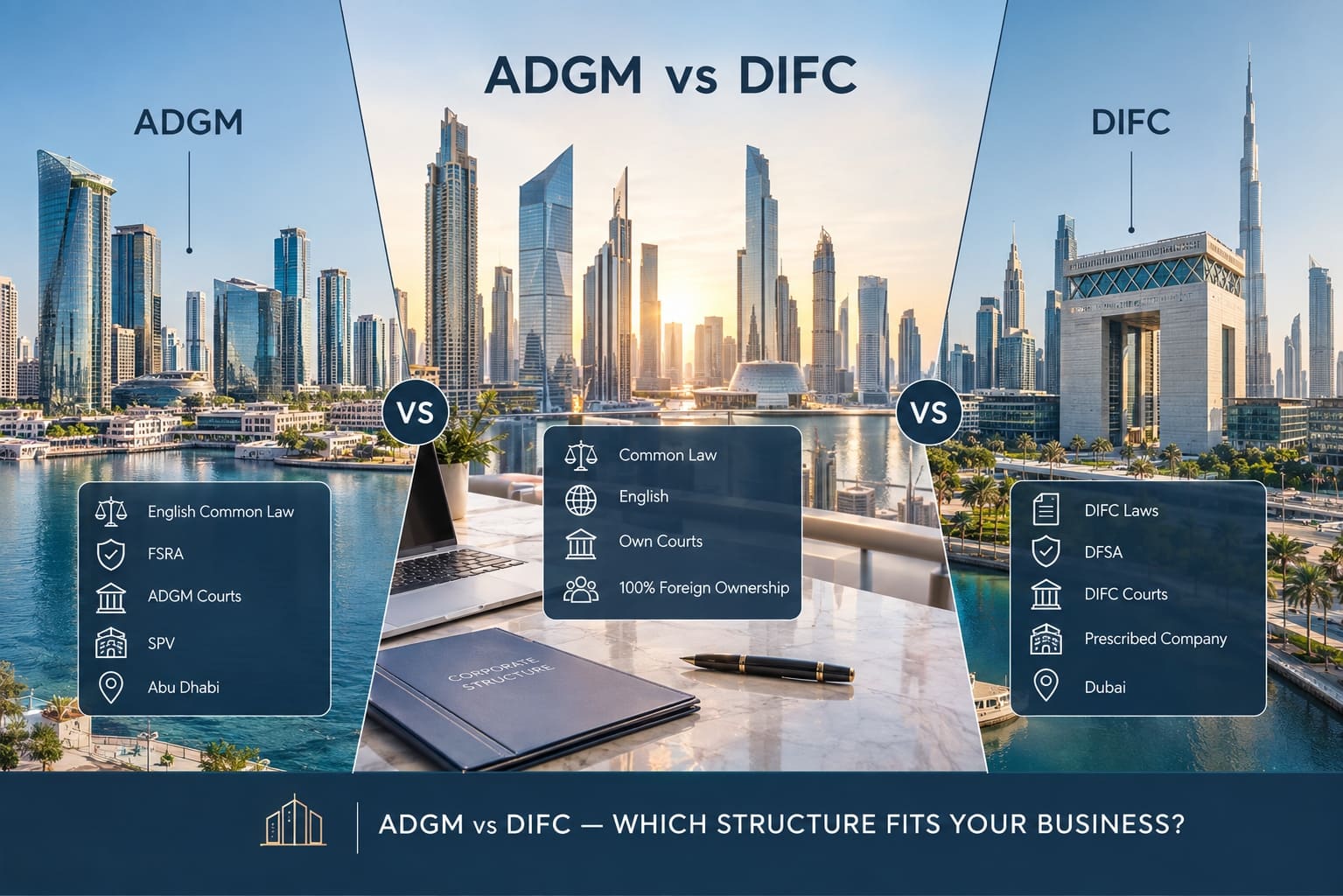
The question of ADGM or DIFC usually comes up in the second conversation, not the first. In the first call, a founder is still asking whether to to set up a company in the UAE at all. By the second, the advisers have started disagreeing: one pushes for Abu Dhabi, another for Dubai, and both sound equally convincing.
Both are common-law centres among the UAE financial free zones, with English as the working language, their own courts, their own regulator and full foreign ownership. The real difference between ADGM vs DIFC isn’t in the pitch — it shows up later, in the source of law each one applies, in who registers what, in the cost of a holding structure, and in where you actually need to keep an office.
What follows is a practical, side-by-side look: where the two overlap, where they part ways, and which task points to which centre.
Where ADGM and DIFC Are Built the Same Way
Both centres rest on the same federal foundation. Federal Law No. 8 of 2004 on financial free zones lets any emirate establish one, and it carves that zone’s financial activity out of federal civil and commercial law. Criminal law still applies in full.
From there, each centre was created by its own decree: DIFC by Federal Decree No. 35 of 2004 in Dubai, ADGM by Federal Decree No. 15 of 2013 in Abu Dhabi. Each has its own courts, its own Registrar of Companies and its own financial regulator.
The practical layer matches too: 100% foreign ownership, English as the language of documents and litigation, and civil and commercial jurisdiction for each centre’s own courts, with no criminal jurisdiction attached.
There’s also an opt-in mechanism worth knowing. DIFC Courts can hear disputes that have nothing to do with the centre itself, provided the parties agreed to it in writing — the basis is Dubai Law No. 16 of 2011. It gets real use: in the first half of 2026 alone, parties from the UAE and 22 overseas jurisdictions opted into DIFC Courts’ jurisdiction.
Source of Law: The Difference Nobody Mentions Upfront
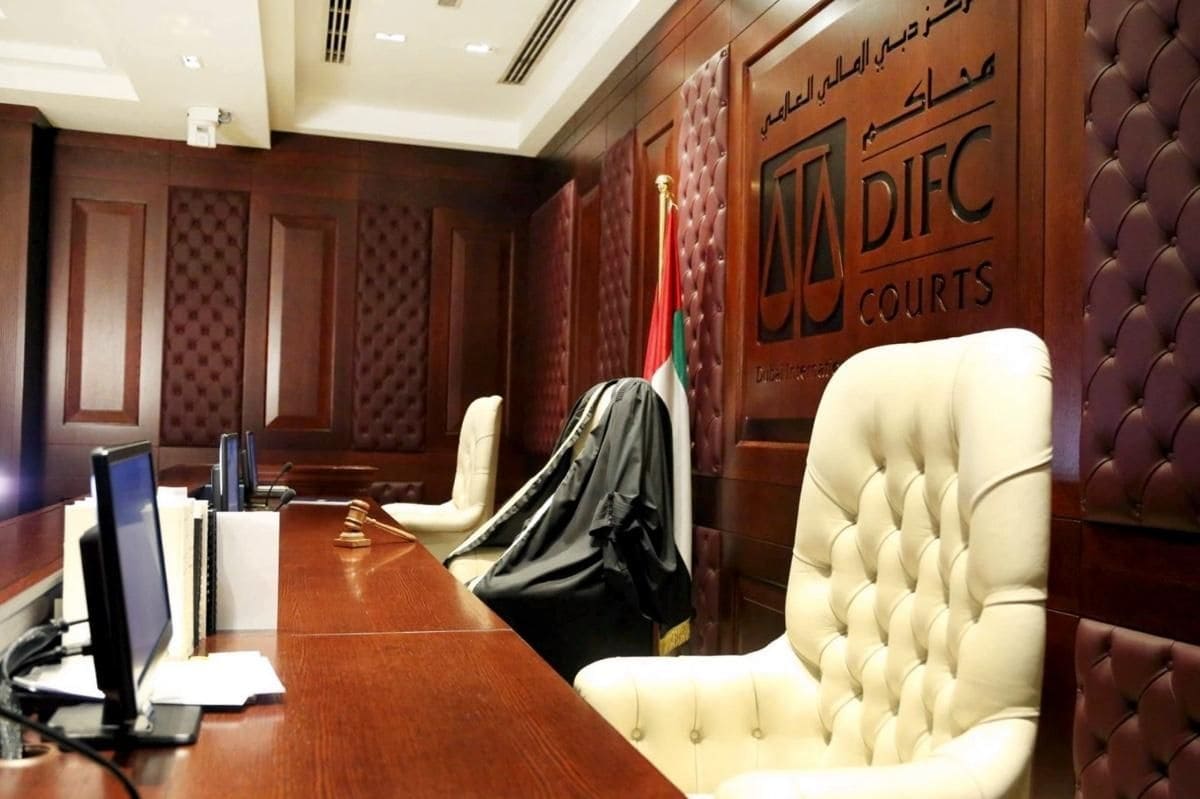
This is where the two centres are built on fundamentally different foundations, and it’s worth understanding before you choose.
ADGM applies English common law directly. The Application of English Law Regulations 2015 says so in plain terms: the common law of England, including the principles and rules of equity, as it stands from time to time, applies and forms part of ADGM law — to the extent applicable to the circumstances of the centre and subject to any necessary modification. A defined list of English statutes is layered on top. Where an ADGM enactment conflicts with the imported law, the ADGM enactment wins.
DIFC took a different route: it has built its own body of law, with common law acting as a backstop. That was written into statute in November 2024. The new Article 8A of the law on the application of civil and commercial law sets the order — DIFC legislation and DIFC court decisions interpreting it come first, then any gap is filled by common law, and the courts may draw on both the law of England and Wales and on other common-law jurisdictions. Article 8B adds that interpretation can lean on comparable laws from recognised common-law jurisdictions, and, for laws drawn from international model instruments, on how those instruments are applied internationally.
The practical takeaway: if a counterparty or investor cares about the predictability of English law specifically, ADGM gives you a shorter chain of reasoning. If a deeper body of local precedent and interpretive flexibility matter more, DIFC is the older legal system and has more case law behind it.
Table 1 — Legal Basis and Courts
| Parameter | ADGM | DIFC |
|---|---|---|
| Established by | Federal Decree No. 15 of 2013 | Federal Decree No. 35 of 2004 |
| Source of law | English common law, applied directly | Own body of law, common law as backstop |
| Key instrument | Application of English Law Regulations 2015 | DIFC Law No. 3 of 2004, Articles 8A and 8B |
| Financial regulator | FSRA | DFSA |
| Courts | ADGM Courts ADGM | DIFC Courts |
| Language | English | English |
Regulators: FSRA and DFSA
The DFSA is the independent financial services regulator for DIFC. Its remit is broad: asset management, banking and credit services, investment business, investment advice, collective funds, custody and trust services, Islamic finance, insurance, fintech, crypto and investment tokens, money services, capital markets, crowdfunding and recognised exchanges — plus anti-money-laundering oversight and auditor regulation.
The FSRA plays the same role in ADGM. Both regulators license financial activity, but neither one handles company registration itself — that sits with each centre’s own registrar. The distinction matters in practice: a non-financial company or a holding structure deals only with the registrar, and the regulator never enters the picture.
Location and Office Space

DIFC is a compact district in central Dubai with its own stock of office buildings. ADGM originally sat on Al Maryah Island, and on 24 April 2023 its jurisdiction as a financial free zone was extended to the neighbouring Al Reem Island. Integration was completed on 24 February 2025, adding over 1,100 entities to the zone — roughly 600 newly formed and more than 500 that migrated onto an ADGM licence.
For a business owner, that translates into a different premises market and different logistics. Since the expansion, ADGM has a considerably larger pool of space to draw on, including the residential and mixed-use districts of Al Reem. DIFC stays pricier to lease but sits right at the commercial centre of Dubai.
Both jurisdictions expect a physical office once a company is trading and hiring staff. The exception is a passive holding structure: a registered address through a corporate service provider, or space at an affiliated company inside the centre, is enough.
Holding Structures: Where the Real Difference Sits Today
This is the section most people are actually comparing the two centres for.
In DIFC, the passive holding vehicle is the Prescribed Company. Following the 2026 amendments, the regime is open to any applicant — the earlier restrictions on who could apply have been lifted, and the centre states this directly on its own website. A Prescribed Company carries out no commercial or operational activity, employs no staff, and is treated as a private company under DIFC companies law. Unless it qualifies as an Exempt Prescribed Company, it needs a corporate service provider as its main interface with the registrar. Its assets can sit anywhere in the world.
In ADGM, the equivalent vehicle is the Special Purpose Vehicle, or SPV. The Registration Authority requires evidence of a connection to ADGM, the UAE or the wider Gulf region — generally referred to as the nexus requirement. In autumn 2026, market chatter suggested this requirement had been scrapped, but there’s no official confirmation of that: ADGM’s own SPV guidance and both of its current filing checklists still ask for it. Confirm the current position with the registrar before you file.
Table 2 — Passive Holding Structure: Official Centre Fees
| Parameter | ADGM (SPV) | DIFC (Prescribed Company) |
|---|---|---|
| Registration fee | USD 1,900 | USD 100 |
| Annual fee | USD 1,400 | USD 1,000 plus AED 20 |
| Who can apply | Connection to the UAE or region required | Any applicant, since 2026 |
| Corporate service provider | Mandatory, except exempt entities | Mandatory, except exempt entities |
| Staff | Not envisaged | Explicitly prohibited |
| Assets | Worldwide | Worldwide |
Tell us what you hold and through whom — we’ll tell you which centre creates less friction for your situation, and what maintaining the structure will actually cost.
Foundations: Both Centres Offer One
Both centres offer a private Foundation — a legal entity with no shareholders that holds assets and distributes them under its charter. In DIFC this sits under the Foundations Law (DIFC Law No. 3 of 2018), passed on 14 March and effective from 21 March 2018, with amendments made in 2024. In ADGM it runs under the Foundations Regulations 2017, amended repeatedly, most recently on 24 April 2026.
The differences here are finer points of legal drafting, and in practice they’re almost always resolved by family composition and the nature of the assets, not by which centre you pick. ADGM’s official Foundation fees are published: USD 1,000 to register and USD 500 for annual renewal, against a minimum initial asset value of USD 100.
If the task is passing a business to the next generation, what matters isn’t the two centres’ branding — it’s how each regime actually handles your specific configuration: who the founder is, where the assets sit, how many heirs there are, and whether any of them are resident in a country with forced-heirship rules.
Succession Planning: DIFC Has a Tool ADGM Doesn’t

DIFC Courts run a wills service for non-Muslims. It was created under Resolution No. 4 of 2014, and its authority was confirmed by Dubai Law No. 15 of 2017 on inheritance, wills and probate for non-Muslims. Anyone who is not, and has never been, Muslim can register a will through it.
The boundaries are worth knowing precisely, because they’re easy to mix up. Disposing of movable and immovable property covers assets across the whole UAE: a full will covers property anywhere in the country, and the more limited will types cover up to five real estate assets, or up to five share portfolios, also anywhere in the UAE. What actually is limited by emirate is something else entirely — guardianship appointments, which only apply if the minor child lives in Dubai or Ras Al Khaimah. Ras Al Khaimah was added through a separate practice direction that took effect on 5 March 2017.
ADGM has no succession law of its own and no wills registry. The Notary Public of ADGM Courts can attest wills for non-Muslims in partnership with the Abu Dhabi Judicial Department, but the probate case itself is registered through that department’s registry, not through ADGM.
Tax: This Is Not Where the Centres Compete
There’s no difference in tax treatment between the two centres, and it’s worth saying plainly. Both are free zones, and Article 18 of Federal Decree-Law No. 47 of 2022 on the Qualifying Free Zone Person applies to companies in either one.
The statutory conditions are identical either way: maintain adequate substance in the UAE, earn Qualifying Income as defined under Cabinet Decision, decline to elect into the standard corporate tax regime, comply with transfer pricing rules and documentation, and meet any further conditions the Minister sets. The rate for a Qualifying Free Zone Person is 0% on Qualifying Income and 9% on everything else. The Ministry of Finance also applies a de minimis rule: the status survives as long as non-qualifying income stays under the lower of 5% of revenue or AED 5 million.
Qualifying Income is defined by Cabinet Decision No. 55 of 2023, and the qualifying activities themselves by Ministerial Decision No. 139 of 2023. VAT in the UAE is 5%, with a mandatory registration threshold of AED 375,000 — and that’s identical for both jurisdictions.
Table 3 — Which Task Usually Points to Which Centre
| Task | Usually a better fit | Why |
|---|---|---|
| Passive holding, owner based outside the region | DIFC | Open to any applicant, lower fees |
| Holding company with UAE-based assets | ADGM | Easier to demonstrate the regional nexus |
| Dispute governed by English law | ADGM | Direct application of English common law |
| Will for a non-Muslim | DIFC | DIFC Courts Wills Service |
| Operating office in Abu Dhabi | ADGM | Larger pool of available space |
| Financial services licence | Depends on the activity | Compare FSRA and DFSA by licence category |
What Choosing a Centre Doesn’t Decide For You
Neither ADGM nor DIFC makes a company automatically tax-free. The 0% rate is a regime you qualify into by meeting conditions — it isn’t a property of the address. Substance, staff and expenditure inside the zone all get checked.
Neither centre replaces bank compliance. The bank opening your account looks at the beneficial owner, the source of funds and the economic substance of the structure, not at a line in a registry.
And neither one rescues a structure put together after the fact. Both Foundations and holding companies work when they’re set up in advance, for a clear and documented reason.
How We Help You Choose
We don’t start with a recommendation. We start by mapping the task: what assets exist and where, who owns them and where they’re resident, whether you need staff and an office, whether you’ll be carrying out licensable activity, and which courts would hear a dispute with your key counterparty.
That produces a short list of differences that actually affect your situation — usually two or three, not twenty. From there, we cost out maintaining the structure in both centres using official fees, and check that against each centre’s filing timelines and requirements.
Tell us about your situation — we’ll come back with a comparison built around your structure, and the reasoning behind our recommendation.
Get a consultation
*This material is for information purposes only and does not constitute legal or tax advice. Requirements set by the centres, their regulators and tax law apply to specific circumstances and should be checked against your own structure. Information current as of September 2026.*