
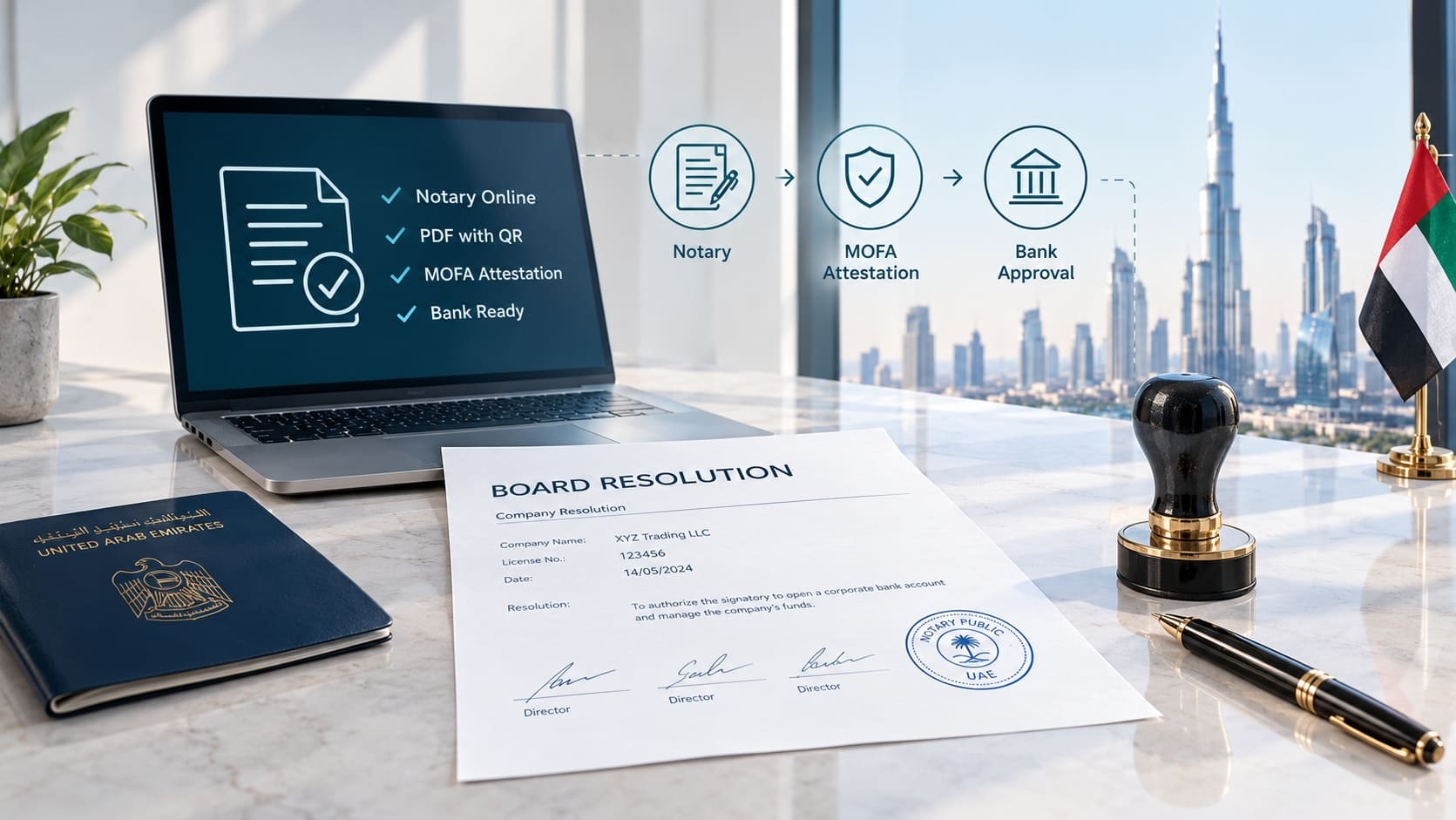
A corporate account application in Dubai stalled on a single page. Compliance asked for a board resolution — the founders’ written decision naming who may sign for the company and move its money. The client had one: letterhead, signatures of all three partners, company stamp. The bank returned it the next morning with a two-word note: *not notarised*.
The story is ordinary. A board resolution UAE banks and registrars will accept is not an internal housekeeping paper. It is a document that faces outside scrutiny — at the notary, at the licensing authority, at the bank, occasionally in court. And the requirements tend to surprise founders used to common-law or European corporate practice: what carries weight is not the company seal but a notary confirming the signatory’s identity over a video call, backed by correct Arabic text.
What follows, step by step: when notarisation is mandatory, who certifies the document, how the procedure differs between the mainland and the free zones, what to do when the shareholder is a foreign company, and what it all costs in money and days.
What a board resolution is, and why it outranks ordinary minutes here

A board resolution is a written decision of a company’s governing body recording one concrete act: appoint a manager, open an account, transfer a share, change capital, issue a power of attorney, wind the business up. The nearest equivalent elsewhere is the minutes of a general meeting, or a written resolution of the sole member.
The difference lies in status. Here the document works as the legal basis on which third parties act. A bank opens the account and grants signing rights on it. The licensing authority amends the manager’s record. The land registry books a transfer. Each checks the paper formally: where a notary’s confirmation is required and missing, the action simply does not happen — no explanation, no room to negotiate.
The second peculiarity is language. Arabic is the language of official record here. Anything heading to a notary or a government department is prepared bilingually — English in one column, Arabic in the other — or accompanied by a certified translation from a licensed legal translation office. A version produced in-house, or run through an online tool, will be refused.
A shareholders’ resolution and a directors’ resolution are not the same thing
In everyday speech “board resolution” covers everything. In law there are two organs, and their powers do not overlap.
A shareholders’ resolution comes from the owners of the shares. Their remit is whatever changes the company itself: membership, share capital, constitutional documents, liquidation, appointing and removing the manager. A resolution of the board or the manager covers operations — bank accounts, signing authority, contracts, powers of attorney, tender submissions.
Choosing the wrong organ is among the most frequent grounds for refusal. If the constitution reserves account opening to the shareholders, a paper signed by the director alone is turned away, however immaculate the notarial stamp.
When notarisation is mandatory, and when a signature will do
No rule says notarise everything, and notarising everything is expensive. The guide is straightforward: a notary is needed wherever the resolution produces consequences for third parties or changes an entry in a state register.
A change of shareholder, a change of capital, amendments to the MOA, appointing or removing a mainland manager, issuing a power of attorney, real-estate transactions — these almost always call for a notarised board resolution.. Internal matters pass without one: approving the budget, splitting profit, appointing an internal auditor, signing off the annual accounts.
Then there is a category of its own: whatever the recipient insists on. A bank may demand notarisation where no statute requires it, because compliance policy says so. Arguing burns a week; notarising takes an afternoon.
Table 1 — When a board resolution needs a notary
| Action | Notary | Comment |
|---|---|---|
| Opening a corporate bank account | Usually yes | Depends on the bank’s policy |
| Adding or replacing a shareholder | Yes | Plus the register amendment |
| Changing share capital | Yes | Together with MOA amendments |
| Appointing or removing a manager | Yes on the mainland | In free zones, per zone rules |
| Issuing a power of attorney | Yes | Executed as a separate deed |
| Approving budgets and dividends | No | Internal company document |
| Liquidating the company | Yes | With appointment of a liquidator |
The table shows the logic rather than an exhaustive list: every emirate and free zone adds its own wrinkles. Before drafting, ask the receiving body for its current checklist — those change far more often than the underlying law.
Who notarises: public notary UAE offices and private notaries, both online
The Emirati notarial system runs on two tiers. Public notaries sit within the emirate’s courts and under the Ministry of Justice. Private notaries are licensed lawyers granted the power to perform notarial acts; the same ministry keeps their register.
The essential point about the procedure today: nobody travels. In-person notary appointments are gone, and the whole act happens online. The signatory joins a video call from wherever they are, shows a passport or Emirates ID to the camera, confirms the content, and receives the finished resolution as a PDF carrying a QR code. A paper original with a wet stamp does not exist in this model at all.
The QR code is the proof of authenticity. A bank, registrar or court scans it and sees the record in the system — same document, same date, same signatory. For an owner that removes the old bottleneck: a resolution can be notarised from London, Singapore or São Paulo on the day it is needed, without pinning a deal to a flight date. Board resolution notarisation Dubai-side is now a calendar entry, not a trip.
Government fees follow the federal tariff in Cabinet Resolution No. 19 of 2024: from a few hundred dirhams for an ordinary document, and for instruments with a stated value, a percentage charge capped at roughly AED 15,000 (about USD 4,100 or EUR 3,500). A private notary’s fee sits on top, so confirm rates when you instruct.
Table 2 — Public notary and private notary compared
| Parameter | Public notary | Private notary |
|---|---|---|
| Procedure | Online, by video call | Online, by video call |
| Booking a slot | General queue on the portal | Usually same day |
| Drafting the text | You supply the document | Normally drafted by the notary |
| Cost | Government fee only | Fee plus professional charge |
| Output | PDF with QR code | PDF with QR code |
The choice between them is about speed and hand-holding, not format: the output is identical. A standard resolution with text already drafted is cheaper through a public notary. Where the wording has to be tuned to one bank’s requirements, or the deal closes tomorrow, a private notary buys back days.
Mainland, free zones, DIFC and ADGM — four different regimes

This is where the confusion usually starts. One country, several regimes of corporate paperwork, and their rules do not line up.
On the mainland the federal commercial companies law applies; documents move through the notary and the emirate’s department of economic development. There is exactly one option here: a mainland company’s resolution is executed before a notary, and nothing else gives it force.
Free zones — DMCC, IFZA, RAKEZ, Meydan, SPC and dozens more — offer two options, and that is the heart of the free zone vs mainland board resolution question. The first: issue the resolution through the zone itself. The document is drawn up on the zone’s template via the online portal, signed by the members and certified by the registrar, with no notary involved. The second: take the same resolution to a notary, as a mainland company would.
Choose according to where the document is going next. Inside the perimeter of the zone — a change of manager, a licence data update — the zone’s own resolution is enough, and it is quicker and cheaper. The moment the paper travels outside, to a bank, a court, the mainland or abroad, the notarised version is the safer bet.
DIFC and ADGM run on their own English-model legal systems. Resolutions are executed in English format, no Arabic translation is required, and notarisation is needed considerably less often — typically only for documents destined to leave the jurisdiction.
The practical conclusion: before drafting, decide not which country the document serves, but which regime.
A resolution from a foreign parent: why an apostille will not help
A common configuration: the Emirati company is owned by a holding company in Cyprus, Singapore or the BVI. The decision to appoint a director or open an account is taken by the parent and signed outside the UAE.
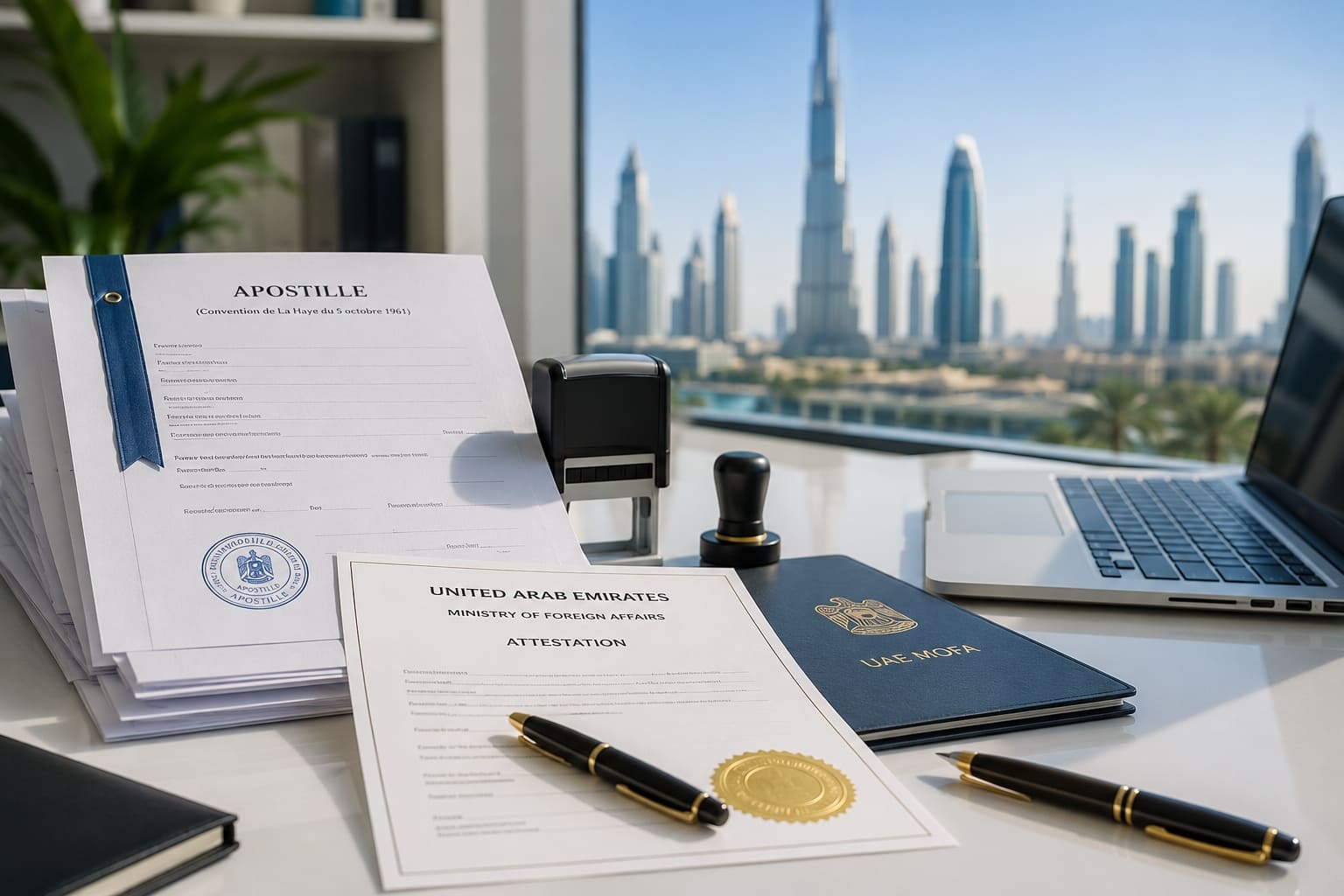
Here is the rule almost everyone trips over. The UAE is not a party to the 1961 Hague Apostille Convention — as of September 2026 that remains the position. An apostille on its own legalises nothing for use in the Emirates.
The chain looks different. A notary in the country of origin certifies the document first. That country’s ministry of foreign affairs authenticates it next. Then the consular section of the UAE embassy there. Once the document arrives, it goes through MOFA attestation UAE-side (MOFAIC). Only after that does a licensed office produce the legal translation into Arabic.
Five steps, each with its own turnaround and fee. Two to five weeks in total depending on the country, before public holidays and peak season. Planning a deal on the assumption it can be done inside a week is a direct route to a missed closing date.
There is a workaround, often cheaper: issue a power of attorney to a representative in the UAE. Then only one document — the POA itself — goes through full legalisation, and every later resolution is signed by the representative inside the country, before a local notary.
What belongs inside the document
The notary checks the form; the bank and the registrar check the substance. A sound resolution answers four questions without ambiguity: who took the decision, under what authority, what exactly was decided, and from what date it bites.
The minimum board resolution format UAE authorities expect covers the company’s full legal name and licence number, the date and place of the decision, a reference to the constitution or MOA, the list of participants with their shareholdings, the operative wording itself, signatures and seal.
The wording deserves particular care. “To authorise Mr John Carter to represent the company before the bank” is a refusal waiting to happen: which bank, within what limits, until when? The working version reads differently. “To authorise Mr John Carter, passport no. …, to open a current account with Emirates NBD and to operate it as sole signatory with no limit on amount, for an indefinite period until these powers are revoked.” A board resolution to open a bank account in UAE lives or dies on that level of specificity.
Timelines and budget
Cost has three components: the government fee, the Arabic translation, and the professional charge of the notary or adviser where one is engaged. Legalisation from abroad adds a fourth — consular fees, which vary wildly from country to country.
Table 3 — Indicative timelines by scenario
| Scenario | Timeline | What drives the cost |
|---|---|---|
| Resolution through the free zone | 1–3 days | Free zone service charge |
| Public notary, online | 1–3 days | Government fee and translation |
| Private notary, online | Same day | Fee, professional charge, translation |
| Full legalisation from abroad | 2–5 weeks | Five rounds of fees plus translation |
Those timings assume calm conditions: no public holidays, no rework. Budget against your specific scenario — the spread between “free zone, done in-house” and “Cypriot holding with consular legalisation” runs to a factor of ten.
Five reasons documents come back
- The first, and the most galling, is that the wrong organ signed. A director’s resolution where the constitution demands the shareholders’: flawless on its face, void in substance.
- The second is a mismatch in the data. The name in the resolution is spelled differently from the passport or the licence. One letter out in transliteration, and compliance freezes the file until it is explained.
- The third is a home-made translation. An Arabic version without the stamp of a licensed office has no force, however faithfully it renders the original.
- The fourth is stale annexures. Many authorities insist the register extract and the licence copy be no more than three months old at submission.
- The fifth is woolly drafting. A document that leaves the scope of authority unclear gets returned even with a live notarial QR code on it.
What to do next
Prepare a board resolution before you need it, not on the day the bank halts a payment. The sequence never changes: identify the organ with authority to decide; confirm the format and shelf life with whoever will receive the document; and build in time for translation and legalisation if the signatory sits abroad.
Dynasty Business Adviser drafts and manages notarised board resolutions for companies on the mainland and across every major UAE free zone — from the wording through notarisation, translation and filing with the bank or registrar. Get in touch and we will tell you which document your situation calls for and how long it will take.
Get a consultation
Disclaimer. This material is provided for information only and does not constitute legal advice. The requirements of UAE notaries, free zones and banks differ and are updated regularly — confirm the current rules with a qualified specialist before preparing any documents.
Data current as of September 2026.