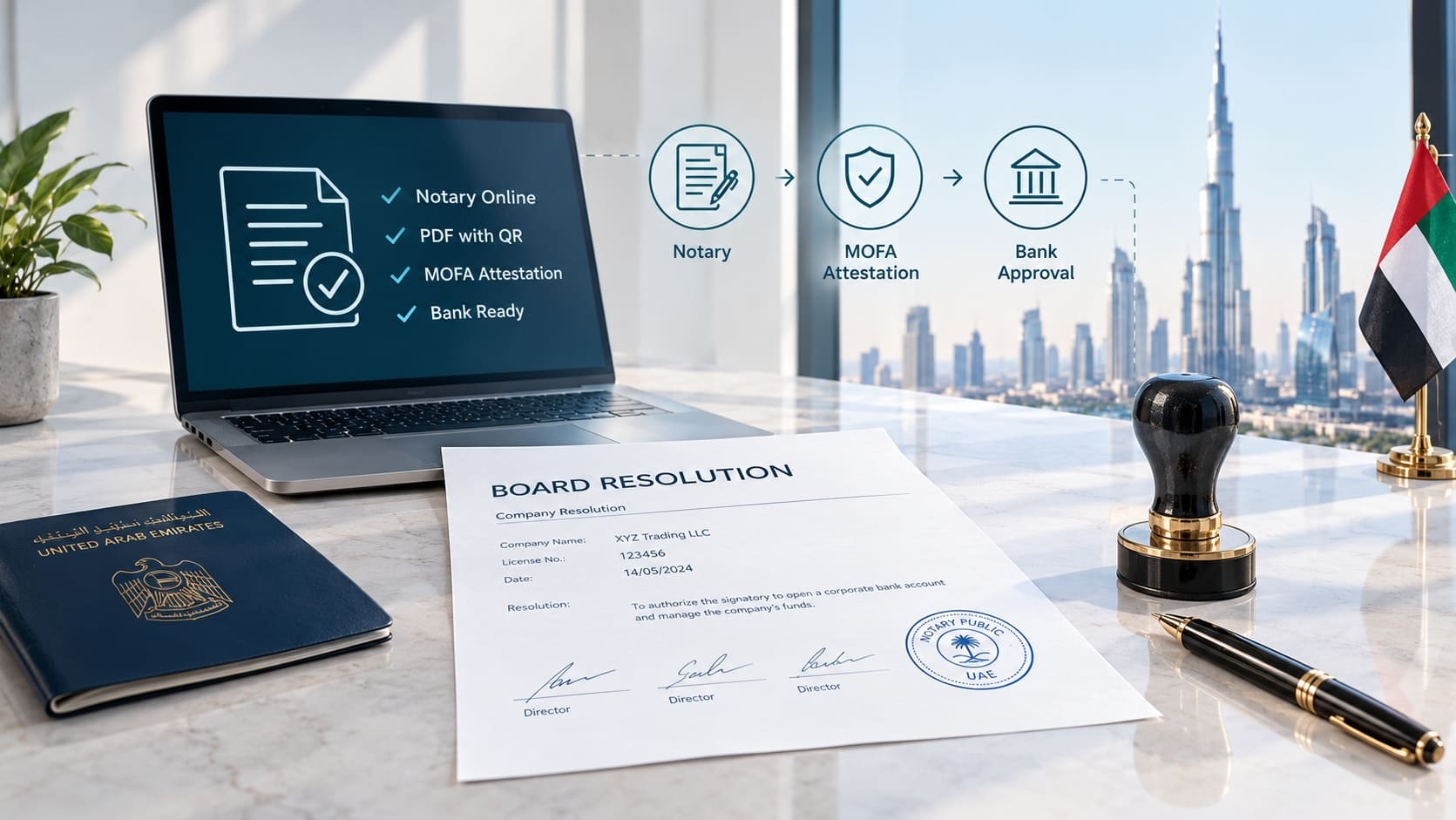

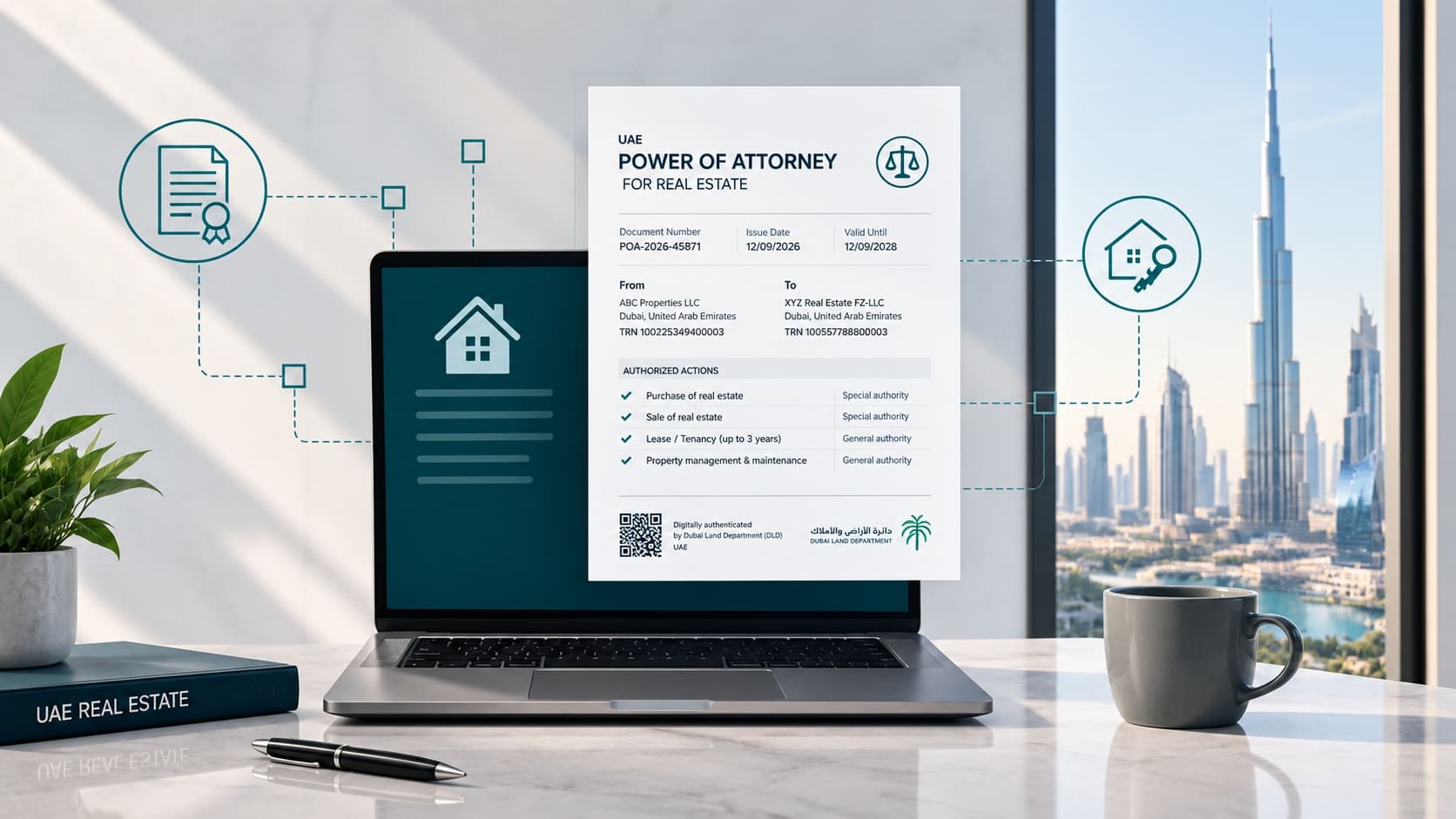
The owner is in London, Almaty or São Paulo. The apartment is in Dubai. A buyer turned up this week and there is no time to fly in, so the answer looks obvious: grant a power of attorney. The document takes an hour to produce — and the registration centre hands it back, because the powers are worded too loosely, the attestation date is too old, or the property is not described as the register describes it.
A power of attorney for property in the UAE is not a one-size document. Requirements come in three layers: the federal civil transactions law, the land rules of the emirate, and the acceptance rule of whichever authority your representative walks into. Three scenarios matter: selling, buying, renting.
A general power of attorney fails where the law demands a special one

This is where most deals break. The principal writes “to represent my interests in my Dubai property”, assumes it covers everything, and the law reads the sentence differently.
The foundation is Federal Decree-Law No. 25 of 2025, the new Civil Transactions Law, in force since 1 June 2026. Article 870 splits acts into two categories. Anything beyond managing and preserving the asset requires a special power of attorney naming the type of act: the law lists, among others, gift, sale, settlement, mortgage, acknowledgement and arbitration.
Article 871 draws the same line from the other side: general wording confers only acts of management — leasing for up to three years, upkeep, collecting what is due, paying debts. Article 872 adds that the authority reaches only the matters expressly named.
The emirates repeat the rule. Article 16 of the executive regulation of Abu Dhabi Law No. 3 of 2005 on real estate registration says almost the same: general wording gives management powers only, while sale, mortgage and gift need a special power of attorney.
Table 1 — What a general power of attorney covers, and what it does not
| Act concerning the property | General POA enough | Special POA required |
|---|---|---|
| Letting for up to three years | Yes | — |
| Maintenance, repairs, utilities | Yes | — |
| Collecting rent | Yes | — |
| Selling the property | No | Yes |
| Mortgage and pledge | No | Yes |
| Gift | No | Yes, naming the property |
One useful detail sits in Article 870(2): a special power of attorney may be granted for a type of transaction without naming a specific property. Gift is the exception. But a registrar reads the text literally, so describe the property with the particulars from the title register.
Selling: why the Dubai Land Department’s two years is an acceptance rule
The principal sets the term. The law imposes no universal shelf life — the document runs until the task is performed, until a date the principal names, or until it is revoked. What does exist is the separate acceptance rule of the authority your representative will face.
A POA to sell property in Dubai meets that rule head-on. The Dubai Land Department states it plainly: the representative acts within the powers set out in the document, and the term of a power of attorney for sale, mortgage and gift is two years. In its guidance on auctions the department repeats the point — the document is accepted if no more than two years have passed since it was issued.
The distinction matters. A power of attorney with no end date, granted three years ago, is legally alive — but for a Dubai property deal you will be asked to re-issue it. Nothing has lapsed; the counter has declined to accept it.
Sales are registered at Real Estate Registration Trustee centres, open 08:00 to 17:30. The Dubai Land Department is the only body authorised to register transactions, and anything not in its registers has no legal effect. A complete file takes about 30 minutes.
Auction sales are stricter. Property belonging to a minor needs permission from the Awqaf and Minors Affairs Foundation; an off-plan unit needs a developer NOC; where the sale enforces a judgment, the judgment itself suffices.
A seller protection few mention. Article 888 allows a sale at a suitable price, but where the principal has named a price, the agent may not go below it. If the agent sells without permission and hands over the property, the principal chooses: recover the asset, ratify the sale, or claim the shortfall. A minimum price costs one line and closes an expensive hole.
Buying: five years, and the question of whose name goes on the title

For purchases the Dubai Land Department allows more room: five years from the date of notarisation. The logic: a search, a mortgage and a wait for handover stretch across years.
The bigger question is whose name ends up on the title. The agent is told to buy an apartment and registers it to himself, his spouse or a relative. Or the reverse: he sells the principal his own property.
Article 885 closes both doors. A person appointed to buy a particular thing may not acquire it for himself, his ascendants or descendants, his spouse, or persons a transaction with whom benefits his own estate — except where the principal has given permission. Even if the agent declares he is buying for himself, the purchase is treated as made for the principal. The second paragraph bars an agent authorised to buy from selling his own property to the principal unless the parties agreed otherwise.
Article 886 then names three cases in which the purchase is treated as made for the agent: he bought above the price stated to him; he bought at a price involving gross unfairness; or he declared he was buying for himself in the principal’s presence.
Abu Dhabi mirrors the prohibition at registration level. Article 16(3) of the regulation states that a representative may not contract with himself on the principal’s behalf unless the power of attorney says so expressly, and the same clause requires a check that the transaction does not exceed the powers granted. If a transfer within the family is the plan, the permission has to be written in.
Where the purchase is mortgage-financed, the power of attorney must be special: Article 870 classes a pledge as disposal. The Abu Dhabi regulation adds that on registration of a mortgage both parties or their representatives. attend. Many banks insist on their own templates — a lender’s condition, not a rule of law, but worth establishing before you attest anything.
Renting: three years in the law, ten years in Ejari
Leasing is the one scenario where a general power of attorney sometimes does the job. Article 871 treats letting for up to three years as management; anything longer is disposal and needs a specific power. Abu Dhabi sets its own threshold: the regulation’s definition of “disposal” captures leases of more than four years, and such a contract goes into the real estate register.
In Dubai the tenancy contract is registered in Ejari — by owners, agencies, owners’ representatives and holding companies, and by service centres, in the presence of one of the parties or a representative acting under an Ejari power of attorney.
Table 2 — What a service centre asks for on Ejari registration
| Item | Requirement |
|---|---|
| Tenancy contract | Original, unified form |
| Proof of identity | Emirates ID mandatory; passport only under the exceptions |
| POA issued in Dubai | Reference number is enough, no copy needed |
| POA from another emirate | Attached to the application |
| Maximum contract term | 10 years |
| Cancelling a registration at a centre | AED 40 |
Two points. First, the Emirates ID is mandatory to register the tenant, and registration on passport details is not carried out. There are exactly two exceptions — embassies and consulates, and GCC nationals, who hold no Emirates ID and are registered on their passport details. Second, a lease lives in Ejari, while usufruct and musataha are recorded in the real estate register — and need a differently drafted power of attorney.
Eviction is separate. Where the owner wants the property for personal use, or intends to sell or demolish it, notice runs through a notary public or by registered mail and must be given at least 12 months in advance. Non-payment works differently: under Article 25 of Dubai tenancy Law No. 33 of 2008 the landlord serves written notice, and only if the arrears remain unsettled after 30 days may he seek termination. Those 30 days are time to pay, not a notice period. Authority to serve and receive legal notices is best written in.
Three situations need no power of attorney at all. Where there are several owners, one of them signs. A husband may file the Ejari application for his wife on production of the marriage certificate and with the approval of the rental relations regulatory department. For a minor, the guardian signs.
Describe the property and the deal, and we will word the powers so the document is accepted the first time — and tell you how long preparation realistically takes.
Abu Dhabi: a different rulebook and different limits

The Abu Dhabi Judicial Department imposes its own ceiling: a maximum of three Gregorian years from the date of attestation. The five-year figure applies only to a litigation power of attorney granted to a lawyer, which has nothing to do with property. The register holds the same line — DARI’s guidance on selecting the power of attorney says a document older than three years is considered outdated and is not accepted.
The service conditions add three restrictions. Where the power of attorney covers sale and assignment, the place of disposal must be stated. For agricultural land and farms, only a relative up to the fourth degree may act as representative. The sale of a government-granted residential plot cannot be delegated by power of attorney until the completion certificate is issued.
Table 3 — Power of attorney for property in the two emirates
| Parameter | Dubai | Abu Dhabi |
|---|---|---|
| Ceiling at attestation | Not published | 3 years from attestation |
| Acceptance rule: sale, mortgage | Not older than 2 years | 3-year ceiling applies |
| Acceptance rule: purchase | 5 years from attestation | 3-year ceiling applies |
| Attestation fee | AED 100 per party plus AED 20 fee | AED 100 for each year of the term |
| Processing time | Not published | 2 working days |
| Where the deal is registered | DLD Trustee centres | ADREC register, DARI platform |
The document set is tougher too. To sell, the representative produces a power of attorney, attested and legalised, stating that the principal authorised him to deal with that specific property. A corporate principal also produces a commercial register extract and the licence.
Attest a power of attorney in Dubai online: how it works
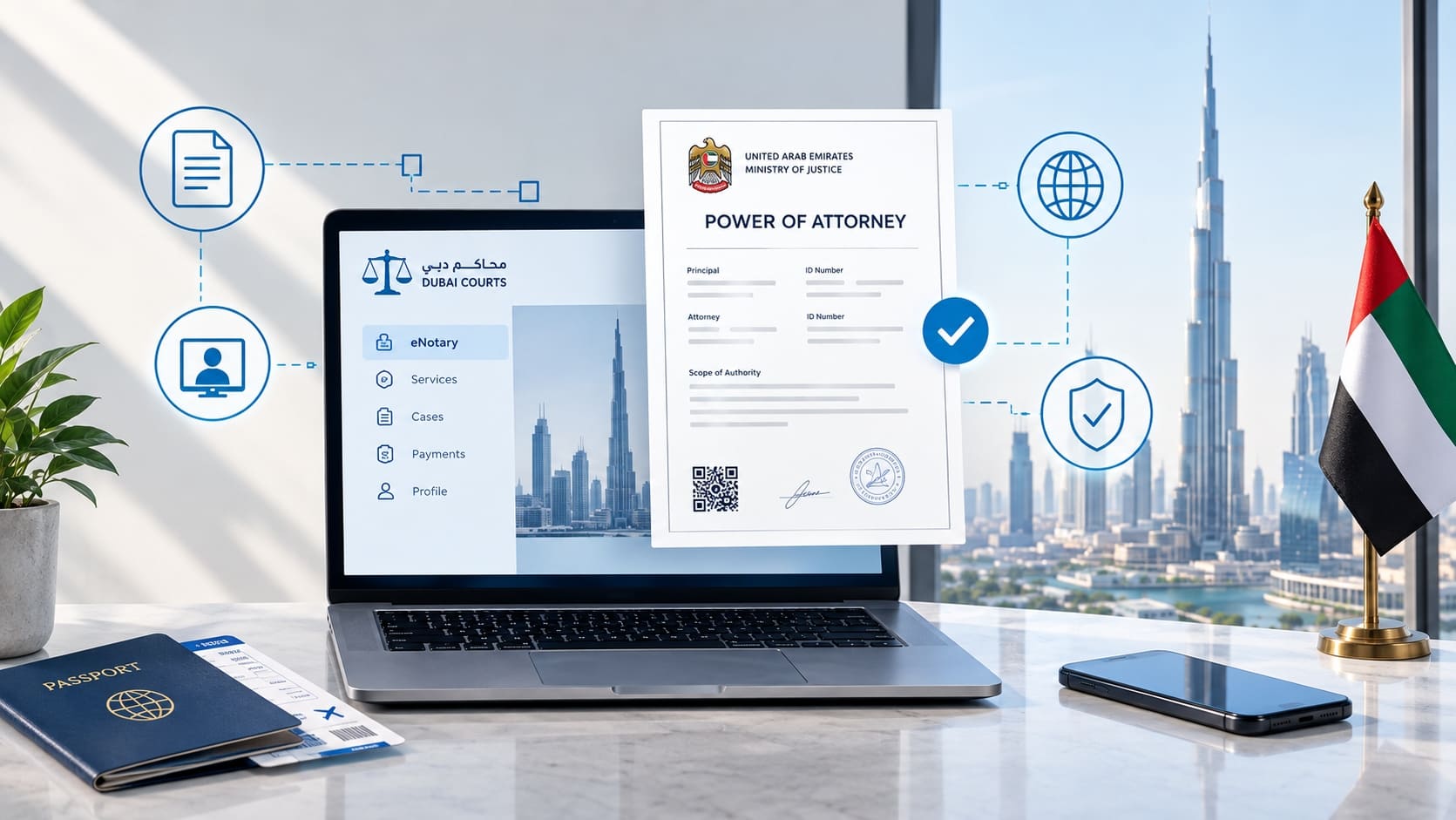
To attest a power of attorney in Dubai online, the “Power of Attorneys Ratification” service runs through the courts’ website with prior registration: the applicant enters their details and identity number, uploads PDFs and pays the fee online. For a property power of attorney the attachment list expressly names the title deed, for a corporate one, a valid trade licence. Legal and administrative review follows, the parties sign electronically, and the document arrives by email.
One condition derails this more often than any other: online attestation is open only to parties holding a valid Emirates ID. A party with nothing but a passport must attend the notary in person. For a non-resident that means a trip, or executing the document at home and legalising it afterwards.
Dubai’s fee is modest: AED 100 per party plus an AED 20 knowledge and innovation fee. In Abu Dhabi the application also goes through the judicial department’s portal, processing time two working days. But “online” there is not only the form: once the application is approved, an appointment is usually booked for a remote video meeting with the notary, and only some applications submitted through UAE Pass go through without one.
A power of attorney in Abu Dhabi is registered on DARI: sign in with UAE Pass, Emirates ID or unified number, then pick the document’s source from four options — Abu Dhabi courts, Dubai courts, another UAE court, or a court abroad. In Dubai the tenancy goes into Ejari via the Dubai REST app, and a sale and purchase through Real Estate Registration Trustee centres, with a video call for parties overseas.
A power of attorney issued abroad: the four-step legalisation chain
The most underestimated part of the process. The Dubai Land Department describes it without alternatives: a power of attorney issued outside the UAE is accepted only after certification by a notary, then by the foreign ministry of the issuing country, then by the UAE embassy there, and finally by the UAE Ministry of Foreign Affairs. The Dubai Courts service conditions list the same three external steps.
And here sits the most common mistake: the client obtains an apostille and considers the matter settled. An apostille does not work in the UAE. The 1961 Hague Convention abolishing the requirement of legalisation for foreign documents has 130 parties, and the Emirates are not among them. To legalise a power of attorney for the UAE you need every link.
Language is a requirement in its own right. In Dubai a document not in Arabic is accepted only with a legal translation certified by the UAE Ministry of Justice. In Abu Dhabi an English-language notary public office has run since October 2023: it accepts documents in English, including every type of power of attorney, though an Arabic translation may still be requested for particular transactions.
In our experience, a power of attorney with a foreign party takes one to two weeks, not a day.
How we prepare a power of attorney for property
We do not start from a template. We start with three questions: what the property is, which act has to be performed, and which authority the representative will hand the document to. The answers decide the category of powers, the term, the language and the method of attestation. We then cross-check details against passports, Emirates ID and the register extract, draft a bilingual text, confirm what the receiving authority and the bank require, and map out the calendar.
Tell us the property and the transaction — we will draft the power of attorney, give you a realistic timeline and point you to the fastest place to have it attested.
Get a consultation
This material is for information only and reflects the position as at September 2026. Laws and authority requirements change; check the current wording and confirm with the authority before you proceed.