
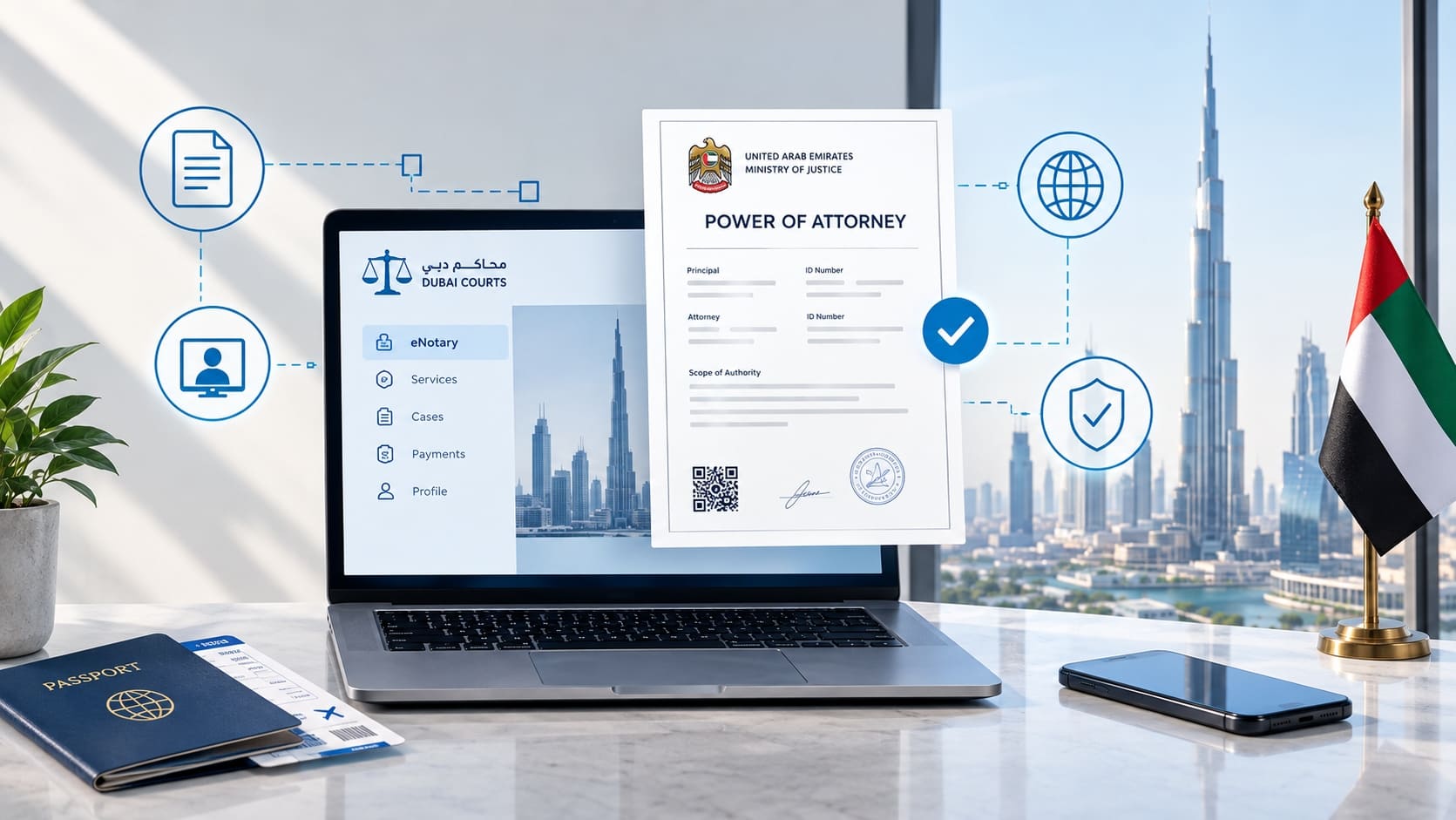
The apartment transfer in Dubai was booked for Thursday. On Monday the client flew to London on a family emergency, with no return date on the ticket. The agency was blunt: without the seller standing in the Trustee centre, the registration would not go through. The fix took two days — a power of attorney UAE remote, signed by video call through the Dubai Courts portal, and the deal closed without him in the country.
UAE residents land in this situation constantly. Emirates ID in the wallet, a company and a property in the country, and the person himself three time zones away with no realistic way back for a few weeks. That used to mean blown deadlines. Today UAE notarisation runs entirely online, and a POA can be issued from anywhere on the map.
Below: which route applies to you, how the notary video session actually runs, what it costs, how long the document survives, and the wording that makes a bank or the Land Department accept it first time.
When a POA saves you, and when it won’t

A power of attorney covers almost every situation that demands your signature or your physical presence. Selling and buying property, registering at a Trustee centre, collecting keys, connecting utilities, filing with a licensing authority, appearing in court, managing a tenancy, sponsoring a family member’s visa — your attorney handles all of it on your behalf.
There is a zone a POA cannot enter, though, and it pays to know about it before you book anything. UAE banks will not let you open an account by power of attorney: compliance demands face-to-face identification of the prospective account holder. On an account that already exists, an attorney can move money if the bank has added him to the signature card — but the owner signs that card too.
Immigration works on the same logic. Nobody gives your biometrics for you, and nobody sits your medical test. Filing the application, paying the fees and collecting the finished papers, however, are fair game for an attorney.
Then there is the question of whom to appoint. The law does not require your attorney to be a UAE resident, but he does need to be physically inside the country when the moment comes: somebody has to walk into the Trustee centre, the bank branch or the immigration office. In practice that is usually a business partner, a relative on a residence visa, or a staff member at your consultancy. Check that his passport and visa outlast the task — an attorney whose visa expires mid-transaction is a problem you do not want.
Two routes: Emirates ID or foreign passport
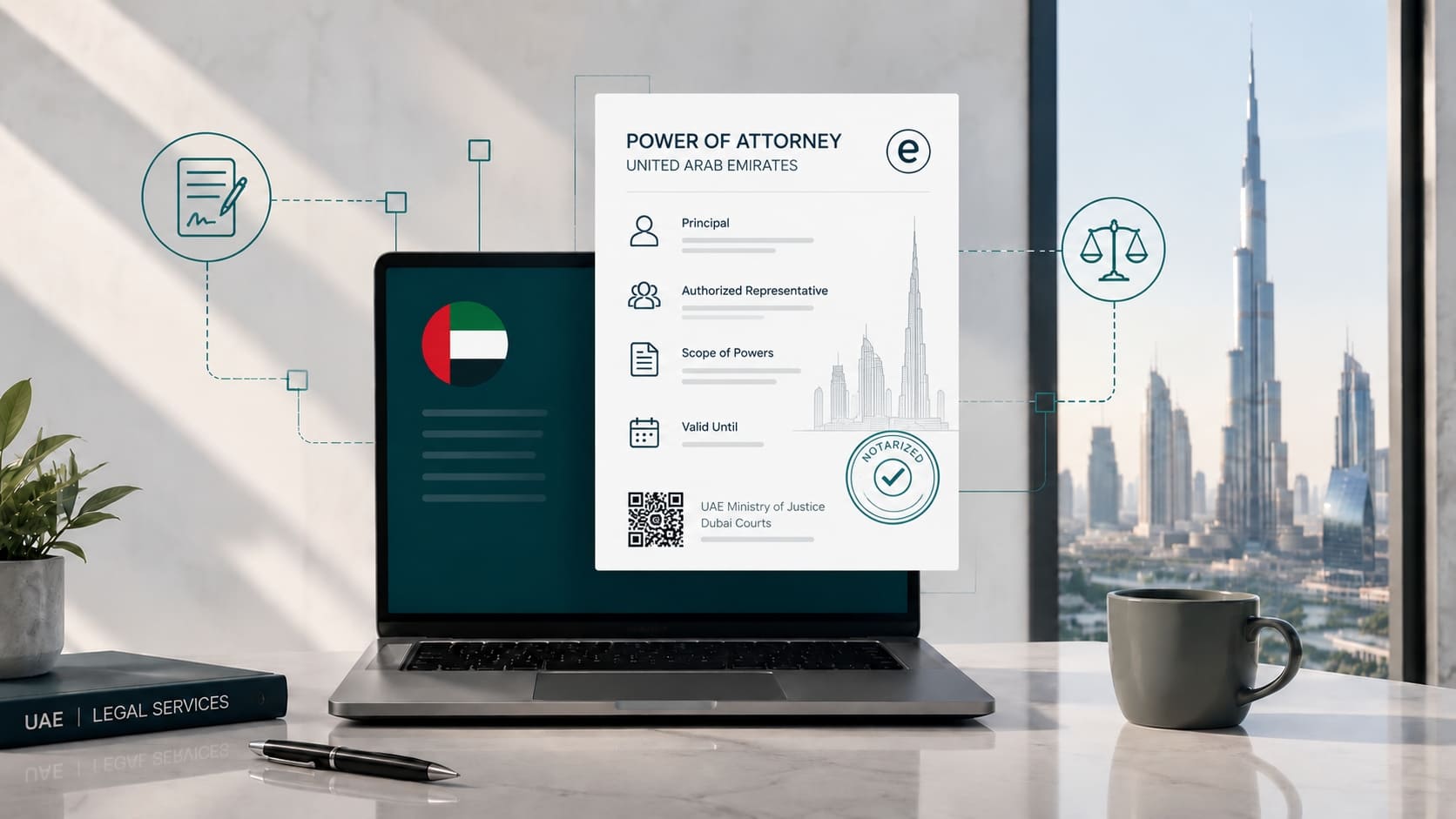
Your entry point depends on your status, and it is the first thing to establish. A UAE resident holding a valid Emirates ID works directly through the Dubai Courts electronic notary platform. Identity is confirmed against the Emirates ID, a government notary issues the document, and this is the cheapest path available.
Someone without a residence visa has no access to the government portal. His route is a licensed private notary who runs the same video session but identifies him against a foreign passport. The substance is identical; the price differs, and the notary usually drafts the text himself rather than reviewing yours.
One detail matters enormously for people who have been away a while: the residence visa must be valid on the date of the session, not merely on the date you left. If it has expired or been cancelled, you drop into the second route automatically — passport, private notary, higher fee.
Table 1 — Route by applicant status
| Parameter | UAE resident | Non-resident |
|---|---|---|
| Who notarises | Dubai Courts, state notary | Licensed private notary |
| ID document | Emirates ID | Foreign passport |
| Where you can be | Any country | Any country |
| Cost | Government fee only | Fee plus notary charge |
| Who drafts the text | You or your lawyer | Usually the notary |
How the notary video session works
The whole thing takes one to three working days and breaks into five steps. You attend none of them in person — all you need is a camera and your original ID in your hand.
- Choose the document type and upload scans: your Emirates ID or passport, your attorney’s documents, and where relevant the title deed or a company extract.
- A lawyer or the notary prepares a bilingual Arabic POA — Arabic in one column, English in the other.
- You pay the fees online and book a slot for the video session.
- At the appointed time you join the call, hold the original ID up to the camera, confirm the contents of the power of attorney out loud, and enter a one-time code sent by SMS. The session is recorded.
- You receive the electronic document in Arabic and English, carrying a QR code for authenticity checks.
A few practical points. Slots run on Dubai time, so if you are in São Paulo the session may land in the small hours — plan around it. Your connection has to carry stable video: do not attempt this on mobile data from a moving car, because the notary will end the session the moment the feed drops. And the original ID must be physically with you. A scan held up on a phone screen is refused.
That finished PDF with the QR code is the document, full stop. Wet-stamped paper has gone out of circulation: the recipient scans the code, sees the record in the system, and satisfies himself the POA is genuine.
What it costs: government fee, notary fee, translation fee
The final invoice has three components, and knowing who gets what explains why quotes in the market differ by a factor of three.
The first is the government fee. Its size is fixed by federal tariff — Cabinet Resolution No. 19 of 2024 — so it is identical everywhere and not open to negotiation, because the money goes to the treasury. It is charged for certifying each signature and separately for registering each party, principal and attorney alike.
The second is the notary’s service fee. This is payment for work performed: drafting the bilingual text, checking the documents, organising and running the video session, issuing the electronic document. Through the Dubai Courts portal a state notary keeps this component minimal. With a private notary it is the bulk of the bill.
The third is the translation agency’s service fee. The Arabic version is mandatory, and only a licensed agency can produce it — a translation carrying its stamp has legal force, one you produced yourself does not. It is priced per page, so a sprawling general POA costs noticeably more to translate than a tight specific one.
Table 2 — What makes up the cost, 2026
| Component | Typical amount | Paid to |
|---|---|---|
| Signature certification fee | AED 100–300 per signature | UAE treasury |
| Party registration fee | AED 100 per person | UAE treasury |
| Notary’s service fee | Per the notary’s tariff | The notary |
| Translation agency fee | AED 50–150 per page | Translation agency |
| Turnkey package | From AED 1,570 (~USD 430) | One invoice for everything |
All three payments go through online — by card on the Dubai Courts portal, or by invoice to the notary and the agency. You walk into no office for any of them, and that is the defining change in this procedure: drafting, payment, certification and delivery now fit inside a browser tab.
The one-to-three-day timeline holds for a document produced entirely inside the UAE. If your file contains a paper issued abroad, add three to five working days for consular legalisation — embassy turnaround is not something you can accelerate.
General or specific: which to choose
The temptation to issue a general power of attorney is easy to understand. One document, every eventuality covered, never think about it again. In practice it tends to cause more trouble than it prevents.
- A specific POA describes one defined authority: sell this apartment, represent the company at this bank, file the renewal for this licence. Recipients like these documents. The text shows exactly what they need to verify, and nothing is left to interpretation.
- A general POA hands over a wide sweep of authority in one go. The Dubai Land Department and the banks treat it warily and frequently ask for a specific instrument covering the actual transaction, even where the general one formally reaches it. There is also the obvious exposure: a holder of a general POA can deal with your assets more freely than you intended.
For someone living abroad, the sensible tactic is a specific power of attorney for each task, bounded by asset, amount and duration. Several tasks running over months? Issue several specific POAs rather than one catch-all. It costs a little more in fees and saves a great deal in rejected filings.
Two years: validity and revocation

A UAE power of attorney is not open-ended, even when the text says “until revoked”. For property transactions the Dubai Land Department accepts a POA for two years from the date of notarisation. A document older than that will not clear the Trustee centre, whatever the closing clause promises. The same two-year benchmark is applied to powers of attorney executed outside the UAE.
That yields a simple planning rule: do not issue a POA “just in case” a year before the transaction you have in mind. Issue it when the task materialises. Re-issuing by video call takes the same one to three days, whereas an expired document is usually discovered at the worst possible moment — in the registration queue, with the buyer’s funds already committed.
Revocation is symmetrical. Telling your attorney, verbally or in writing, is not enough. To revoke a power of attorney Dubai-side you go back to a UAE notary — remotely again, same procedure — and only then does the document stop binding third parties. If the POA was filed with a particular authority, send the revocation there directly rather than assuming the news will travel on its own.
Notarising with a notary where you are
Some clients take what looks like the short route and have the POA notarised by a local notary wherever they happen to be. It works, but it is markedly slower and dearer than the online path, and here is why.
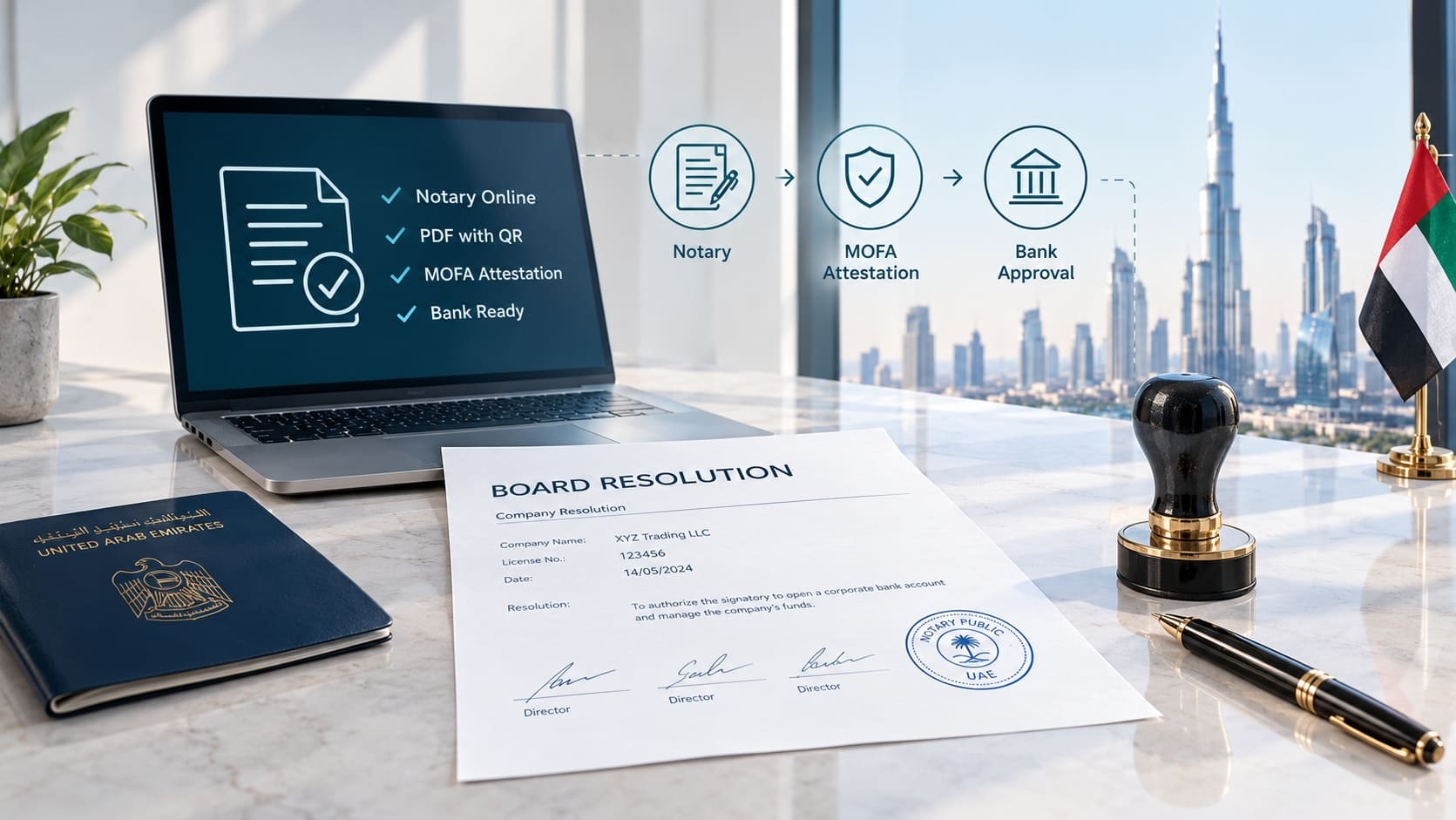
The UAE is not a party to the 1961 Hague Apostille Convention — as of September 2026 that remains the case. An apostille on its own legalises nothing in the Emirates. The chain runs differently: a notary in your country of residence, then that country’s foreign ministry, then the consular section of the UAE embassy, then after import MOFA attestation with MOFAIC, and finally a legal translation into Arabic by a licensed agency.
Five steps, each with its own fee and its own queue. Two to five weeks in total depending on the country, holidays excluded. Set that against one to three days online and the choice makes itself for anybody holding a live Emirates ID.
The route still earns its place in one scenario: the residence visa has expired and a UAE private notary is out of reach. Then legalisation is the only path, and you start it early — a client in Singapore who begins in week one closes on time, and one who begins in week four does not.
What to spell out for a specific task
The notary checks the form; the recipient checks the substance. A power of attorney whose scope is unclear gets bounced back even with a flawless QR code. The wording has to be executable: the attorney’s full name and passport number, an identified asset or account, and defined limits on what he may do.
Table 3 — What each task requires in the text
| Task | Must appear in the wording |
|---|---|
| Property sale | Title deed number, unit address, right to sign at DLD |
| Tenancy management | Right to sign and terminate leases, rent ceiling |
| Company matters | Licence number, list of authorities, signing rights |
| Visa applications | Family member’s full name and passport, application type |
| Court representation | Case number or subject of dispute, instances covered |
Address the duration and the right of substitution separately. By default your attorney may not delegate the authority onward, so if you need that flexibility it has to be written in. The reverse holds too: where you do not want substitution, prohibit it expressly rather than relying on the default. It costs one sentence and removes an argument later.
Five mistakes that get a POA rejected
- The first is a mismatch in the spelling of a name. One transliteration in the POA, another on the Emirates ID, a third on the title deed. One letter out and the registrar stops the file.
- The second is an expired residence visa on the date of the session. The government portal simply will not accept the application, and the day is gone.
- The third is a do-it-yourself translation. An Arabic version without a licensed agency’s stamp carries no weight, however accurate the language.
- The fourth is a POA older than two years submitted for a property transaction. “Until revoked” does not rescue it.
- The fifth is vague authority. “To represent my interests in all matters” sounds convenient, but the recipient cannot tell whether the phrase reaches the specific act in front of him, so he asks for a new document — and you lose a week.
What to do next
Issuing a power of attorney from abroad has stopped being an emergency. With a valid Emirates ID it is a matter of two or three days and one video call — whether you are sitting in London, Singapore or São Paulo, and whether the asset is an apartment in Dubai Marina or a holding in Cyprus, Singapore or the BVI that needs a UAE signature. What matters is not leaving it until the day of the transaction, checking with the recipient in advance which wording they expect to see, and reconciling the spelling of your name across every document in the file.
Dynasty Business Adviser drafts and manages powers of attorney for UAE residents and non-residents alike — from task-specific wording through the notary video session, the certified Arabic translation and submission to the bank, the DLD or the licensing authority. Write to us and we will tell you which POA your situation calls for and how long it will take.
Get a consultation
Disclaimer. This material is provided for information only and does not constitute legal advice. Notarial, court and government requirements in the UAE vary between emirates and are updated regularly — confirm current rules with a qualified specialist before executing any document.
Data current as of September 2026.