
The owner of an ADGM holding SPV usually finds out at the worst possible moment: the bank asks for a fresh certificate of incumbency, and the company service provider has not answered an email in three weeks. Then the rest surfaces. The licence was never renewed, the registered address is effectively hanging in the air, and the beneficial ownership register has not been touched since incorporation. The story is ordinary, and it almost always has the same root cause — the structure was incorporated and then forgotten, by the owner and by the provider alike.
ADGM corporate services are not “renew the licence once a year”. They are a continuous cycle: annual filings, statutory registers kept current, notifications to the Registration Authority every time something changes, the UAE tax perimeter, and a working relationship with the bank. The entity that holds this cycle together is the CSP — the Company Service Provider, a licensed corporate service provider through which your company physically exists in the jurisdiction. When it stops delivering, nobody winds up the structure. They change the provider.
Below: what servicing covers, how to tell your CSP has to go, and how to move without fines or a gap in compliance.
What a CSP does in ADGM and why your structure cannot exist without one

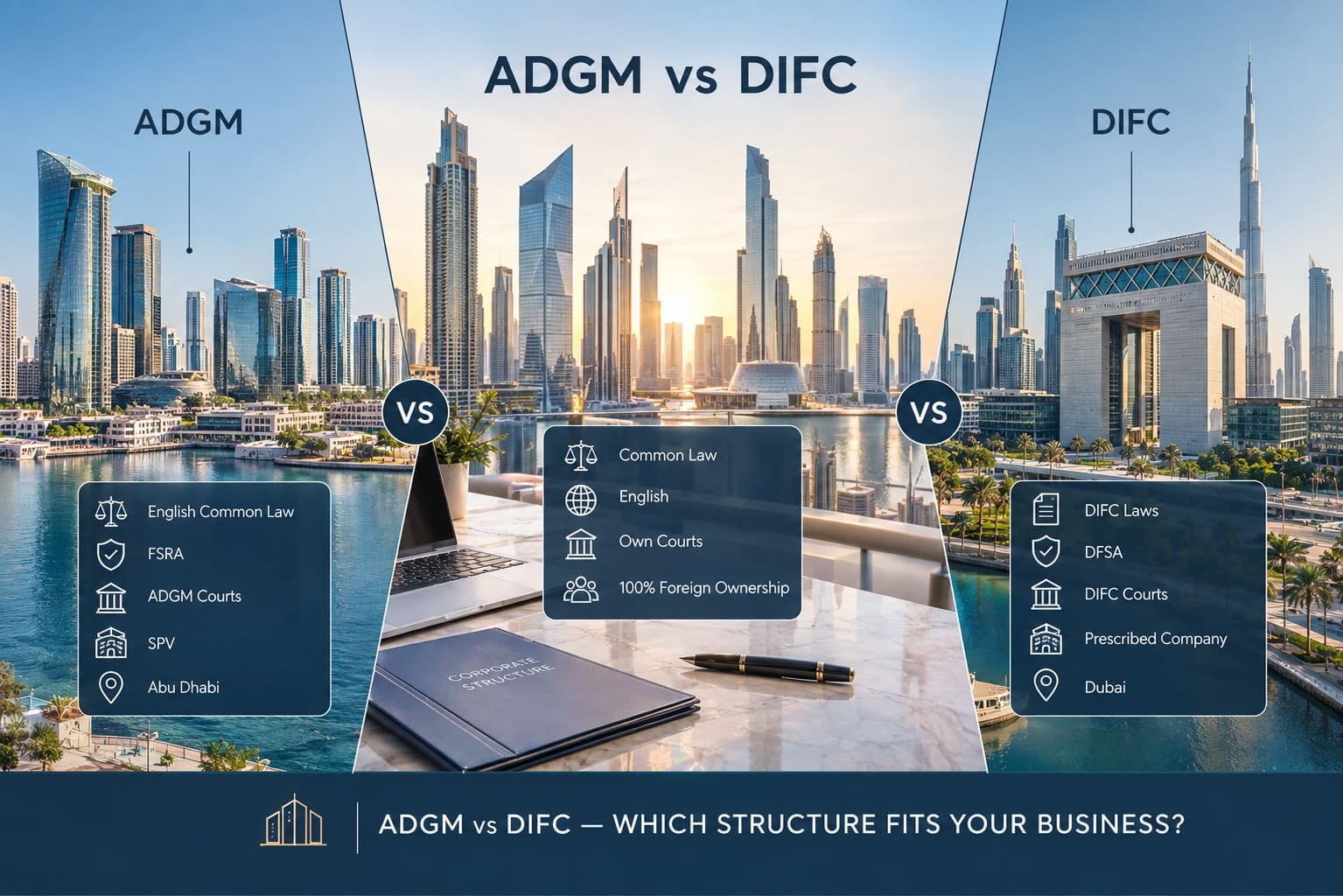
Abu Dhabi Global Market is an international financial centre in Abu Dhabi, operating since 2015. Its distinguishing feature is that English common law applies directly here rather than being paraphrased by a local legislator. ADGM has its own courts, its own arbitration centre, and three independent bodies: the Registration Authority, the financial regulator FSRA, and the ADGM Courts.
The Registration Authority licenses company service providers and maintains a public register of them. Verifying that your provider really is licensed takes a minute in the public registers section of the ADGM website — and it is the first thing to do before signing with a new CSP.
The role is broader than it looks at incorporation. A CSP supplies the registered office: the legal address at which the structure appears in the register and to which official notices are delivered. It acts as company secretary, drafting board resolutions and minutes and maintaining the statutory registers of members, directors, charges and beneficial owners. It also acts as filing agent, since access to the Registration Authority’s online portal sits with the provider, and most changes to the structure are physically submitted by them.
The provider’s position in the anti-money-laundering framework deserves separate attention. Company service providers fall within the DNFBP category — designated non-financial businesses and professions carrying AML/CFT obligations under UAE federal law. That explains the depth of onboarding: passports, proof of address, source of funds and source of wealth for every beneficial owner, and the corporate chain traced to the ultimate individual. A provider willing to take you on “with a passport copy in a day” is not saving you time. It is building you a problem with a two-year fuse.
Which ADGM structures need servicing, and how much of it
The volume of work depends heavily on what you actually hold. A classic SPV is a holding shell with no premises and no staff: it owns shares in operating companies, real estate or intellectual property, or acts as borrower in a financing. A CSP is mandatory for it, simply because without the provider’s address the structure has no registered address at all.
An ADGM Foundation follows a different logic. It is a standalone legal person with no shareholders, created to hold assets and pass them on under the rules its founder wrote. Servicing is denser here: on top of the standard filings comes work with the foundation council, the guardian and the constitutional documents, and the quality of register-keeping directly affects whether the structure survives a succession dispute.
An operating company with real office space in ADGM can formally do without a CSP, because it has its own address. In practice, company secretarial work and filings still tend to go to a provider — an in-house administrator in Abu Dhabi costs more than an annual service package.
Table 1 — Scope of servicing by ADGM structure type
| Parameter | SPV | Foundation | Operating company |
|---|---|---|---|
| Purpose | Asset holding, deals | Ownership and succession | Active business |
| CSP mandatory | Yes | Yes (without own office) | No, but usually engaged |
| Physical office | Not required | Not required | Required |
| Financial statements | Required | Required | Required, often audited |
| Employee visas | Not available | Not available | Available within quota |
| Public disclosure | Limited | Limited | Broader |
Two categories sit apart: the Restricted Scope Company, with reduced disclosure for group and family structures, and the family office, which carries its own requirements. Both are serviced on a bespoke basis, and a provider’s standard package rarely fits either.
What ADGM corporate services actually cover
Proper support breaks into five perimeters, and a failure in any one of them eventually shows up in the rest.
- The first is registry-facing: the legal address, receipt of official correspondence from the Registration Authority, and a timely response to it.
- The second is company secretarial: shareholder and director resolutions, statutory registers, changes of director, share capital movements, share transfers, powers of attorney issued and revoked.
- The third is regulatory: commercial licence renewal, annual accounts, updates to beneficial ownership information, and the annual data protection notification.
- The fourth perimeter is tax, and in the UAE it has become the most demanding one in recent years. Corporate tax was introduced by Federal Decree-Law No. 47 of 2022: a headline rate of 9% on profits above AED 375,000, while a free zone company meeting the Qualifying Free Zone Person conditions can apply a 0% rate to qualifying income. For ADGM holding SPVs this matters a great deal — holding shares and securities, group treasury and financing, and fund and wealth management sit within the list of qualifying activities. The zero rate is not granted automatically, though. It requires adequate substance and documentation that stands up to review. Registration with the Federal Tax Authority runs through the EmaraTax portal, and the return is filed and the tax paid within nine months of the end of the tax period. Add VAT at 5% once taxable supplies pass the mandatory registration threshold of AED 375,000, and you have a second annual — sometimes quarterly — cycle. Economic Substance Regulations requirements were repealed for financial years starting on or after 1 January 2023, but filings for earlier periods remain the company’s responsibility.
- The fifth perimeter is banking. A UAE bank runs a periodic review of the client file each year and asks for current corporate documents, proof of address and updated beneficial ownership data. When the provider is slow to issue certificates, the account goes into restriction — and this is the single most common reason owners start thinking about changing CSP at all.
The annual compliance calendar for an ADGM entity
Keep the calendar visible, because deadlines in ADGM hang off different anchors: the licence off the incorporation date, tax filings off the financial year end, change notifications off the date of the change itself.
Table 2 — Key annual obligations and the cost of missing them
| Obligation | Frequency | Consequence of delay |
|---|---|---|
| Commercial licence renewal | Annually, on incorporation date | Fine, suspension, risk of strike-off |
| Annual accounts to the Registration Authority | Annually after year end | Fine, bank questions at review |
| Confirmation of corporate data | Annually | Fine, register data mismatch |
| Beneficial ownership register update | On every change | Fine, filings blocked |
| Data protection notification | Annually | Fine from the Office of Data Protection |
| Corporate tax return | Nine months after period end | FTA penalty, loss of relief |
| VAT returns | Per FTA schedule | Late payment penalties and interest |
The Registration Authority publishes its fine schedule separately and revises it periodically. The more useful point is that delays cascade. An unrenewed licence makes it impossible to submit changes; stale register data breaks the bank’s file review; unfiled accounts turn the tax return into an exercise in reconstructing figures after the fact.
Six signs it is time to change your CSP

The decision rarely follows a single incident. What usually happens is an accumulation of small things, each tolerable on its own.
- A straightforward request takes more than three working days, and urgent documents have to be chased
- You are the one who remembers the licence renewal date, not the provider
- Bank certificates arrive late, or with errors in the data
- Statutory registers live in a drawer: a current copy of the register of members takes a week
- The invoice keeps growing with line items that were not in the original proposal
- The provider cannot give a clear answer on corporate tax or Qualifying Free Zone Person status
A separate scenario is when the problem is not the service but the provider itself: a change of ownership, the departure of key people, or suspension or withdrawal of its licence by the Registration Authority. Here there is no room to wait — a structure registered at the address of a provider without a valid licence is left in limbo.
There is one more reason that gets discussed less often: conflict of interest. If the same provider services your counterparty in a deal or your opponent in a dispute, the question of separate information perimeters stops being theoretical very quickly.
Want an independent view? We run a health check on your ADGM structure: licence status, completeness of registers, filing history and the tax perimeter, followed by a plain list of what is overdue and what needs fixing first. Get in touch and we will look at your situation.
How a CSP change works, step by step
Changing a company service provider is a technical procedure, but one that is unforgiving about sequence. The governing principle: the new address must exist before the old one disappears.
- Step 1. Vet the incoming provider. Confirm that the candidate appears in the public register of licensed CSPs on the ADGM website, and get the scope of services in writing. A good maturity signal is a provider willing to show you upfront which filings it handles itself and which need an external auditor or tax adviser.
- Step 2. Onboarding and KYC. The new CSP must complete full due diligence before it can take the structure on. Prepare early: passports and proof of address for every beneficial owner and director, the corporate documents of the structure, and a clear account of source of funds and source of wealth. Legalisation and notarisation of foreign documents take longer than the onboarding itself.
- Step 3. Health check of the current position. Before filing the change of address, you need to know what you are taking on. An unrenewed licence, unfiled accounts and an outdated UBO register do not disappear in transit — they become your problem at the new address. The sensible order is to close the arrears first, then move.
- Step 4. Notice to the outgoing provider. CSP engagement terms usually include a notice period. Settle the account at the same time. This part is critical: withholding documents until outstanding fees are paid remains the most common way to stall a transfer.
- Step 5. Filings with the Registration Authority. The change of registered office is submitted through the online portal, together with a change of company secretary and authorised signatories where needed. The change of address takes effect on registration, so the transfer date is planned so that no gap opens between the old address and the new one.
- Step 6. Handover of the corporate archive. The outgoing provider releases the constitutional documents and registers; the incoming one receives them against an inventory and rebuilds whatever is missing.
- Step 7. Updating the external perimeter. Bank, auditor, tax profile in EmaraTax, data protection notification — wherever the structure’s address and contact details appear, the record has to match. A bank left out of the loop means a blocked payment a month later.
With documents ready, the full cycle takes a few weeks. What stretches it, almost always, is the same two things: legalising beneficial owner documents, and settling up with the outgoing provider.
What to collect from your outgoing provider

The inventory is not a formality. Reconstructing lost corporate documents costs more and takes longer than handing them over properly.
- Certificate of incorporation and the current commercial licence
- Articles of association and constitutional documents, with every amendment
- Registers of members, directors, authorised signatories and charges
- Register of beneficial owners, including the history of changes
- Board and shareholder minutes and resolutions for the whole period
- Share certificates, share transfer documents, powers of attorney
- Financial statements, audit reports, correspondence with the Registration Authority
Ask separately for the KYC file. The new provider will build its own, but the history of previous checks helps explain the origin of the structure to a bank without gaps. And check who retains access rights to the Registration Authority portal — that item is forgotten more often than any other.
The risks nobody warns you about
- The first risk is a gap in the address. If the outgoing provider stops servicing before the new address is registered, the structure formally has no registered office. That is a breach, and it is recorded in the register.
- The second is a transfer that collides with the licence renewal date. The classic version: the old CSP no longer considers renewal its job, and the new one does not yet have authority to file. The practical conclusion is simple — do not plan a transfer in the renewal month.
- The third is a mismatch between the ADGM register, the EmaraTax profile and the bank file. Banks compare addresses mechanically, and a discrepancy produces an account restriction with no warning.
- The fourth risk sits outside the procedure and appears later. A change of provider is a natural moment to revisit the structure’s tax position: does it still meet the Qualifying Free Zone Person conditions, is income correctly characterised, is there documentation for related party transactions. A transfer without that review simply moves an unresolved question to a new address.
What our service packages include
We treat ADGM as a jurisdiction for holding and family structures rather than as one more free zone selling licences. Hence the sequence: health check first, servicing second.
Table 3 — Corporate service packages for ADGM structures
| Parameter | Basic | Standard | Premium |
|---|---|---|---|
| Registered office | Yes | Yes | Yes |
| Company secretarial | Core filings | Full | Full |
| Registers and UBO | Yes | Yes | Yes |
| Tax perimeter (CT, VAT) | No | Registration and filings | Full support |
| Banking support | No | Documents on request | Managing the file review |
| Fee | Case by case | Case by case | Case by case |
We deliberately do not publish a single price list. The fee is worked out case by case: the type of structure, the number of beneficial owners and directors, whether anything is overdue at handover, whether an audit is required, whether there are related party transactions and a UAE bank account. A holding SPV with one owner and a foundation with a four-member council are different amounts of work, and an averaged figure would tell you nothing useful.
A CSP change is scoped as a separate project, priced case by case and quoted after the health check. It covers the review itself, preparation of the handover inventory, filings with the Registration Authority, and updating the external perimeter — bank, auditor, tax profile.
What to do next
An ADGM structure cannot be paused: deadlines run whether or not anyone is watching them. If you are unsure about your current provider, start with a health check rather than a transfer — it will show what is overdue and what closing it costs.
Dynasty Business Adviser audits ADGM structures, takes on corporate servicing end to end, and manages CSP changes from the first letter to the outgoing provider through to updating the bank. Get in touch, and we will go through your situation and give you timelines on the first call.
Get a consultation
This material is for information only and does not replace individual legal and tax advice. ADGM rules and UAE tax rates and thresholds change periodically — confirm current requirements at the official sources: adgm.com, tax.gov.ae, mof.gov.ae. Information is current as at the date of publication.