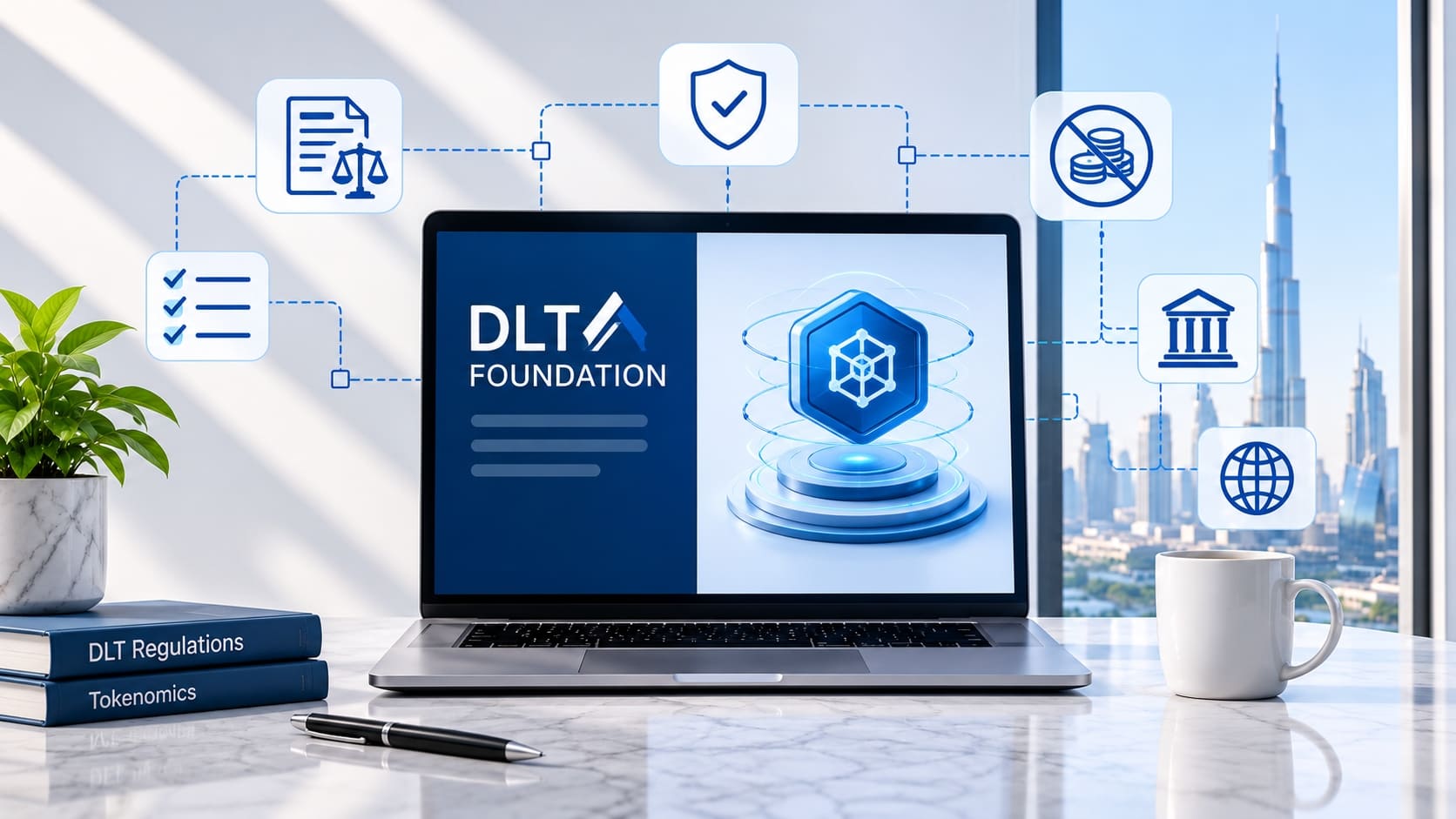
An ADGM DLT Foundation exists, among other things, to issue tokens: the regulations say so directly. But this often leads to the wrong conclusion: once the foundation is registered, any token can be issued and sold to anyone. In practice, the line is drawn not by the legal form but by the nature of the token. The same foundation can lawfully issue a protocol governance token and, at the same time, break the law if a token turns out to be a security in substance. Below is what a DLT Foundation can do with tokens, where FSRA regulation begins, which rules apply to token issuance in the UAE outside ADGM, and which documents to prepare.
What the DLT Foundation regulations permit

Under the DLT Foundations Regulations 2023, a foundation can be set up to use and develop distributed ledger technology and to issue tokens. The charter must describe:
- the types of tokens, their purposes and uses;
- the rules for issuance and transfer;
- how the smart contracts work;
- total supply and vesting;
- transfer restrictions and lock-up;
- pre-emption rights and buy-back, if any.
The charter also determines which matters token holders vote on. ADGM’s model charter is published on the Registrar’s website.
Token holder rights are also set by the charter:
- holders can vote on matters the charter assigns to them;
- the charter decides whether holders count as beneficiaries;
- a holder who is not a beneficiary has no monetary claims against the foundation’s assets;
- a holder is not liable for the foundation’s obligations merely because he holds a token.
The boundary. ADGM’s guidance on permitted activities for DLT Foundations states directly: the foundation may issue tokens, but may not engage in any activity regulated by the FSRA. ADGM’s page on the regime puts it this way: the foundation may issue utility tokens, and whether a token is a utility token or a security is determined under ADGM guidance. Regulated activity can only be carried out by a separate subsidiary with its own licence.
If the foundation nonetheless carries on activity that requires an FSRA licence, the regulations provide for a fine of up to level 8 on the ADGM scale, and the foundation may be struck off the register. The foundation’s advertising must be fair and not misleading. On public-policy grounds, the Registrar may temporarily prohibit the foundation from any marketing.
How the FSRA looks at tokens
The FSRA (ADGM’s financial regulator) assesses each token individually, by substance rather than by name. The main categories under FSRA guidance:
| Category | How it is treated | What it means for issuance |
|---|---|---|
| Digital Security | A security | A public offer with an FSRA-approved prospectus or under an exempt offer. A DLT Foundation is not designed for such issuances: it is prohibited from FSRA-regulated activity |
| Virtual Asset | A commodity, not a security | Issuance itself is not a regulated activity. Exchanges, brokers and custodians are regulated |
| Utility token | A commodity | Under FSRA guidance, offers of utility tokens fall outside its remit |
| Fiat-referenced token (stablecoin) | A separate regime since December 2024 | Requires an FSRA licence, reserves and redemption at par. Not possible through a DLT Foundation |
| Privacy tokens and algorithmic stablecoins | Prohibited in regulated activity | Do not issue |
A licensed firm in ADGM (an exchange, broker or custodian) may deal in a token only if it has become an Accepted Virtual Asset for that firm. The firm assesses the token itself against the FSRA’s criteria and notifies the regulator at least 5 business days in advance. This status applies only to that firm and does not mean the FSRA has approved the token as such.
Outside the financial free zones, the Central Bank of the UAE rules separately prohibit issuing algorithmic stablecoins and privacy tokens in the UAE or to persons in the UAE, as well as advertising such an issuance.
The FSRA defines the features of a security simply: a token that has the characteristics of a security is treated as a security. The FSRA compares a token with traditional securities such as shares, debt instruments and fund units. The risk is therefore higher if the token gives a right to a share, profit, dividends or debt payments. The FSRA treats utility tokens as commodities: their offer is not regulated, but market-rules mechanisms such as an exempt offer are not used for them either.
Even for a digital security, a prospectus is not always required. An offer is exempt from the prospectus requirement if it is made only to professional clients other than natural persons, or to fewer than 50 persons within 12 months (such clients are not counted), or if each buyer pays at least $100,000. But a DLT Foundation is still not suitable for such issuances.
Outlook. According to the law firm Pinsent Masons (October 2026), the FSRA’s plans for 2027 include a proposal to bring virtual assets into the scope of regulated investments (Specified Investments). For now this is only an announced plan, not a rule in force. If it is adopted, the line will shift. It is worth planning an issuance with a margin of safety.
What is and isn’t allowed: a table
| Action | Through a DLT Foundation |
|---|---|
| Issue a protocol or DAO governance token | Allowed, under the charter and tokenomics |
| Issue a utility token for access to a network or service | Allowed, if in substance it is not a security |
| Award grants in tokens, run hackathons | Allowed |
| Hold its own treasury, including in virtual assets | Allowed |
| Issue a token with a right to profit or dividends | Not allowed: these are features of a security |
| Issue a fiat-referenced stablecoin | Not allowed: an FSRA licence is required |
| Issue a privacy token or an algorithmic stablecoin | Not allowed |
| Run an exchange, brokerage or custody business | Not allowed: only a licensed subsidiary |
| Raise investment on a promise of returns | Not allowed |
If the token is sold outside ADGM
ADGM is not the whole of the UAE. If a token is offered to buyers in other emirates, different rules apply.
- Dubai (excluding DIFC). VARA, Dubai’s virtual assets regulator, is in charge. Under its Issuance Rulebook, fiat-referenced and asset-referenced tokens (Category 1) may only be issued with a VARA licence. For other tokens (Category 2), the issuer does not need a licence, but all placement goes through a licensed distributor. A whitepaper is published before any offer or marketing, together with a separate risk disclosure statement. A lighter regime applies to non-transferable tokens and closed-loop tokens.
- The rest of the UAE. The SCA rules on virtual assets apply (Cabinet Resolution No. 111 of 2022, excluding the financial free zones).
- Payment tokens. Regulated by the Central Bank of the UAE (the Payment Token Services Regulation was adopted in June 2024 and has applied since August 2024; it does not extend to the financial free zones). Dirham payment tokens are used to pay for goods and services. Foreign tokens may only be used to buy virtual assets. The CBUAE gave a one-year transition period for obtaining licences.
- The new CBUAE law. Federal Decree-Law No. 6 of 2025 has been in force since 16 September 2025. Under it, technology or a business model alone does not take an activity outside supervision: payment tokens and DeFi are mentioned explicitly. According to law firms, the one-year transition period expired on 15 September 2026. The CBUAE Board may extend it; according to legal reviews, as of the end of September 2026 no general extension had been reported.
How to choose between a structure and a licence is covered in DLT Foundation, VARA Licence or FSRA: What You Actually Need.
Documents for token issuance
When registering a DLT Foundation, ADGM asks for:
- a charter with the issuance rules and token holder rights;
- a legal opinion on the charter from a reputable lawyer;
- a whitepaper;
- a tokenomics paper: supply, distribution, vesting and mechanics. If no issuance is planned, a founders’ declaration to that effect;
- a security audit of the DLT infrastructure (the DLT Framework, in practice mainly the smart contracts) by an information security firm, if such infrastructure exists and whenever it changes.
The foundation’s minimum initial assets are at least $50,000. They are contributed within six months of registration, in fiat currency or in FSRA-recognised stablecoins. Other forms of contribution, including the foundation’s own tokens, are not permitted. ADGM fees for registering the foundation are from $15,000, and annual renewal is from $14,500 (ADGM fee schedule, January 2025). The services of a corporate service provider (CSP) and the registered office are paid for separately.
In practice, a separate legal opinion on token classification is added: whether the token is a utility token or has the features of a security. The Registrar does not require it separately, but without it, conversations with exchanges, banks and investors are difficult. The Registrar may ask for the whitepaper and tokenomics to be confirmed by a report from a specialist firm. A full checklist is in What ADGM Will Ask For: Legal Opinion, Smart Contract Audit, Tokenomics Paper.
The cost of Dynasty Business Adviser’s services for registering a DLT Foundation and preparing the documents is calculated individually for your project. Contact us for a personal consultation.
Tax
VAT. Under Cabinet Decision No. 100 of 2024, the transfer of ownership of virtual assets and their conversion are exempt from VAT, with retroactive effect from 1 January 2018.
Corporate Tax. Revenue from token sales may be subject to Corporate Tax. The foundation’s tax status and the issuance model should be checked with an adviser before the placement.
Common mistakes
| Mistake | Consequence |
|---|---|
| Calling a token a utility token without checking its substance | Risk of classification as a security and breach of FSRA rules |
| Promising returns or price growth in marketing | A feature of an investment product |
| Selling a token in Dubai without regard to VARA rules | Breach of the emirate’s rules |
| Running exchange or custody activity through the foundation | Breach of the regulations: a fine of up to level 8 and possible striking off the register |
| Not setting out token holder rights in the charter | Disputes with the community, claims against the council |
| Skipping the smart contract audit | Technical risks and questions from exchanges and the regulator |
Conclusion
A DLT Foundation is a lawful way to issue a governance or utility token in ADGM. But the foundation cannot issue securities or stablecoins, or carry on any FSRA-regulated activity. Each token is assessed by substance, and outside ADGM the rules of VARA, the SCA and the Central Bank apply. Before issuance, you need a charter with token holder rights, a tokenomics paper, a whitepaper, a legal opinion and a smart contract audit.
The Dynasty Business Adviser team will help you register a DLT Foundation, prepare the charter and tokenomics, and arrange a legal opinion from specialist lawyers. More details on the page. How the foundation differs from other forms is covered in DLT Foundation: How It Differs From a Foundation and a Company
Get a consultation
Information is current as of October 2026. Sources: ADGM DLT Foundations Regulations 2023; ADGM — Guidance on Permitted Activities for DLT Foundations (November 2023) and the DLT Foundations page; FSRA — Guidance on Regulation of Virtual Asset Activities in ADGM (2025 edition) and Guidance on Regulation of Digital Securities Activities in ADGM; VARA — Issuance Rulebook; Cabinet Resolution No. 111 of 2022; CBUAE Payment Token Services Regulation (2024); Federal Decree-Law No. 6 of 2025; Cabinet Decision No. 100 of 2024. This article is not legal, tax or investment advice and does not assess the regulatory status of any specific token.
Author: Dynasty Business Adviser team