A power of attorney in the UAE looks deceptively simple: a page of text, a signature in front of a notary, a stamp. The problem surfaces at the worst possible moment — your representative walks into the land department, a bank or a free zone registrar, and the document is turned away. By then the principal is usually abroad, and redoing the paperwork takes weeks.
The reasons for rejection are rarely exotic. A typo in the draft. A power written the way people speak rather than the way the law defines it. A term that does not suit the task. Processing time nobody budgeted for. Below are eight such scenarios, all concerning POAs executed inside the UAE, before a notary in Dubai or Abu Dhabi.

First, the law that changed
The foundation is Federal Decree-Law No. 25 of 2025, the new Civil Transactions Law. It was issued on 1 October 2025 and came into force on 1 June 2026, replacing Law No. 5 of 1985. The rules on representation now sit inside the chapter on the contract of agency, at Article 866 and following.
The practical consequence is immediate: the article numbering has shifted. If someone hands you a draft POA citing Articles 924–961, it was built on the superseded text — reason enough to re-read the whole document, not just the citations.
Mistake one: powers described in everyday words instead of legal categories
Principals explain the task the way they understand it themselves. “Let him sort out the apartment.” “She should handle the company.” That phrasing goes straight into the document. What happens next is that the person reading it is not the principal but an official, and officials read literally.
- Article 870 splits everything into two categories. Any act that is not an act of management and preservation of property requires a special power of attorney that names the type of act and the dispositions flowing from it. The law lists them expressly: gift, sale, settlement, mortgage, admission, arbitration, administering and taking an oath, and conducting litigation.
- Article 871 explains what a general wording still covers: acts of management only — leases of up to three years, maintaining the property, collecting what is due, paying debts, dispositions needed to manage the asset, and buying what the subject of the agency requires. Article 872 adds that an agency confers authority only over the matters it specifies and their necessary incidentals.
- One useful detail sits in the second paragraph of Article 870: a special POA may be granted for a type of transaction even where the specific asset is not named. There is a single exception — a gift, where the subject matter must be identified. So “to sell the real estate I own in Dubai” is workable; “to gift real estate”, with no property named, is not.
Mistake two: the details in the draft are entered inaccurately
This is the most frustrating category, because it has nothing to do with law. The principal’s name is typed the way it sounds rather than as printed in the passport. A middle name is dropped. A passport number is swapped for the Emirates ID number. Property details are lifted from an old contract instead of the current title extract.
The receiving side compares character by character. One letter of difference between the POA and the passport is a standard ground for handing the document back, and there is nothing to argue about — the authority is not entitled to assume the two are the same person.
Arabic spelling is a trap of its own. A single name can be transliterated several ways, and if the Emirates ID and the POA diverge, the document comes back even though the Latin script matches.
Mistake three: the principal never read what they signed
Formally this is on the principal; in practice it is on the process. One side prepares the draft, only the notary sees the Arabic version, and the principal signs on the strength of a summary.
Dubai applies a firm rule: a document not in Arabic needs a legal translation certified by the UAE Ministry of Justice. Not a translation agency, not a bilingual colleague — a translator accredited by the ministry. Abu Dhabi offers a way around it: since October 2023 the Abu Dhabi Judicial Department has run an English-language notary public office that accepts English documents as they are.
The conclusion is plain. If you do not read Arabic, insist on a bilingual version before the notary appointment and use it to check names, numbers and the list of powers. Once the document is signed, correcting it means a fresh procedure and a fresh fee.
Table 1 — What to check before you sign
| What to check | What to check it against |
|---|---|
| Names of principal and agent, middle names included | Passport and Emirates ID, Latin script and Arabic transliteration |
| Document numbers | Passport, Emirates ID, company licence number |
| List of powers | The wording used by the authority the document is going to |
| Term | The task, and the acceptance rules of that specific authority |
| Property or company details | The current extract, not last year’s contract |
| Right to delegate onward | Expressly granted or expressly excluded |
Mistake four: confusing the POA’s term with the term an authority will accept

Start with the point that matters most. The principal sets the term. The law imposes no universal expiry date: a power of attorney runs until the task is done, until the date stated in it, or until it is revoked. You can grant it for a month, for five years, or with no term at all.
The mistake is not that the document “expires” by itself. Some authorities operate their own acceptance rule — they will not work with a POA notarised too long ago, whatever the text says. And a notary may apply a cap of their own at the moment of notarisation. Those are three different things, and mixing them up is what causes the trouble.
Table 2 — Limits layered on top of the principal’s own choice
| Who imposes it | The limit | Nature of the limit |
|---|---|---|
| The principal | Any term, or no term at all | The parties’ own choice, the general rule |
| Abu Dhabi Judicial Department | 3 Gregorian years from the date of notarisation | Cap applied at notarisation |
| The same, for a litigation POA | 5 years, but only where granted to a lawyer | Cap applied at notarisation |
| ADGM notary | 3 years; 5 years for a lawyer acting in legal representation | Cap applied at notarisation |
| Dubai Land Department | 2 years — sale, mortgage, gift | Acceptance rule of that authority |
| Dubai Land Department | 5 years from the date of notarisation — purchase | Acceptance rule of that authority |
Two qualifications go with the table. The five-year ceiling in Abu Dhabi is not a general privilege for lawyers: it is written specifically for powers of attorney to conduct a case in court granted to a lawyer. And the ADGM notary cap applies only to POAs intended for use inside the UAE — where the document is meant for use outside the country, ADGM will notarise it with no term at all. Dubai Courts do not publish a maximum.
There is one conclusion to draw. An open-ended POA signed three years ago is legally alive and does not need revoking — but for a Dubai property sale you will be asked to redo it, because the Dubai Land Department’s two-year figure is that authority’s acceptance rule, not the document’s own expiry. Set the term to fit the task and the authority your representative will walk into, rather than picking a long one “just in case”.
Mistake five: an incomplete pack at submission
The wording of the POA can be flawless and the application still comes back, because the POA is not the only thing attached to it.
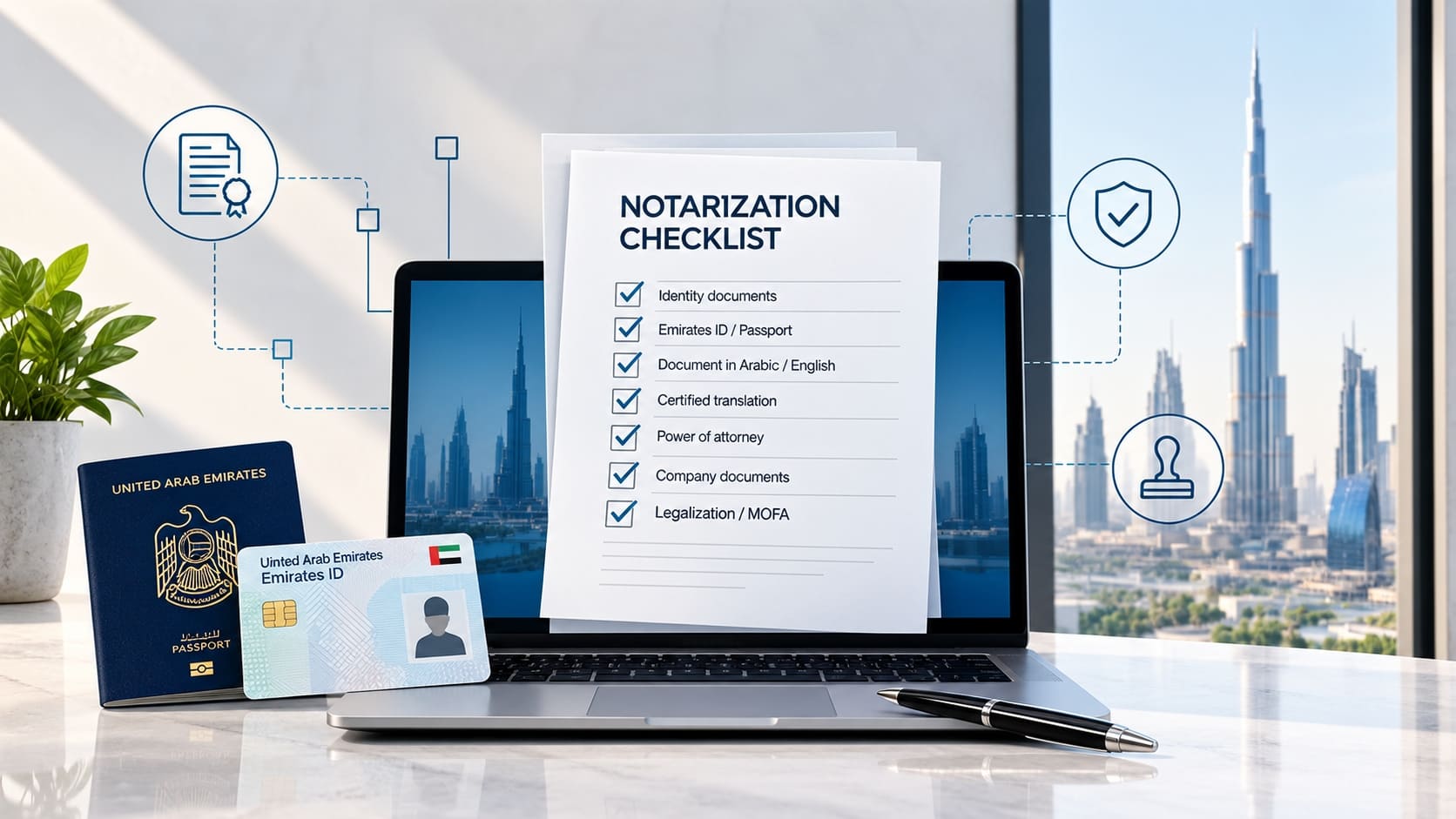
There is no single rule across all free zones, but the published guidance converges. Zones ask for the original power of attorney, not a scan. They ask for the agent’s original passport so identity can be verified. A POA issued inside the UAE is verified against the courts portal — against the database, not the look of the paper. One issued outside the UAE must be notarised and legalised at the UAE embassy in the country of issue. And they state separately that the document must expressly grant authority for the specific act the application concerns: a general “to represent the company” will not push it through.
The financial centres add their own layer. Under DIFC real property law a POA must be in writing, the original or a certified copy goes to the registrar, and one executed outside the UAE must be notarised and attested; the registrar retains the right to reject it. In ADGM a company may appoint a representative by an instrument under seal, either generally or for specific matters.
Tell us what act your representative has to perform and which authority they are walking into — we will draft the powers and assemble the pack so the document is not sent back.
Mistake six: no time built in for the system
People treat a POA as a one-day errand. In reality a queue of steps sits between the decision and the finished document, each one adding time.
Abu Dhabi publishes a processing time of two working days. Dubai Courts do not publish one, but they impose the condition that wrecks plans most often: for online notarisation the parties need a valid Emirates ID, and anyone holding only a passport has to attend the notary in person. For a non-resident principal that means either a flight or abandoning the remote route entirely.
Then everything else stacks up: the bilingual text, the accredited translation, the notary appointment, and legalisation where foreign documents are involved. Add weekends and public holidays, and a realistic horizon for a POA with an overseas participant is one to two weeks, not a day.
Table 3 — Notarising a power of attorney in the two emirates
| Parameter | Dubai | Abu Dhabi |
|---|---|---|
| Channels | Courts website, service centres, private notaries | Judicial department portal |
| Remote execution | Only with a valid Emirates ID | Portal runs through UAE Pass |
| Official fee | AED 100 per party plus AED 20 | AED 100 for each year of the term |
| Processing time | Not published | 2 working days |
| Maximum term at notarisation | Not published | 3 years; 5 years for a litigation POA to a lawyer |
| Language | Translation certified by the Ministry of Justice | English accepted through the dedicated office |
Abu Dhabi carries three further restrictions that tend to surface without warning. For agricultural land and farms, the agent can only be a relative up to the fourth degree. The sale of a government-granted residential plot cannot be delegated by POA until the completion certificate has been issued. And a litigation POA in favour of someone who is not a lawyer will only be accepted where the agent is a relative of the principal up to the fourth degree.
Mistake seven: the agent ends up on both sides of the transaction

This happens more often than you would expect. An agent is instructed to sell an apartment and registers it to himself, his wife or a relative. Or the reverse: he is instructed to buy, and sells the principal a property he already owns.
Article 885 closes both doors. A person appointed to buy a particular thing may not acquire it for himself, for his ascendants or descendants, for his spouse, or for anyone a transaction with whom benefits his own estate — except where the principal has authorised it. Even if the agent declares that he is buying for himself, the purchase is treated as made for the principal. The second paragraph bars an agent authorised to purchase from selling his own property to the principal unless the parties have agreed otherwise.
The takeaway: where a transaction genuinely is meant to stay inside the family, write the authorisation in expressly. Otherwise the deal is vulnerable — at the instance of the very principal who wanted it.
Mistake eight: the POA was “cancelled” but is still legally alive
Revocation is not a verbal decision and not a deleted file. Article 898 gives the right to revoke or restrict the authority at any time, with one caveat: where the POA affects the right of a third party or was granted in the agent’s own interest, it cannot be revoked without that person’s consent. Article 899 adds an obligation to compensate the agent for loss where revocation comes at an unsuitable time or without acceptable justification.
The procedure has a price. Abu Dhabi runs a separate service for attesting a cancellation at a fee of AED 100, and its conditions record that the principal undertakes to notify the agent of the revocation, and the agent to notify the principal of any withdrawal. In Dubai, cancellation runs through a notarised legal notice: AED 200 for the attestation plus AED 100 for electronic data entry per signature.
Separately, there is termination that needs nobody’s decision. Article 897 names four situations: completion of the work entrusted, expiry of the term, death or loss of capacity of the principal, and death or incapacity of the agent. Termination bites even where a third party’s right is attached to the POA; the only narrow exception the law makes is the sale of mortgaged property where the mortgagor authorised a neutral custodian or the mortgagee to sell. For a business the lesson is direct: a power of attorney is no substitute for a corporate structure with properly authorised signatories.
How we prepare a power of attorney
We do not start from a template. We start from two questions: what act does your representative need to perform, and which authority will they present the document to. The answers drive the wording of the powers, the term, the language and the method of notarisation. From there we reconcile the details against passports and title extracts, prepare the bilingual text, check the receiving side’s requirements, and plan the calendar with room for processing and legalisation.
Tell us what needs doing and where — we will draft the power of attorney, give you a realistic timeline, and tell you which emirate will notarise it faster.
Get a consultation
This material is for information only and reflects the regulatory position as at September 2026. Laws and the requirements of individual authorities change; before you proceed, check the current text of the law and confirm the position with the authority the power of attorney will be submitted to.