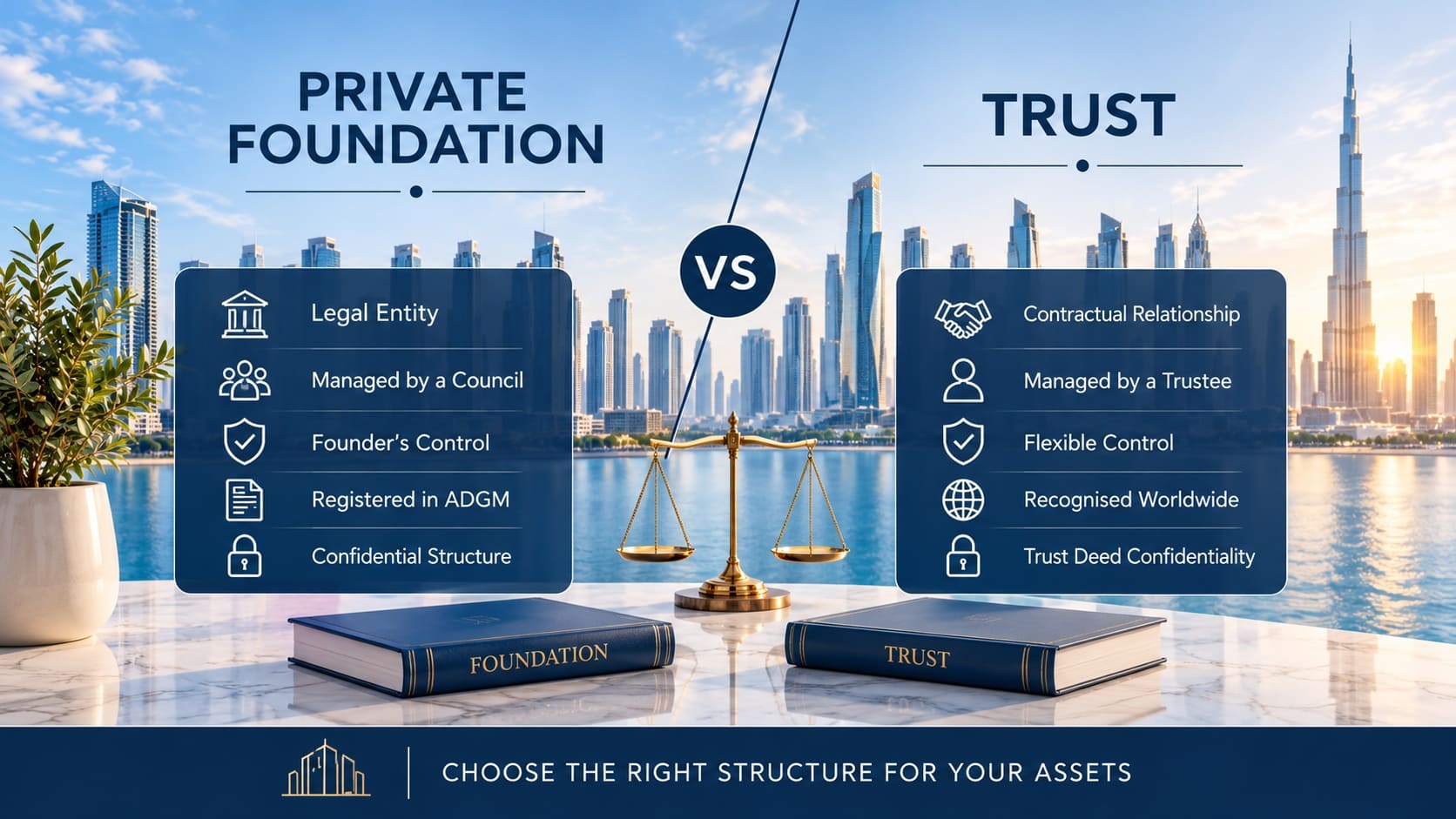
A private foundation and a trust solve the same problem: they separate family assets from the owner personally, so that the assets are managed under predefined rules and passed to the next generation without court proceedings or disputes. But they work differently. A trust is a relationship between people in which the property is owned by a trustee. A private foundation is a separate legal entity that owns the assets itself. For a client from a civil law country, this difference is decisive: banks, registrars and courts understand a foundation, while a trust often has no equivalent there. Below we explain what a private foundation is, who is involved in it, the difference between a foundation and a trust, and what to choose in the UAE.
What is a private foundation
A private foundation is a legal entity with no shareholders or members. The founder transfers assets to the foundation, and from that moment they belong to the foundation. The foundation is managed by a council, which can deal with the assets only within the objects set out in the charter.
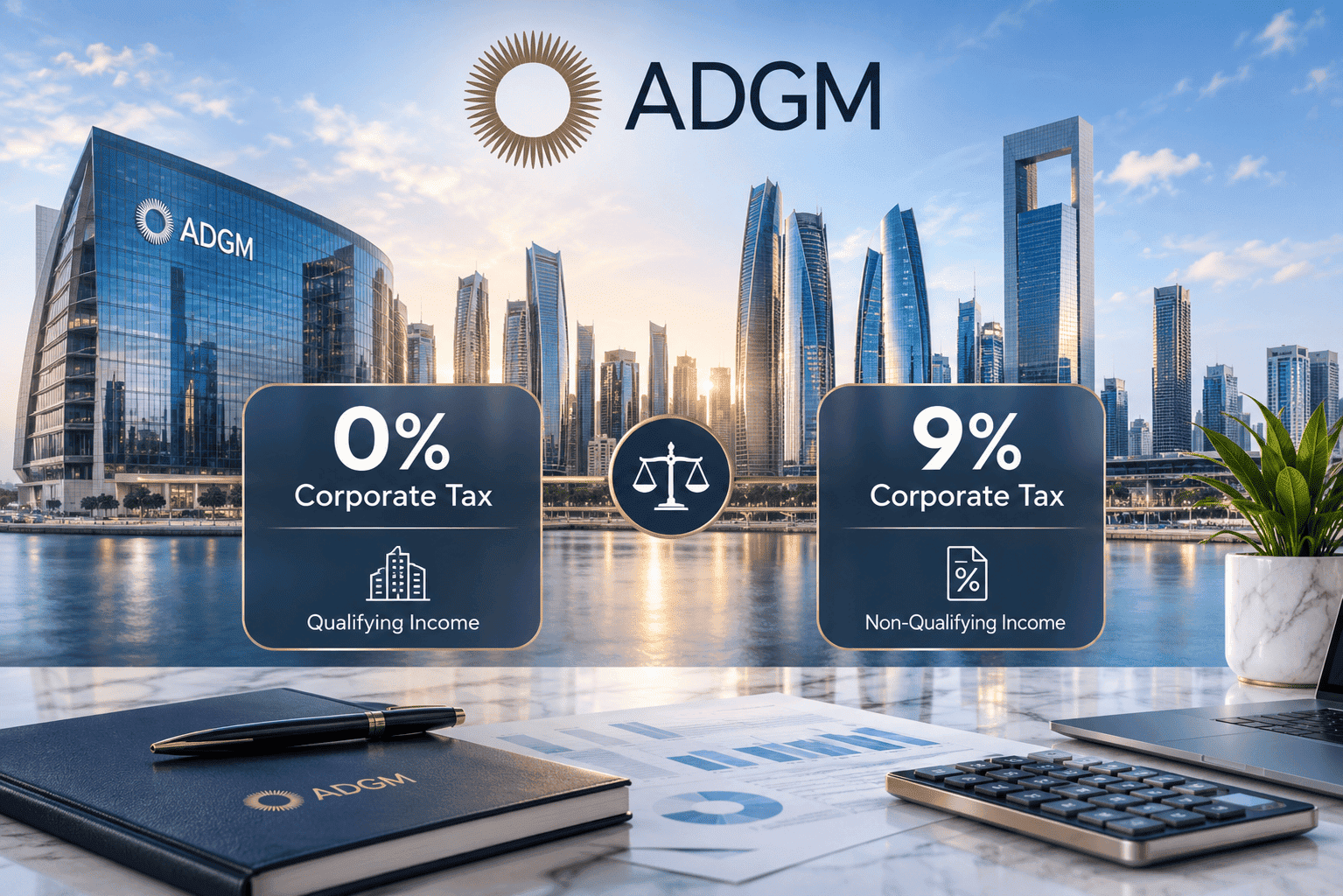
In ADGM, private foundations are governed by the Foundations Regulations 2017:
- Legal entity. From the date of registration, the foundation is a separate legal entity that can sue and be sued (Article 3(5)).
- Objects. The charter must provide for the management and distribution of assets (Article 2).
- Initial assets from $100 (Article 13).
- Council of at least two members (Article 19(1)).
- Guardian oversees the council. Mandatory if there is no living founder (Article 26(1)). The guardian cannot be the founder, a council member or the sole beneficiary (Article 26(3)).
- The founder may reserve powers: to amend the charter, to appoint and remove council members and beneficiaries, and to give investment instructions (Article 17).
- Beneficiaries have no rights to specific assets of the foundation (Article 34(1)).
Who is responsible for what in a foundation is covered in Founder, Council, Guardian, Beneficiaries: Who Is Responsible for What.
What is a trust
A trust is an institution of Anglo-Saxon (common) law. The settlor transfers property to a trustee, who holds it for the benefit of the beneficiaries. A trust is not a legal entity but a relationship based on trust and on the trustee’s fiduciary duties.
A classic trust relies on split ownership: the trustee becomes the legal owner, while the beneficiaries receive the benefit. It is exactly this split that is missing from the law of most countries in continental Europe, the CIS and the Middle East.
Key differences: table

| Criterion | Private foundation | Trust |
|---|---|---|
| Legal nature | Legal entity | Relationship, contractual arrangement |
| Who owns the assets | The foundation itself | The trustee |
| Who manages | The foundation council | The trustee |
| Oversight | Guardian, founder’s reserved powers | Protector (if appointed) |
| Constitutional document | Charter and by-laws | Trust deed |
| Registration | Mandatory, in a public register | In a classic trust, usually not required |
| Can it sign contracts in its own name | Yes | No, the trustee acts |
| Clarity for civil law countries | High: equivalent to a legal entity | Low: often no legal equivalent |
| Founder’s role | Can retain broad powers | Too much control puts the trust at risk |
Who owns the assets
Foundation. The assets belong to the foundation as a legal entity. The bank account is opened in the foundation’s name, and shares and interests are registered to the foundation. If a council member leaves or dies, the owner of the assets does not change, only the composition of the council.
Trust. The legal owner is the trustee. When the trustee changes, the assets have to be transferred to the new one. Accounts and interests are registered to the trustee, with a note that they act as trustee.
In practice, this means a foundation is easier to explain to a bank, a tax authority and a land registry in any country: for them, it is an ordinary company with its own charter.
Founder control
In an ADGM foundation, the founder can legitimately retain control: reserve the right to amend the charter, appoint the council and beneficiaries, and give investment instructions. Any disposal of assets is still made by a council decision (Article 17).
In a trust, too much control by the settlor is a risk. If the settlor in fact deals with the property personally, a court or tax authority may treat the trust as a sham trust and consider the assets to still be the settlor’s own property.
Confidentiality
The public register of ADGM foundations shows the name, number, date of establishment, details of the council members and the registered agent. Information on the beneficiaries and the guardian is filed with the registrar confidentially (Article 7). The foundation’s accounting records are not disclosed publicly (Article 21(13)), and an auditor is not mandatory.
At the same time, a foundation is not a tool for anonymity. The registrar knows the ultimate beneficiaries, and banks check every participant in the structure.
What the Central Bank requires. Under the CBUAE anti-money laundering guidance, a bank must identify its client’s beneficial owners. For a trust, these are the settlor, the trustee, the beneficiaries and any person who exercises effective control over the structure. For legal entities, including foundations, they are the individuals who own or control at least 25%, or, if there are none, the persons who manage the structure. The bank verifies this information independently, not only on the client’s word. That is why both a foundation and a trust disclose the entire chain of participants to the bank when opening an account.
Recognition in different countries
- Civil law countries (continental Europe, CIS countries) understand legal entities well but are often unfamiliar with trusts. For their banks, courts and tax authorities, a foundation is a familiar corporate form.
- Common law countries (the UK, the US, Singapore) are used to trusts, and a foundation is also a clear structure for them, comparable to a company.
- Protection from foreign forced heirship rules. The ADGM Regulations state directly that a transfer of assets to a foundation is not invalid because of foreign inheritance rules, and foreign judgments that contradict this are not recognised (Article 32). Comparable provisions exist in the DIFC and ADGM trust legislation.
A comparison of a UAE foundation with European foundations is in UAE Foundation vs Liechtenstein, Jersey and Panama.
Foundations and trusts in the UAE

| Form | Regulation |
|---|---|
| Foundation in ADGM | ADGM Foundations Regulations 2017 |
| Trust in ADGM | ADGM Trusts (Special Provisions) Regulations 2016 and English common law |
| Trust in DIFC | DIFC Trust Law No. 4 of 2018 |
| Onshore UAE trust | Federal Decree-Law No. 31 of 2023 on Trusts (in force since 30 September 2023, replacing the 2020 law). An onshore trust is a legal entity. It operates only after registration with the competent authority of an emirate, and registration in one emirate is valid in all of them. Property transferred into the trust ceases to belong to the settlor and the trustee |
Trusts are fully recognised in the DIFC and ADGM free zones. The onshore trust law is relatively new, and there is little practice under it for complex international inheritance cases.
Cost of a foundation in ADGM. Registrar fees start from $1,000 at registration and from $500 per year (ADGM fee schedule, January 2025). A corporate service provider (CSP) is mandatory unless the foundation is exempt from this requirement. The cost of Dynasty Business Adviser’s services is calculated individually for your structure. Contact us for a personal consultation.
Taxes in the UAE
- A foundation is a Corporate Tax payer, but a family foundation can apply to the UAE Federal Tax Authority (FTA) to be treated as tax transparent (Article 17 of the Corporate Tax Law). Conditions: the beneficiaries are individuals or public benefit entities, the main activity is holding and managing savings and investments, there is no business activity, tax is not the main purpose of the structure, and income is distributed to the beneficiaries within 6 months after the end of the tax period.
- Trusts. Contractual DIFC and ADGM trusts are treated by default as unincorporated partnerships for Corporate Tax purposes. Trusts that are legal entities are taxable, but they can also apply for transparency.
- Management from the UAE. A foreign foundation can become a UAE taxpayer if it is effectively managed from the UAE.
More details in Taxation of a Foundation in the UAE: Corporate Tax, Reporting, ESR.
What to choose
| Situation | What usually fits |
|---|---|
| The founder and family are from civil law countries | Private foundation |
| You need to hold real estate, companies and accounts with an owner banks understand | Private foundation, often combined with an SPV |
| The founder wants to retain control during their lifetime | Private foundation with defined founder’s reserved powers |
| The family and advisers work within the Anglo-Saxon system | DIFC or ADGM trust |
| You need a professional trustee and a complex fiduciary structure | Trust with a licensed trustee |
What happens to assets when there is no structure at all is covered in What Happens to Your Assets in the UAE If You Die Without a Structure.
Conclusion
A private foundation is a legal entity that owns the assets itself, is managed by a council and acts under its charter. A trust is a relationship in which the property is owned by a trustee. For families from civil law countries, a foundation is usually clearer and more convenient: a bank, a registrar and a court see it as an ordinary legal entity, and the founder can legitimately retain control during their lifetime. Both forms are available in the UAE, but a private foundation in ADGM is one of the most affordable solutions for family wealth in terms of fees.
The Dynasty Business Adviser team will help you choose between a foundation and a trust, prepare the charter and by-laws, and register a private foundation in ADGM. More details on the page.
Get a consultation
Information is current as of October 2026. Sources: ADGM Foundations Regulations 2017 (Articles 2, 3, 7, 13, 17, 19, 21, 26, 31, 32, 34); ADGM — Foundations Regime and Overview of Fees (January 2025); ADGM Trusts (Special Provisions) Regulations 2016; DIFC Trust Law No. 4 of 2018; Federal Decree-Law No. 31 of 2023 on Trusts (replacing Decree-Law No. 19 of 2020); CBUAE Rulebook — anti-money laundering guidance, section on beneficial owners of legal persons and legal arrangements; Federal Decree-Law No. 47 of 2022 (Article 17); FTA — Taxation of Family Foundations Corporate Tax Guide (2025); Chambers — Private Wealth 2026, UAE. This article is not legal or tax advice.
Author: Dynasty Business Adviser team