
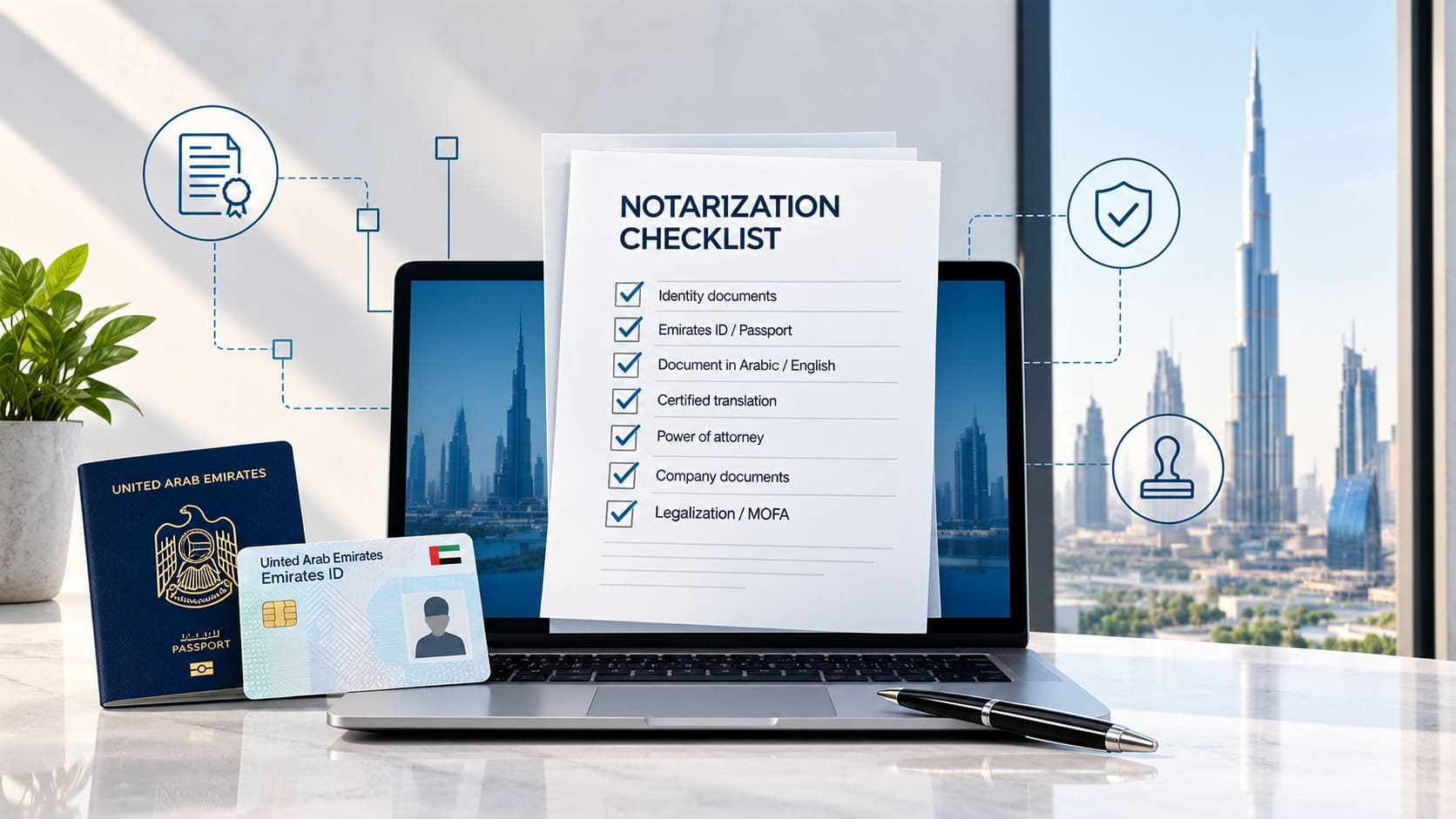
A typical situation: you go to a notary in Dubai to notarise a power of attorney for selling an apartment, and you are turned away. The text is only in English, the attorney has no copy of their passport, and a marriage certificate from another country carries an apostille, which the UAE does not accept. The second attempt comes a week later, after translation and legalisation. Most of these delays can be avoided if you know in advance which documents a notary in the UAE needs and in what form.
Below we explain what you need for notarisation in Dubai and the other emirates: who notarises documents, the basic set everyone needs, the documents required for a power of attorney in the UAE and for companies, how to prepare foreign documents, whether an Emirates ID is required and which mistakes are most common.
Who notarises documents in the UAE
Several types of notaries carry out notarial acts in the UAE. Which one suits you depends on the emirate and on where the document will be used.
The federal notary service operates under the UAE Ministry of Justice (MOJ) and serves the emirates that do not have their own judicial system. The MOJ also keeps a register of private notaries and runs the e-notary system: a power of attorney and a number of other documents can be completed online on the ministry’s portal. In Dubai, notarial practice is governed by Dubai Law No. 4 of 2013 concerning Notaries Public: government notaries of the Dubai Courts and private notaries licensed by the Dubai Courts work there. In Abu Dhabi, notarial services are provided by the Abu Dhabi Judicial Department (ADJD). The courts of the financial centres, DIFC Courts and ADGM Courts, have their own notary services. If you are outside the UAE, a document for use in the Emirates can be executed before a notary in your country and then legalised, or at a UAE embassy.
The basic set of documents for any notarial act
Documents for a notary in Dubai, Abu Dhabi and the other emirates are largely the same. Whatever the document, the notary needs three things: proof of identity, the document itself in the correct form, and the presence of the signatory, in person or by video link.
To prove identity, UAE residents present their original Emirates ID and non-residents their original passport. If several people are involved, such as the principal and the attorney, the notary will need the details and copies of documents for each of them. The document must be prepared in advance: the notary reviews and notarises it but does not draft it for you. The signatory must understand the content and sign voluntarily, and the notary checks this.
If you go through the procedure online, via the MOJ e-notary or the courts’ online services, you will need digital identification, most often through UAE PASS, and a video call with the notary.
Do you need an Emirates ID for a notary?
The short answer: residents do, non-residents do not.
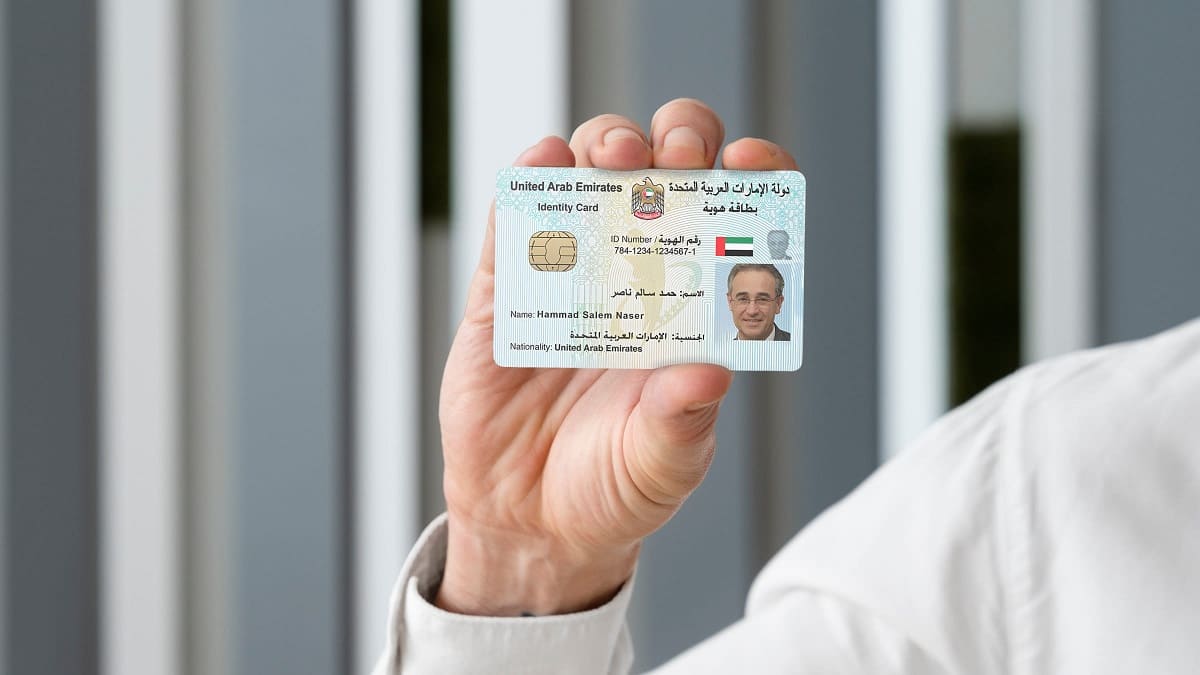
For UAE residents, the Emirates ID is the main document proving identity before a notary, and the Dubai Courts usually ask for it, including the attorney’s Emirates ID number or scan. Non-residents prove their identity with a passport: a notarial document can be executed in Dubai without a residence visa. What matters is that the document is valid. An expired Emirates ID or passport is one of the most common reasons for refusal.
Document language and Arabic translation
The main language of notarisation in the UAE is Arabic. At most notaries, the document must be drawn up in Arabic or in a bilingual format, usually Arabic and English. For example, the ADGM Courts notary states on its official website that a document must be bilingual in Arabic and English and certified by a legal translator licensed by the UAE Ministry of Justice. The exception is the DIFC Courts notary service, where, according to law firms, documents can be notarised in English. If a document is in another language, a legal translation into Arabic is needed. It must be made by a translator licensed by the UAE Ministry of Justice; the profession is regulated by Federal Decree-Law No. 22 of 2022 on the Regulation of the Translation Profession.
The translation must match the original in all key details: names, passport numbers, property addresses and amounts. A difference in how a name is spelled in Latin letters between the passport and the document is a common reason for refusal. Read more about translation mistakes in powers of attorney in a separate article.
Documents for a power of attorney in the UAE
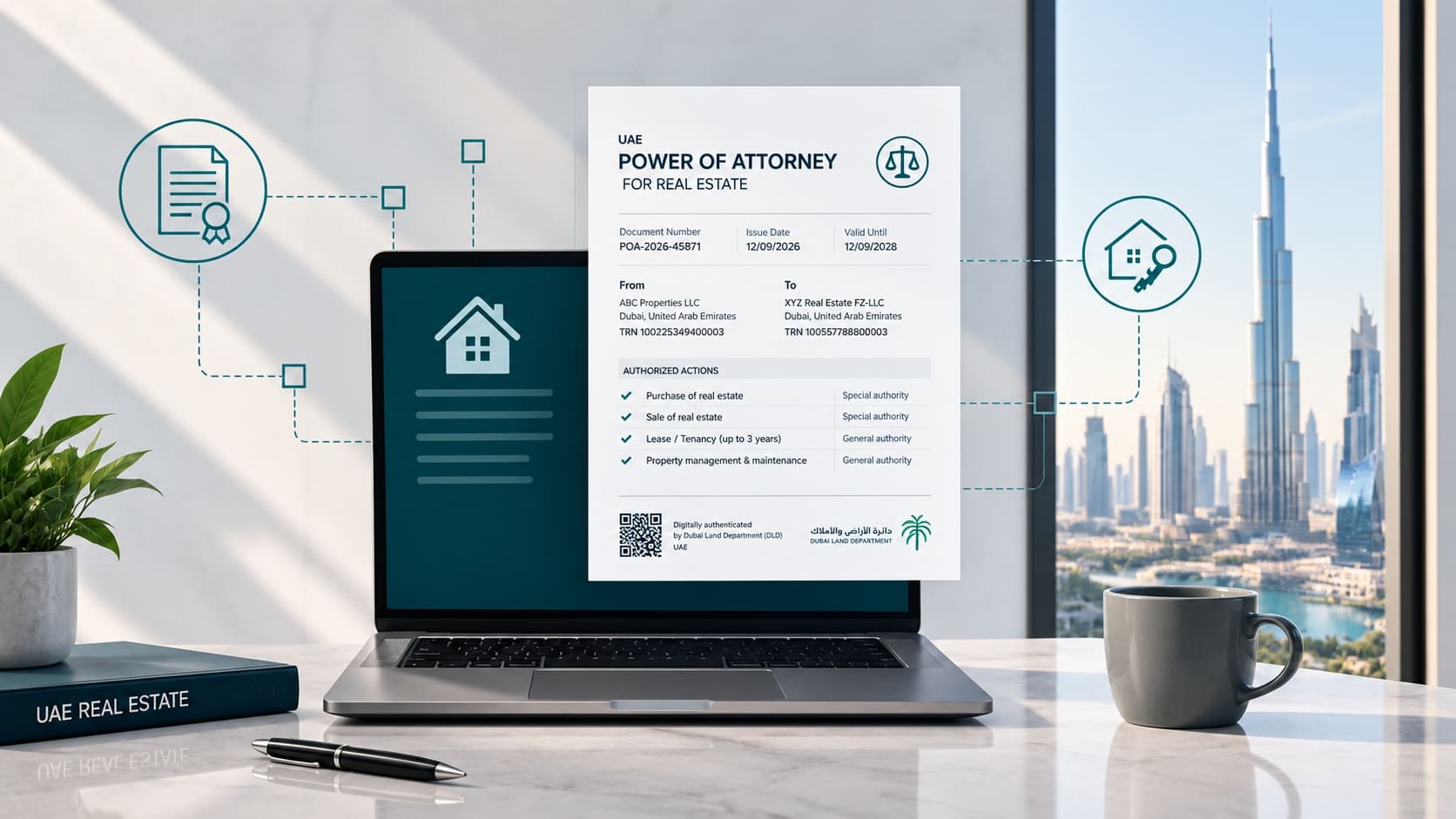
A power of attorney is the most common notarial act in the Emirates. The set of documents depends on who grants the power of attorney and for what.
For a power of attorney from an individual, you need: the principal’s ID (Emirates ID or passport), the attorney’s details and a copy of their Emirates ID or passport, and the text of the power of attorney in Arabic or in bilingual form with a clear list of powers. If it concerns specific property, documents for that property are added: for real estate, the title deed; for a vehicle, the registration card (Mulkiya).
If a company grants the power of attorney, you need documents confirming the signatory’s authority: the trade licence, the memorandum of association (MOA) and, as a rule, a shareholders’ or board resolution authorising the power of attorney. How to choose between a general and a special power of attorney is covered in our full guide.
Table 1 — Documents for typical notarial acts
| Act | Individual | Company |
|---|---|---|
| Power of attorney | Principal’s Emirates ID or passport, attorney’s details, Arabic text | Licence, MOA, authorising resolution, signatory’s ID |
| Power of attorney for property | Same plus title deed | Same plus title deed |
| Power of attorney for a vehicle | Same plus Mulkiya | Same plus registration documents |
| Shareholders’ resolution | — | Licence, MOA, resolution, IDs of all signatories |
| Attestation of a signature on a contract | Signatory’s ID, contract in Arabic or bilingual | Licence, document confirming signatory’s authority |
| Amendment of the MOA | — | Current MOA, new version, IDs of all partners |
Documents for companies
For corporate notarial acts, the key question is the signatory’s authority. The notary must be satisfied that the person is entitled to sign on behalf of the company.
The standard set includes a valid trade licence, the memorandum or articles of association (MOA, AoA) with all amendments, a document confirming the signatory’s authority (a shareholders’ resolution, a board resolution or a power of attorney), and the signatory’s Emirates ID or passport. Amending the MOA, selling a share or changing a manager usually requires the presence or signature of all partners or their representatives under a power of attorney. Read more about shareholders’ resolutions in this article.
If a partner or founder is a foreign company, its documents must first be legalised for the UAE. Without this, the notary will accept neither the foreign company’s articles nor its board resolution.
Foreign documents: why an apostille does not work
This is the main source of confusion. The UAE is not a party to the Hague Apostille Convention. A document issued in another country and certified only with an apostille is not accepted in the UAE, despite widespread claims that the country has joined the convention.
Instead of an apostille, consular legalisation applies. A document usually goes through these steps: certification by a notary or competent authority in the issuing country, then by that country’s foreign ministry, then by the UAE embassy or consulate, and, once in the Emirates, by the UAE Ministry of Foreign Affairs (MOFA). A legal translation into Arabic is then made. Only then can the document be used before a notary.
The reverse is also true: if a document notarised in the UAE is needed abroad, it is legalised through MOFA and the embassy of the destination country. We have explained how this works for different countries separately.
What the cost depends on
The cost of notarisation depends on the type of document, the number of parties and signatories, the notary chosen and whether translation, legalisation of foreign documents or a notary visit is needed. It is therefore best confirmed for each specific case. Read more about what makes up the costs in this article.
Common mistakes
Most refusals at the notary are caused not by the law but by poor preparation.
Table 2 — Common mistakes and how to avoid them
| Mistake | Consequence | How to avoid it |
|---|---|---|
| Document only in English or another foreign language | Notarisation refused | Prepare an Arabic or bilingual version |
| Translation by an unlicensed translator | Translation not accepted | Use a translator licensed by the UAE MOJ |
| Expired Emirates ID or passport | Notary cannot verify identity | Check expiry dates before the visit |
| Foreign document with an apostille | Document not accepted | Complete consular legalisation and MOFA attestation |
| Different spellings of a name | Refusal or problems on execution | Check names against the passport |
| No proof of the company signatory’s authority | Notarisation refused | Prepare a shareholders’ resolution or power of attorney |
One more tip: before your visit, check the requirements of the specific notary. The Dubai Courts, ADJD, MOJ and the DIFC and ADGM notaries may take different approaches to document format and attachments.
Expert comment
“Clients most often lose time on two things: translation and foreign documents. People arrive with a power of attorney in English or a certificate with an apostille and are sure that’s enough. We always start by checking the set: language, document validity, legalisation and the signatory’s authority. It takes an hour and saves a week”.
— Lead Lawyer, Dynasty Business Adviser
Conclusion
Notarisation in the UAE does not require much: a valid ID, a properly prepared document in Arabic or bilingual form and, where necessary, proof of authority or property documents. Difficulties arise with translation, document validity and foreign papers, which must be legalised rather than apostilled. If you prepare the set in advance, one visit to the notary is enough.
If you need to notarise a power of attorney or corporate documents, or prepare foreign papers for the UAE, the Dynasty Business Adviser team will check the set, arrange translation and legalisation and accompany you to the notary, in person or online. Book a consultation.
Get a consultation
Information is current as of October 13, 2026. This article is for information only and does not constitute legal advice. Notary requirements and fees may change, so check the conditions with a specialist or the chosen notary before your visit.