
The team has launched a protocol and issued a governance token, and the DAO treasury holds several million dollars. Everything works until someone needs to sign a contract with a smart contract auditor, open a bank account or respond to a claim. That is when it turns out the DAO has no legal entity. Without one, participants risk being treated as a general partnership and being personally liable for the DAO’s obligations. That is why mature projects sooner or later choose a legal shell: a DAO legal wrapper.
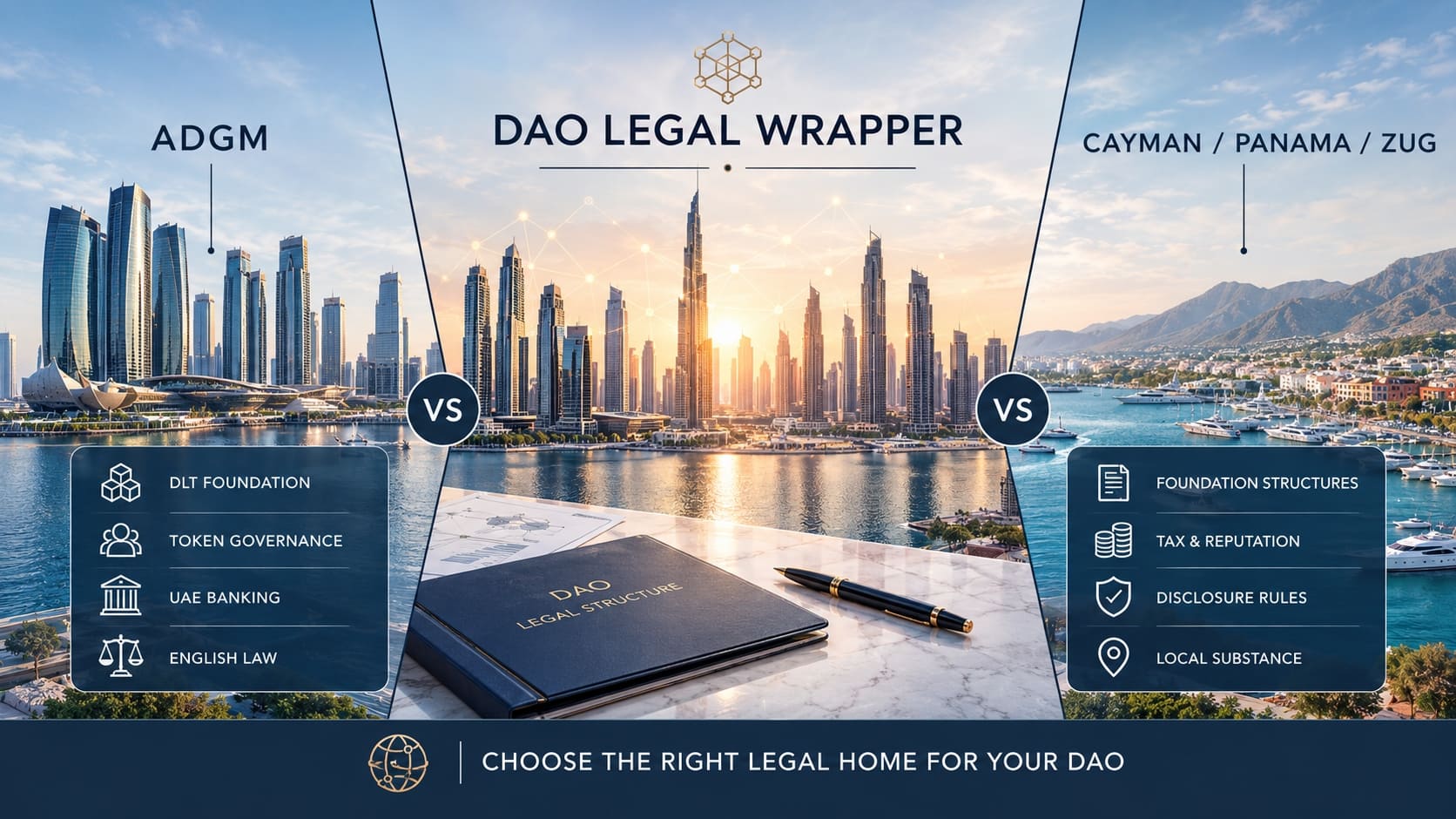
DAO registration means choosing a jurisdiction and a legal form. Below we compare four popular options for where to register a DAO: a DLT Foundation in ADGM, a foundation company in the Cayman Islands, a private interest foundation in Panama and a Swiss foundation in Zug. We look at legislation, governance requirements, tax, standing on international lists and which option suits whom.
Why a DAO needs a legal wrapper
A DAO (decentralised autonomous organisation) is governed by token holders through smart contracts. Technically, it does not need a legal entity. Legally, it does, and the bigger the project, the more pressing the issue.
A DAO legal wrapper serves several purposes. It limits participants’ liability: without a legal entity, courts in some countries may treat a DAO as a general partnership in which every participant is liable for its debts. It makes it possible to sign contracts with developers, auditors, exchanges and suppliers. It allows the DAO to open a bank account, hire people through a subsidiary, pay taxes and meet regulatory requirements. And it creates a clear point of legal responsibility for partners and investors.
It is important to understand that registering a DAO as a foundation or company does not make it centralised. A good structure keeps governance with the token holders, while the legal entity carries out their decisions in the real world. We explain how a DLT Foundation differs from an ordinary foundation and a company in a separate article.
DLT Foundation in ADGM

In 2023, ADGM, Abu Dhabi’s financial centre, adopted the Distributed Ledger Technology Foundations Regulations. This is one of the few legal regimes in the world designed specifically for blockchain projects and DAOs.
According to the official text of the regulations, a DLT Foundation is a separate legal person established to use, deploy, develop, facilitate or support distributed ledger technology or to issue tokens. The regime expressly reflects how DAOs work. If a DLT Foundation issues tokens, its organisational and governance structure must include token holders exercising their rights by voting. According to law firms, the regulations also expressly provide that a token holder is not liable for the foundation’s acts merely by virtue of holding a token, which is exactly the protection a DAO without a legal entity lacks. The council of a DLT Foundation has at least two and no more than sixteen members. A foundation that does not issue tokens is exempt from some of the token-related requirements.
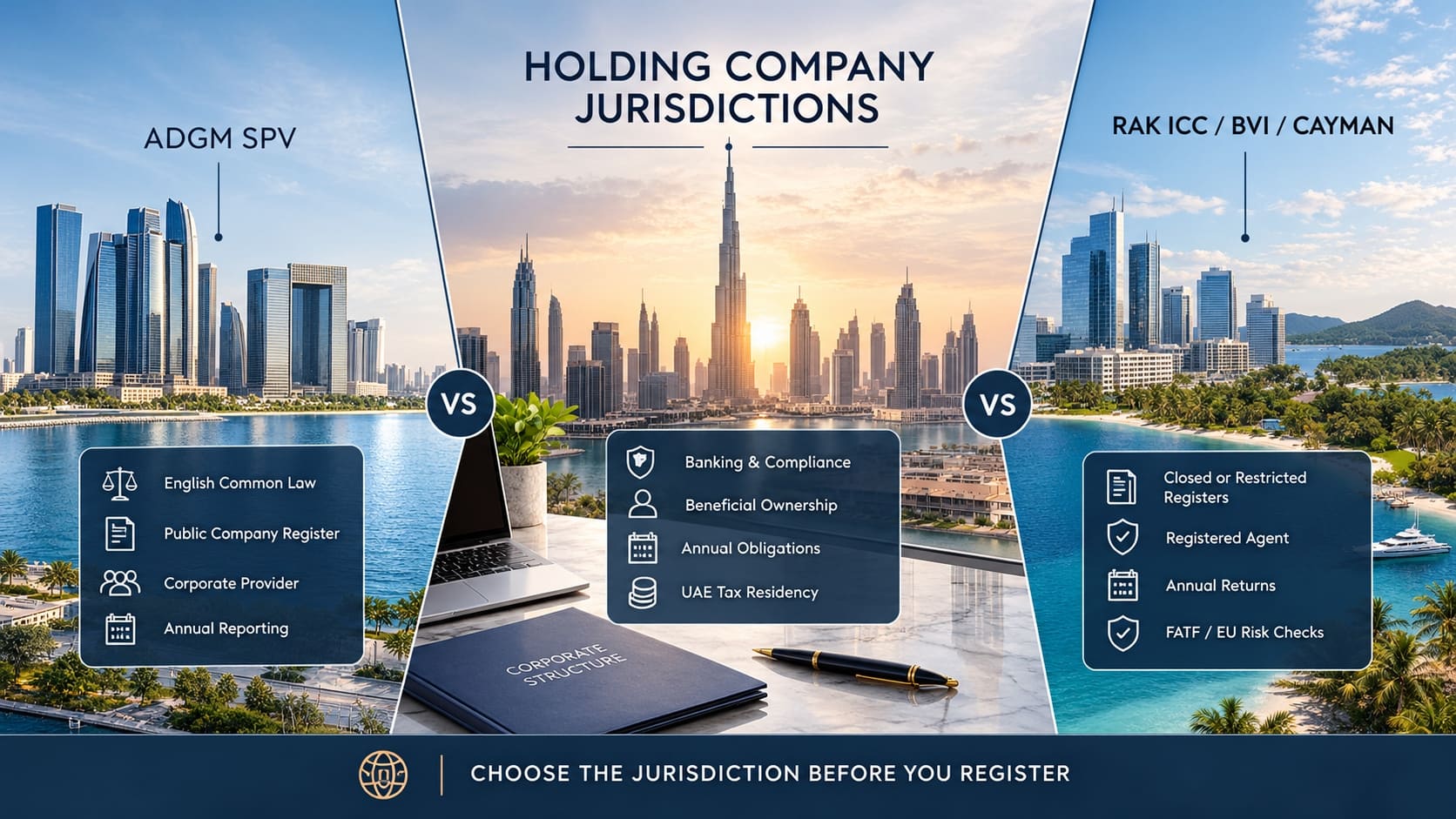
ADGM applies English common law and has its own courts, and crypto service providers in the centre are regulated by the FSRA. As with other ADGM structures, ADGM checklists require at least one authorised signatory to be a UAE or GCC national or to hold a UAE residence visa. For projects that want to work with UAE banks, have a team in the Emirates and a clear tax regime, this is a strong option.
Foundation company in the Cayman Islands

The Cayman Islands have long been the most popular choice for DAOs and crypto projects. The main vehicle is the foundation company under the Foundation Companies Law 2017.
A foundation company is a hybrid of a company and a foundation. It can operate with no members at all, provided it has at least one supervisor, which suits a DAO that has no “owners”. A secretary licensed in the Cayman Islands to provide company management services is mandatory. There are no residency requirements for directors. Taxation is neutral: the Cayman Islands levy no direct taxes on profits.
The Cayman Islands are a British Overseas Territory with a legal system based on English law and a well-developed fund industry. On 6 October 2020, the Council of the EU removed them from the list of non-cooperative tax jurisdictions. Crypto service providers are regulated by a dedicated virtual asset service providers law. The downsides are the high cost of professional services and the lack of real presence: a Cayman structure usually has no office or team on the islands, which increasingly raises questions from banks and tax authorities in other countries.
Private interest foundation in Panama

A private interest foundation (Fundación de Interés Privado) under Panama’s Law No. 25 of 1995 is a budget option that some projects use as a DAO wrapper. The foundation has no owners, its council must consist of at least three natural persons or one legal entity, and a resident agent, a Panamanian lawyer or law firm, is mandatory. Panama applies territorial taxation: foreign-source income is not taxed.
The main problem is reputation. On 17 February 2026, the Council of the EU once again kept Panama on the list of non-cooperative jurisdictions for tax purposes (Annex I). For a DAO that works with European exchanges, banks, partners or token holders, this means enhanced due diligence and possible defensive measures by EU tax authorities. In addition, Panama has no dedicated legal regime for DAOs or tokens comparable to ADGM or Switzerland. More on the Panama foundation in our comparison.
Foundation in Zug (Switzerland)

Zug is Switzerland’s Crypto Valley, home to some of the first major blockchain foundations, including Stiftung Ethereum, the Swiss foundation that has supported the development of Ethereum since 2014. A Zug foundation is a Swiss foundation (Stiftung) under Article 80 et seq. of the Swiss Civil Code: a legal entity created by dedicating assets to a specific purpose, with no owners.
A Swiss foundation is set up for a purpose rather than for the benefit of its founders; for blockchain projects, this is usually protocol development and funding development and the ecosystem. The foundation is supervised by a cantonal or federal supervisory authority, which increases trust but adds reporting and oversight. The law sets no fixed minimum capital, but supervisors expect the assets to be adequate for the foundation’s purpose. Besides foundations, DAOs in Switzerland often use the association (Verein) form, which is closer to a membership-based governance model. Since 2018, FINMA has applied its published ICO guidelines to tokens, dividing them into payment, utility and asset tokens.
Zug’s strengths are a strong reputation, a predictable legal environment and a well-developed ecosystem. The downsides are higher taxes compared with tax-neutral jurisdictions (except for foundations with a recognised public-benefit purpose), strict supervision and high running costs.
Comparing the jurisdictions
Table 1 — Legal forms and key requirements
| Jurisdiction | Form and law | Governance | DAO features |
|---|---|---|---|
| ADGM | DLT Foundation, 2023 regulations | Council of 2 to 16 members | Dedicated regime for DLT and tokens, token holders in governance |
| Cayman | Foundation company, 2017 law | Directors, licensed secretary, supervisor | Can operate without members |
| Panama | Private interest foundation, Law No. 25 of 1995 | Council of 3 individuals or 1 legal entity, resident agent | No dedicated DAO regime |
| Zug | Foundation under Art. 80 Swiss Civil Code | Foundation board, state supervision | Purpose foundation; association also possible |
Table 2 — Tax and reputation (2026)
| Jurisdiction | Taxation | EU blacklist | Perception by banks and partners |
|---|---|---|---|
| ADGM | UAE corporate tax, free zone incentives possible | No | Growing, access to UAE banks |
| Cayman | No direct taxes on profits | No, removed in 2020 | Familiar to the crypto market, questions about real presence |
| Panama | Territorial principle | Yes, Annex I (February 2026) | Cautious, especially in the EU |
| Zug | Swiss taxes, relief for public-benefit foundations | No | High |
How to choose a jurisdiction for a DAO
There is no universal answer: the choice depends on where the team works, who the token holders are, which banks and exchanges are needed and whether the DAO issues tokens.
Table 3 — Typical scenarios
| Situation | Recommended option | Why |
|---|---|---|
| Team in the UAE, needs a bank and real presence | ADGM DLT Foundation | Dedicated regime, UAE banks, team on the ground |
| Large protocol targeting the international crypto market | Cayman or ADGM | Familiar structure, neutral taxation |
| Protocol with a European community and partners | Zug or ADGM | Strong reputation, not on the EU blacklist |
| Small project with a minimal budget | ADGM or Cayman, not Panama | Panama saves money at the start but creates problems with EU banks |
Substance is an important practical point. Banks, exchanges and tax authorities increasingly look not only at where an entity is registered but also at where people actually work and decisions are made. If the team lives in the UAE, registering the DAO in the Cayman Islands may raise questions about the place of effective management. In that case, an ADGM DLT Foundation is often the more consistent solution. Operating activities are then moved into subsidiaries, and the DAO treasury is held under clear rules.
Besides the four options covered here, there are other wrappers, such as the DAO LLC in the US state of Wyoming or in the Marshall Islands. They suit specific cases but are used less often by international projects with a team in the Middle East.
Expert comment
“Five years ago, DAOs were almost automatically registered in the Cayman Islands. Now the first question is different: where does the team live and where does the project need a bank? If the answer is the UAE, ADGM and its DLT Foundation offer a dedicated regime for tokens, English law and consistency with real presence. Today we do not recommend Panama to projects with European partners because of its status on the EU list.”
— Lead Lawyer, Dynasty Business Adviser
Conclusion
Choosing a jurisdiction for a DAO means choosing between tax neutrality, reputation, dedicated regulation and real presence. The Cayman Islands remain a familiar option for the crypto market, Zug offers a strong European reputation, and Panama saves money at the start but loses out because of its status on the EU list. ADGM with its DLT Foundation offers a dedicated regime for tokens and DAOs, English law and access to UAE banks, especially if the team works in the Emirates.
If you are choosing a wrapper for a DAO or want to move a project to the UAE, the Dynasty Business Adviser team will compare the options for your project, prepare the charter and governance rules and register a DLT Foundation in ADGM end to end.
Book a consultation.
Information is current as of October 16, 2026. This article is for information only and does not constitute legal or tax advice. Laws, crypto-asset regulation and international lists may change, so check the conditions with a specialist before making decisions.