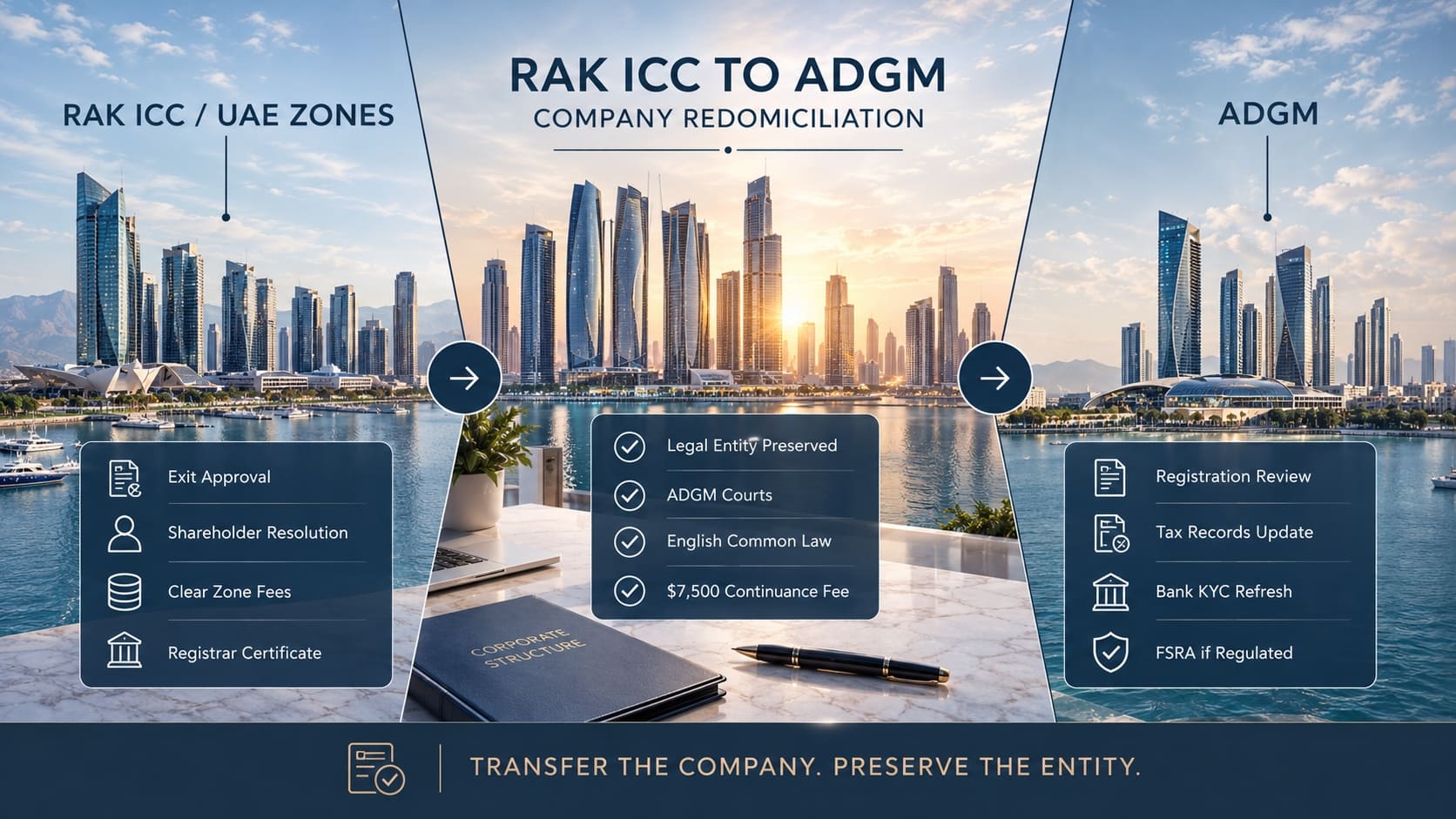
A RAK ICC company is already in the UAE, so it can seem there is nowhere to move it. In practice, owners of holding companies and SPVs in RAK ICC, JAFZA Offshore or DMCC are increasingly moving them from RAK ICC to ADGM, Abu Dhabi Global Market. The reasons are the same every time: the bank asks questions about offshore status, investors and counterparties want English law and an independent court, and a fund or a large deal needs a regulator of FSRA’s standing. A transfer within the UAE is possible, but each zone releases companies under its own rules, and since October 2025 there has also been a general federal provision. Below is why you would change jurisdiction within the country, how the exit from each zone works, and when it is simpler to set up a new company in ADGM.
Why move to ADGM if the company is already in the UAE

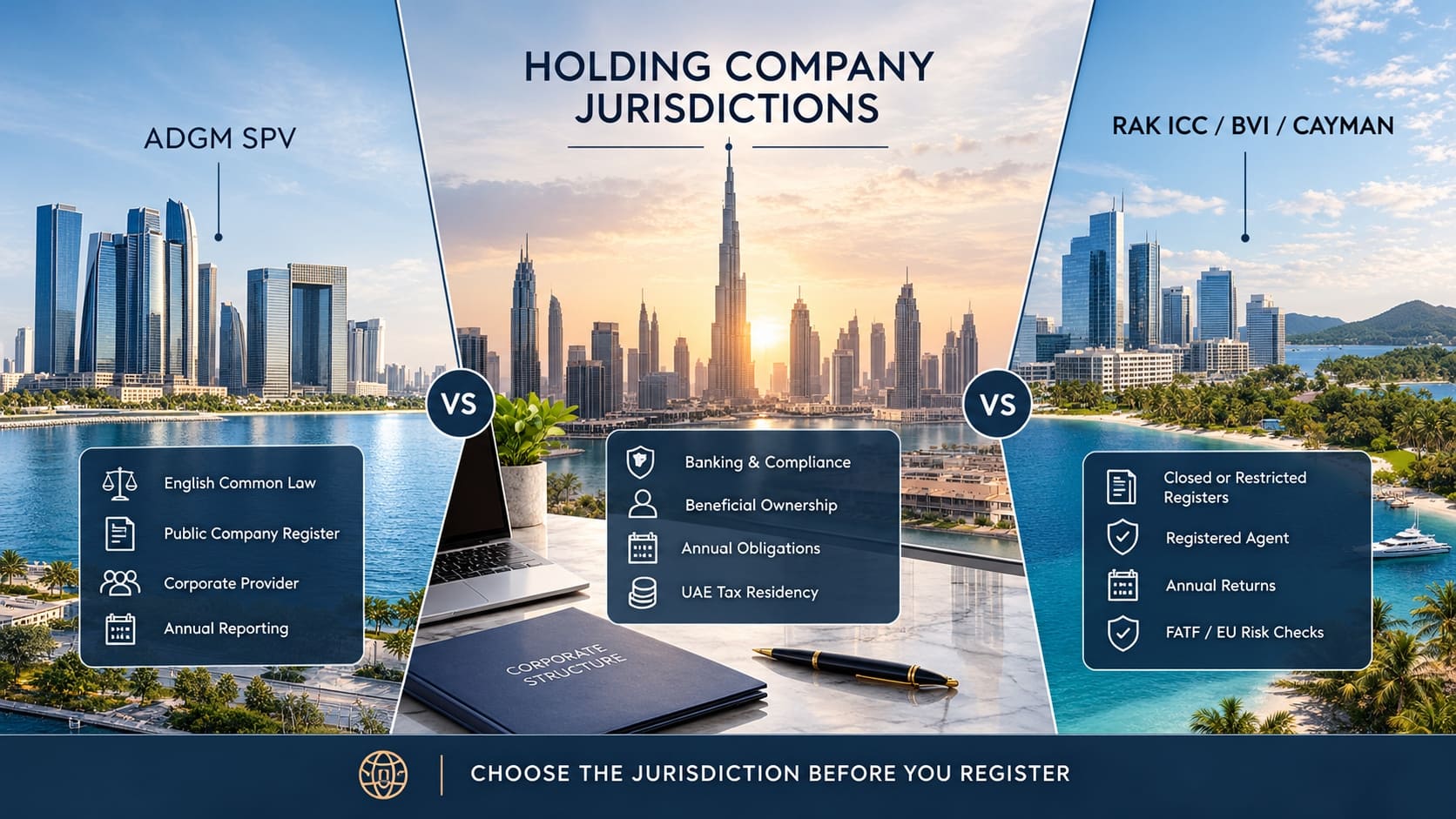
| Parameter | RAK ICC and offshore zones | ADGM |
|---|---|---|
| Law | Zone regulations | English common law applied directly |
| Courts | Local courts or arbitration | ADGM’s own courts, modelled on the English courts |
| Activity in the UAE | Not allowed without a separate licence | Operating companies do business under an ADGM licence |
| Financial services regulator | None | FSRA |
| Fund structures | Limited | SPVs, GP/LP, funds, fund managers |
| How banks and investors see it | As an offshore entity | As an international financial centre |
- Banks. A RAK ICC company is a UAE tax resident under the Corporate Tax Law (Article 11(3)(a)). But banks still view it as an offshore entity and take longer to review it.
- Courts and law. In 2017, RAK ICC, ADGM and the ADGM Courts signed a memorandum allowing RAK ICC companies to use ADGM dispute resolution mechanisms. But this does not make a RAK ICC company an ADGM company: the governing law and the registrar stay the same.
- Funds and investors. A fund, a syndicate or a deal with institutional investors needs a jurisdiction with a financial regulator. How these structures work is covered in GP/LP Structure in ADGM: How to Set Up a Fund and ADGM SPV vs RAK ICC, BVI and Cayman: a Comparison.
How redomiciliation within the UAE works
ADGM accepts a company through the continuance procedure (Part 7, Chapter 2 of the Companies Regulations 2020) if the law of the home jurisdiction permits the transfer. For UAE zones, this means the zone’s regulations must provide for an exit, and its registrar must release the company.
The general sequence:
- Check the company’s status in the home zone: the licence is valid, fees and fines are paid.
- Shareholders’ special resolution on the transfer and the new ADGM constitutional documents.
- Approval or a no objection certificate (NOC) from the home zone’s registrar, if its rules require one.
- Application to the ADGM Registration Authority.
- Certificate of continuance from ADGM.
- Removal from the home zone’s register and a certificate of deregistration.
- Updating details with the Federal Tax Authority (FTA) and the bank.
A step-by-step walkthrough using the BVI as an example is in How to Move a BVI Company to ADGM: Redomiciliation Step by Step.
RAK ICC: exit rules
Legal basis: RAK ICC Business Companies Regulations 2018, Part X. Article 190, “Continuation under foreign law”, governs a company’s exit from RAK ICC.
What the regulations tell us:
- after the transfer, the RAK ICC registrar issues a certificate of discontinuance (Art. 190(8));
- a company that continues outside RAK ICC ceases to be a company under these regulations;
- another company can take its name only after 3 years.
A transfer out of RAK ICC goes through the registered agent. Before filing, the agent checks that annual fees are paid and beneficial ownership information has been filed. RAK ICC’s exit fee is not publicly available; the agent will quote it.
Other zones: JAFZA Offshore, DMCC, RAKEZ, DIFC

| Zone | Exit provision | What is required | Zone fees |
|---|---|---|---|
| RAK ICC | Business Companies Regulations 2018, Art. 190 | Shareholders’ resolution, documents via the agent | Confirm with the agent |
| JAFZA Offshore | Offshore Companies Regulations 2018, Art. 116 | Company resolution, approval of the offshore companies registrar | Confirm with JAFZA |
| DMCC | DMCCA Company Regulations 2024, Art. 23 | Special resolution (75%), registrar approval; the receiving law must preserve the company’s property and liabilities | Confirm with DMCC |
| RAKEZ | Official Re-domicile / Transfer of Incorporation service | Special resolution, Certificate of Continuation from the new jurisdiction, settlement of debts | NOC AED 3,000 and transfer fee AED 2,000, 2–5 business days |
| DIFC | Companies Law No. 5 of 2018, Art. 145–146 | Approval of the DIFC registrar, who may refuse | Confirm with DIFC |
Mainland companies and the new transfer provision
Since 15 October 2025, Article 15bis has been in force in the federal Commercial Companies Law (Federal Decree-Law No. 32 of 2021). It was added by Federal Decree-Law No. 20 of 2025. The provision allows a company’s registration to be transferred between emirates and between the mainland and free zones while keeping the legal entity. The conditions: the rules of both jurisdictions permit the transfer, and regulators’ approvals are obtained.
As of October 2026, implementing rules for this provision have not been issued for every type of transfer. ADGM has not officially published its position on transfers from the mainland. So for a mainland company, workarounds are more common today:
- a new company in ADGM, with the shares or business transferred to it;
- a branch or subsidiary in ADGM.
ADGM documents and fees
ADGM’s requirements are the same for companies from any jurisdiction:
- shareholders’ special resolution and board resolution;
- Certificate of Incorporation, Certificate of Good Standing and register of members, no older than 3 months;
- confirmation that the home zone’s law permits the transfer (legal opinion);
- the home jurisdiction’s consent to deregistration;
- directors’ statement of solvency;
- current and new articles, a structure chart up to the ultimate beneficial owners, directors’ documents.
An SPV needs a licensed corporate service provider (CSP), an operating company needs a business plan and an office, and a financial company needs FSRA approval.
| ADGM fee | Amount |
|---|---|
| Continuance fee | $7 500 |
| Name reservation | $200 |
| Commercial licence | $200 per year |
| Activity fee | SPV — $900, Category B — $4,800 per year |
| Data protection | $300 per year |
| Total in year one | from $9,100 for an SPV, from $13,000 for Category B |
The cost of Dynasty Business Adviser’s transfer services is calculated individually for your structure. Contact us for a personal consultation.
Tax on transfer
- Residence does not change. RAK ICC, DMCC, JAFZA and ADGM companies are UAE residents under the Corporate Tax Law. A transfer within the country neither creates nor ends residence.
- FTA records. Under continuance, the legal entity is preserved. Licence and registrar details are updated through a Tax Records Amendment with the FTA. The FTA has not officially clarified whether the tax registration number (TRN) is kept; in practice, it is confirmed when the amendment is filed.
- QFZP status. The 0% rate on qualifying income for a Qualifying Free Zone Person does not carry over automatically. The conditions are reassessed for the new zone.
- If you set up a new company instead of transferring. Relief for intra-group asset transfers (Art. 26) and for business restructuring (Art. 27 of the Corporate Tax Law) does not apply if either party is a QFZP. So transferring assets to a new ADGM company with QFZP status may be taxable. This is a common reason to choose continuance specifically.
Transfer or new company: which to choose
| Situation | What is usually chosen |
|---|---|
| RAK ICC or JAFZA Offshore holding company with shareholdings and assets | Continuance into ADGM: the legal entity and assets are preserved |
| DMCC or RAKEZ company that needs financial centre status | Continuance, if the zone’s registrar releases the company |
| Mainland company | A new company or branch in ADGM, until the Art. 15bis rules are fully published |
| Company needs an FSRA licence | A new company, or a transfer with a parallel FSRA application |
| Company with debts or disputes | Settle them first, otherwise the zone and ADGM will refuse |

Risks and common mistakes
| Mistake | Consequence |
|---|---|
| Home zone registrar’s approval not requested | ADGM will not accept the application; the zone will not issue a certificate |
| Debts to the zone and an expired licence | Delay in issuing the NOC and certificate |
| QFZP status not checked after the transfer | Wrong tax rate in the first period |
| Transferring assets to a new company instead of continuance | Possible tax; Art. 26–27 relief unavailable with QFZP status |
| FTA and bank details not updated | Discrepancies in the tax record, blocked payments |
| FSRA licence not applied for in advance | Regulated activity stops |
Conclusion
Moving from RAK ICC and other UAE zones to ADGM gives you English law, the ADGM Courts, the FSRA as regulator and the standing of a financial centre without changing the legal entity. RAK ICC, DMCC, RAKEZ, JAFZA Offshore and DIFC all provide for an exit, but each zone has its own requirements: a shareholders’ resolution, registrar approval, settlement of debts. For mainland companies, the transfer law is already in force, but the procedure for ADGM has not yet been published.
The Dynasty Business Adviser team will check your zone’s rules, obtain the approvals and prepare the ADGM package. The general procedure and our services are on the page. A comparison of ADGM with other zones is in ADGM or UAE Free Zones: Which to Choose.
Get a consultation
Information is current as of October 2026. Sources: RAK ICC Business Companies Regulations 2018 (Part X, Art. 190); memorandum between RAK ICC, ADGM and the ADGM Courts (16 November 2017); DMCCA Company Regulations 2024 (Art. 23); RAKEZ — Re-domicile / Transfer of Incorporation service; DIFC Companies Law No. 5 of 2018 (Art. 145–146); JAFZA Offshore Companies Regulations 2018 (Art. 116); Federal Decree-Law No. 20 of 2025 (Art. 15bis of the Commercial Companies Law); Federal Decree-Law No. 47 of 2022 (Art. 11, 26, 27); ADGM Companies Regulations 2020, Part 7, Chapter 2; ADGM Registration Authority — Overview of Fees (January 2025). This article is not legal or tax advice.
Author: Dynasty Business Adviser team